May 20, 2013
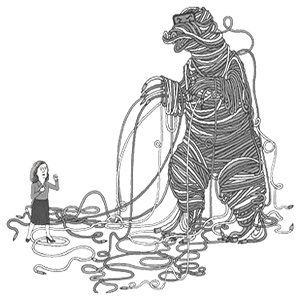
‘Captive Audience: the Telecom Industry and Monopoly Power in the New Gilded Age’ is an American non-fiction book by legal expert Susan P. Crawford. It describes high-speed internet access in the United States as essential (like electricity) but currently too slow and too expensive. To ensure national competitiveness ‘most Americans should have access to reasonably priced 1-Gb symmetric fiber-to-the-home networks.’
Crawford explains why the United States should revise national policy to increase competition in a market currently dominated by Comcast, Verizon Wireless, AT&T, and Time Warner Cable. Meanwhile towns and cities should consider setting up local networks after the example of pioneers such as Lafayette, Louisiana’s LUSFiber and Chattanooga, Tennessee’s EPB.
Posted in Language, Money, Technology |
2 Comments »
May 20, 2013

Michael Moss was awarded the Pulitzer Prize for explanatory reporting in 2010, and was a finalist for the prize in 2006 and 1999. He is also the recipient of a Loeb Award and an Overseas Press Club citation.
Before coming to ‘The New Times,’ he was a reporter for ‘The Wall Street Journal,’ ‘New York Newsday,’ and ‘The Atlanta Journal-Constitution.’ He has been an adjunct professor at the Columbia School of Journalism and currently lives in Brooklyn with his wife and two sons.
Posted in Food, Health, Money |
1 Comment »
May 20, 2013

Mind-Blindness can be described as a cognitive disorder where an individual is unable to attribute mental states to the self and other. As a result of this disorder the individual is unaware of others’ mental states. The individual is also not capable of attributing beliefs and desires to others. This ability to develop a mental awareness of what is in the mind of an individual is known as the ‘Theory of Mind’ (ToM).
This allows one to attribute our behavior and actions to various mental states such as emotions and intentions. Mind-blindness is associated with autism and Asperger’s syndrome (AS) patients who tend to show deficits in social insight. It is also associated with schizophrenia, dementia, bi-polar disorders, and antisocial personality disorders.
Continue reading →
Posted in Health, Science |
2 Comments »
May 20, 2013
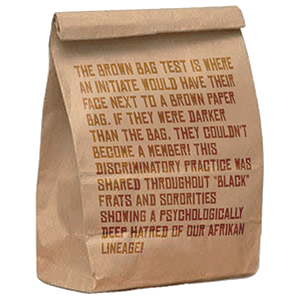
Paper bag parties are African-American social events at which only individuals with complexions at least as light as the color of a brown paper bag were admitted.
Hosts at many churches, fraternities and nightclubs would take a brown paper bag and hold it against a person’s skin. People whose skin was not lighter than a brown paper bag were denied entry The term also refers to larger issues of class and caste within the African-American population.
Continue reading →
Posted in Politics |
Leave a Comment »
May 20, 2013
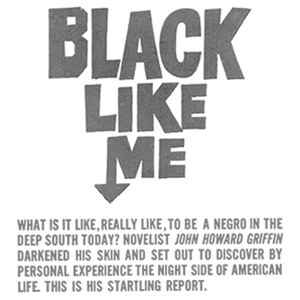
Racial passing refers to a person classified as a member of one racial group attempting to be accepted as a member of a different racial group.
The term was used especially in the U.S. to describe a person of mixed-race heritage assimilating into the white majority during times when legal and social conventions of hypodescent classified the person as a minority, subject to racial segregation and discrimination.
Continue reading →
Posted in Politics, World |
Leave a Comment »
May 17, 2013

When a person receives unfair treatment or alienation due to a social stigma, the effects can be detrimental. Social stigmas are defined as any aspect of an individual’s identity that is devalued in a social context. These stigmas can be categorized as visible or invisible, depending on whether the stigma is readily apparent to others. Visible stigmas refer to characteristics such as race, age, gender, physical disabilities, or deformities; whereas invisible stigmas refer to characteristics such sexual orientation, gender identity, religious affiliation, early pregnancy, certain diseases, or mental illnesses.
When individuals possess invisible stigmas, they must decide whether or not to reveal their association with a devalued group to others. This decision can be an incredibly difficult one, as revealing one’s invisible stigma can have both positive and negative consequences depending on several situational factors. In contrast, a visible stigma requires immediate action to diminish communication tension and acknowledge a deviation from the norm. People possessing visible stigmas often use compensatory strategies to reduce potential interpersonal discrimination that they may face.
Continue reading →
Posted in Health, Money, Politics |
Leave a Comment »
May 14, 2013

‘The Gift of Fear‘ (1997) is a nonfiction self-help book by security consultant Gavin de Becker. The book provides strategies to help readers avoid trauma and violence by teaching them various warning signs and precursors to violence.
De Becker’s book presents a paradox of genre: described as a ‘how-to book that reads like a thriller.’ By finding patterns in stories of violence and abuse, de Becker seeks to highlight the inherent predictability of violence. Continue reading →
Posted in Health, Language |
Leave a Comment »
May 14, 2013

The Disposition Matrix is a database that United States officials describe as a ‘next-generation capture/kill list’ developed by the Obama Administration beginning in 2010. It is a blueprint for tracking, capturing, rendering, or killing terrorism suspects. It is intended to become a permanent fixture of American policy. The process determining criteria for killing is not public, but has been heavily shaped by presidential counterterrorism adviser John Brennan.
Under the Presidency of George W. Bush, Brennan served as top aide to CIA director George Tenet, where he defended the administration’s use of extraordinary rendition and enhanced interrogation, also described as torture. Brennan’s association with the CIA’s interrogation program was controversial, and forced him to withdraw his candidacy for directorship of the CIA or National Intelligence in 2008.
Continue reading →
Posted in Death, Politics, War |
1 Comment »
May 14, 2013

‘The Constitution is not a suicide pact‘ is a phrase in American political and legal discourse which expresses the belief that constitutional restrictions on governmental power must be balanced against the need for survival of the state and its people. It is most often attributed to Abraham Lincoln, as a response to charges that he was violating the United States Constitution by suspending habeas corpus (the right of detainees to contest their imprisonment) during the American Civil War.
Although the phrase echoes statements made by Lincoln, and although versions of the sentiment have been advanced at various times in American history, the precise phrase ‘suicide pact’ was first used by Justice Robert H. Jackson in his dissenting opinion in ‘Terminiello v. Chicago,’ a 1949 free speech case. The phrase also appears in the same context in ‘Kennedy v. Mendoza-Martinez,’ a 1963 U.S. Supreme Court decision written by Justice Arthur Goldberg. Continue reading →
Posted in Death, Politics, War |
Leave a Comment »
May 13, 2013
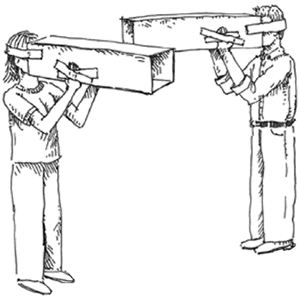
The selective exposure theory is a concept in media and communication research that refers to individuals’ tendency to favor information that reinforces pre-existing views while avoiding contradictory information. In this theory people tend to select specific aspects of exposed information based on their perspective, beliefs, attitudes and decisions.
People can determine the information exposed to them and select favorable evidence, while ignoring the unfavorable. This theory has been explored using the cognitive dissonance theory, which suggests information consumers strive for results of cognitive equilibrium (consistent rather than conflicting thoughts). In order to attain this equilibrium, individuals may either reinterpret the information they are exposed to or select information that are consonant with their view.
Continue reading →
Posted in Language, Money, Science |
1 Comment »
May 13, 2013

Countersignaling is the behavior where agents with the highest level of a given property invest less into proving it than individuals with a medium level of the same property. This concept is primarily useful for analyzing human behavior and thus relevant to economics, sociology and psychology; there is no known animal behavior which conforms to the predictions of the countersignaling model.
Many of the things – such as toughness, cooperativeness or fertility – that people and animals want to know about each other are not directly observable. Instead, observable indicators of these unobservable properties must be used to communicate them to others. These are signals. Signaling theory deals with predicting the level of effort that individuals, the signalers, should invest to communicate their properties to other individuals, the receivers, and how these receivers interpret the signals.
Continue reading →
Posted in Language, Money, Science |
Leave a Comment »
May 13, 2013

Within evolutionary biology, signalling theory is a body of theoretical work examining communication between individuals. The central question is when organisms with conflicting interests should be expected to communicate honestly (no presumption being made of conscious intention) rather than cheating. Mathematical models in which organisms signal their condition to other individuals as part of an evolutionarily stable strategy are important for research in this field.
Signals are given in contexts such as mate selection by females, which subjects the males’ signals to selective pressure. Signals thus evolve because they modify the behaviour of the receiver to benefit the signaller. Signals may be honest, on average conveying information that is actually useful to the receiver, increasing its fitness, or dishonest. A cheat can give a dishonest signal, gaining an advantage, but potentially undermining the signalling system for all.
Continue reading →
Posted in Language, Science, Sex |
Leave a Comment »



