December 13, 2012

Psychohistory [sahy-koh-his-tuh-ree] is a fictional science in Isaac Asimov’s ‘Foundation’ universe which combines history, sociology, and mathematical statistics to make general predictions about the future behavior of very large groups of people. It was first introduced in the five short stories (1942–1944) which would later be collected as the 1951 novel ‘Foundation.’
Psychohistory depends on the idea that, while one cannot foresee the actions of a particular individual, the laws of statistics as applied to large groups of people could predict the general flow of future events. Asimov used the analogy of a gas: an observer has great difficulty in predicting the motion of a single molecule in a gas, but can predict the mass action of the gas to a high level of accuracy (physicists know this as the Kinetic theory). Asimov applied this concept to the population of his fictional Galactic Empire, which numbered a quintillion. Continue reading →
Posted in Art, Language, Science |
Leave a Comment »
December 13, 2012

Psychohistory [sahy-koh-his-tuh-ree] is the study of the psychological motivations of historical events. It attempts to combine the insights of psychotherapy with the research methodology of the social sciences to understand the emotional origin of the social and political behavior of groups and nations, past and present. Its subject matter is childhood and the family (especially child abuse), and psychological studies of anthropology and ethnology.
Psychohistory derives many of its concepts from areas that are perceived to be ignored by conventional historians as shaping factors of human history, in particular, the effects of childbirth, parenting practice, and child abuse. The historical impact of incest, infanticide and child sacrifice are considered. Psychohistory holds that human societies can change between infanticidal and non-infanticidal practices and has coined the term ‘early infanticidal childrearing’ to describe abuse and neglect observed by many anthropologists. Continue reading →
Posted in Education, Health, Politics |
Leave a Comment »
December 12, 2012

Transdisciplinarity connotes a research strategy that crosses many disciplinary boundaries to create a holistic approach.
It applies to research efforts focused on problems that cross the boundaries of two or more disciplines, such as research on effective information systems for biomedical research or bioinformatics, and can refer to concepts or methods that were originally developed by one discipline, but are now used by several others, such as ethnography, a field research method originally developed in anthropology but now widely used by other disciplines. Continue reading →
Posted in Education, Philosophy, Science |
Leave a Comment »
December 12, 2012

Interdisciplinarity involves the combining of two or more academic disciplines into one activity (e.g. a research project). It is about creating something new by crossing boundaries, and thinking across them. It is related to an interdiscipline (e.g. Sociolinguistics, Biosemiotics) which is an organizational unit that crosses traditional boundaries between academic disciplines or schools of thought, as new needs and professions have emerged.
Originally, the term interdisciplinary is applied within education and training pedagogies to describe studies that use methods and insights of several established disciplines or traditional fields of study. Interdisciplinarity involves researchers, students, and teachers in the goals of connecting and integrating several academic schools of thought, professions, or technologies – along with their specific perspectives – in the pursuit of a common task. Continue reading →
Posted in Education, Philosophy, Science |
Leave a Comment »
December 12, 2012
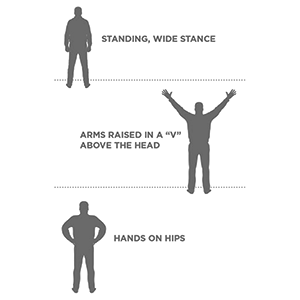
Amy Cuddy is an American social psychologist known for her studies of the relations between stereotyping and behavior. She is Associate Professor in the Negotiation, Organizations & Markets Unit at Harvard Business School. Cuddy studies the origins and outcomes of how people judge and influence each other.
She has conducted experimental and correlational research on stereotyping and discrimination against various groups (e.g., Asian Americans, elderly people, Latinos, working mothers), the causes and consequences of feeling ambivalent emotions (e.g., envy and pity), nonverbal behavior and communication, and hormonal responses to social stimuli. She is a sought-after speaker on the psychology of power, influence, nonverbal communication, and prejudice. Continue reading →
Posted in Education, Money, Science |
Leave a Comment »
December 12, 2012

The hormonal theory of sexuality holds that, just as exposure to certain hormones plays a role in fetal sex differentiation, such exposure also influences the sexual orientation that emerges later in the adult. Prenatal hormones may be seen as the primary determinant of adult sexual orientation, or a co-factor with genes, biological factors and/or environmental and social conditions. Differences in brain structure that come about from hormones and genes interacting on developing brain cells are believed to be the basis of sex differences in countless behaviors, including sexual orientation.
Prenatal factors that affect or interfere with the interaction of these hormones on the developing brain can influence later sex-typed behavior in children. This hypothesis is originated from countless experimental studies in non-human mammals, yet the argument that similar effects can be seen in human neurobehavioral development is a much debated topic among scholars. Recent studies, however, have provided evidence in support of prenatal androgen exposure influencing childhood sex-typed behavior. Continue reading →
Posted in Health, Science, Sex |
Leave a Comment »
December 12, 2012
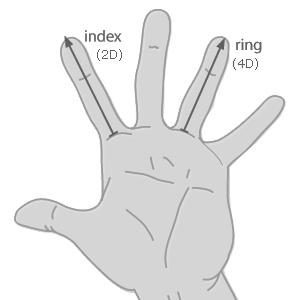
The digit ratio (the ratio of the lengths of different fingers) is possibly affected by exposure to androgen hormones (e.g. testosterone) while in the uterus. The index to ring finger ratio (2D:4D) in particular has been suggested as a crude measure for prenatal androgen exposure, with lower 2D:4D ratios pointing to higher androgen exposure.
A longer index finger will result in a ratio higher than 1, while a longer ring finger will result in a ratio of less than 1. The 2D:4D digit ratio is sexually dimorphic: while the second digit is typically shorter in both females and males, the difference between the lengths of the two digits is greater in males than females. Continue reading →
Posted in Health, Science, Sex |
Leave a Comment »
December 12, 2012

Allometry [uh-lom-i-tree] is the study of the relationship of body size to shape. In particular, it refers to the rate of growth of one part of the body compared to other parts. In most cases, the relative size of body parts changes as the body grows. Most allometric relationships are adaptive.
For example, organs which depend on their surface area (such as the intestine) grow faster as the body weight increases. Also, there are changes in allometry in the evolution of a clade (branches on the tree of life).
Continue reading →
Posted in Science |
Leave a Comment »
December 12, 2012

Male pregnancy is the incubation of one or more embryos or fetuses by male members of any species. In nearly all sexually reproducing animal species, offspring are ordinarily carried by the female until birth, but in fish of the Syngnathidae family (pipefish and seahorses), males perform this function. They may possess a brood pouch on the trunk or tail (in other species, the eggs are merely attached to the male’s trunk or tail when the female lays them).
Fertilization may take place in the pouch or in the water before implantation, but in either case, syngnathids’ male pregnancy ensures them complete confidence of paternity. After implantation in or on the brood pouch or brood patch, the male incubates the eggs. Many species osmoregulate the brood pouch fluid to maintain proper pH for the developing embryos. Continue reading →
Posted in Health, Science, Sex |
1 Comment »
December 12, 2012

In Feminist psychology the terms womb envy and vagina envy denote the unexpressed anxiety that some men feel in natural envy of the biological functions of women (pregnancy, parturition, breast feeding) — emotions which impel their social subordination of women, and to drive themselves to succeed in perpetuating their names via material legacies.
Each term is analogous to the concept of female penis envy, derived from the theory of psychosexual development, presented in Freudian psychology; they address the gender role social dynamics underlying the ‘envy and fascination with the female breasts and lactation, with pregnancy and childbearing, and vagina envy [that] are clues to a femininity complex of men, which is defended against by psychological and sociocultural means.’
Continue reading →
Posted in Health, Sex |
Leave a Comment »
December 11, 2012
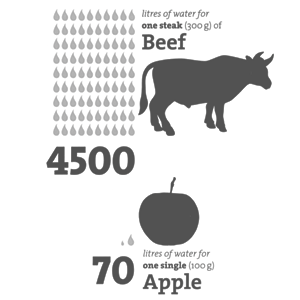
Virtual water (also known as embedded or embodied water) refers to the hidden flow of water if food or other commodities are traded from one place to another. For instance, it takes 1,600 cubic meters of water on average to produce one metric ton of wheat.
The precise volume can be more or less depending on climatic conditions and agricultural practice. Hoekstra and Chapagain have defined the virtual-water content of a product (a commodity, good or service) as ‘the volume of freshwater used to produce the product, measured at the place where the product was actually produced.’ Continue reading →
Posted in Food, Money, Politics |
Leave a Comment »
December 11, 2012

‘How to Rob‘ is a 1999 song by American hip hop recording artist 50 Cent. The song serves as his debut single and the lead single from his album ‘Power of the Dollar’ (officially unreleased but heavily bootlegged).
The album, which was originally set for a 2000 release, was supposed to be his debut with Columbia Records, but was cancelled after 50 Cent was dropped from the label when Columbia discovered that he had been shot. ‘How to Rob’ was produced by Tone & Poke of Trackmasters and features D-Dot, also known as The Madd Rapper. The song was also included on the soundtrack to the 1999 film ‘In Too Deep,’ staring LL Cool J and Omar Epps. Continue reading →
Posted in Art, Humor, Money |
Leave a Comment »



