November 29, 2012

‘The Singularity Is Near: When Humans Transcend Biology’ is a 2005 update of Raymond Kurzweil’s 1999 book ‘The Age of Spiritual Machines’ and his 1990 book ‘The Age of Intelligent Machines.’ In it, as in the two previous versions, Kurzweil attempts to give a glimpse of what awaits us in the near future.
He proposes a coming technological singularity (a period of rapid change), and how we would thus be able to augment our bodies and minds with technology. He describes the singularity as resulting from a combination of three important technologies of the 21st century: genetics, nanotechnology, and robotics (including artificial intelligence).
Continue reading →
Posted in Language, Technology |
Leave a Comment »
November 29, 2012

The Merry Pranksters was a cohort that formed around American author Ken Kesey in 1964 and sometimes lived communally at his homes in California and Oregon. The group promoted the use of psychedelic drugs. Their motto was ‘Never Trust a Prankster.’
Kesey and the Merry Pranksters are noted for the sociological significance of a lengthy road trip they took in the summer of 1964, traveling across the United States in a psychedelic painted school bus enigmatically and variably labeled ‘Further.’ Their early escapades were chronicled by Tom Wolfe in ‘The Electric Kool-Aid Acid Test.’ Wolfe also documents a notorious 1966 trip on Further from Mexico through Houston, stopping to visit Kesey’s friend, novelist Larry McMurtry. Kesey was in flight from a drug charge at the time.
Continue reading →
Posted in Drugs, Humor |
Leave a Comment »
November 28, 2012
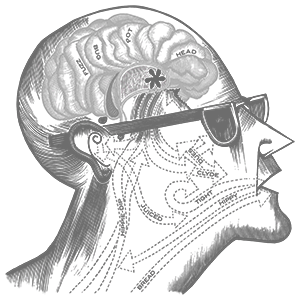
How to Speak Hip is a spoken-word comedy album by improv pioneer Del Close and John Brent, released by Mercury Records in 1959. The album is designed as a satire of language-learning records, where the secret language of the ‘hipster’ is treated as a foreign language.
Part of the joke, however, is that it actually does a good job of describing the Beat Generation/Beatnik sub-culture: Basic concepts such as ‘cool’ and ‘uncool’ are taught, as well as vocabulary building (‘dig,’ ‘dig it,’ ‘dig yourself, baby,’ ‘dig the chick,’ ‘dig the cat,’ ‘What a drag!’). Continue reading →
Posted in Art, Humor, Language |
Leave a Comment »
November 28, 2012

Harold is a structure used in longform theatrical improvisation. Developed by Del Close and brought to fruition through Close’s collaboration with Charna Halpern, the Harold has become the signature form of Chicago’s iO and the Upright Citizens Brigade Theater in New York and Los Angeles. It is now performed by improvisational theater troupes and teams across the world.
The Committee, a San Francisco improv group, performed the first Harold in Concord, California in 1967. They were invited to a high school and decided to do their improvisations on the war in Vietnam. On the way home they were discussing the performance when one of them asked what they should call it. Allaudin (Bill) Mathieu called out ‘Harold.’ It was a joking reference to a line from ‘A Hard Days Night’ where a reporter asked George Harrison what he called his haircut; he answered ‘Arthur.’ Close later remarked that he wished he had chosen a better name. Continue reading →
Posted in Art, Games, Humor |
Leave a Comment »
November 28, 2012

Del Close (1934 – 1999) is one of the premier influences on modern improvisational theater. He was also an actor appearing in a number of films and television shows.
He was a co-author of the book ‘Truth in Comedy,’ which outlines techniques now common to longform improvisational theater and describes the overall structure (he named ‘Harold’) which remains a common frame for longer improvisational scenes. His favorite framework for comedic storytelling was the structures of Wagner’s ‘Ring Cycle.’
Continue reading →
Posted in Art, Games, Humor |
Leave a Comment »
November 28, 2012

Sergei Eisenstein (1898 – 1948) was a pioneering Soviet Russian film director and film theorist, often considered to be the ‘Father of Montage.’
He is noted in particular for his silent films ‘Strike’ (1924), ‘Battleship Potemkin’ (1925), and ‘October’ (1927), as well as the historical epics ‘Alexander Nevsky’ (1938) and ‘Ivan the Terrible’ (1944). Continue reading →
Posted in Art, Politics, World |
Leave a Comment »
November 28, 2012

Recess is an American animated television series created by Paul Germain and Joe Ansolabehere (credited as ‘Paul and Joe’) and produced by Walt Disney Television Animation. The series focuses on six elementary school students and their interaction with other classmates and teachers.
The title refers to the period of time during the school day in which children are not in lessons and are outside in the schoolyard, in North American society. One of the main features of the series is how the children form their own society, complete with government and a class structure, set against the backdrop of a regular school.
Continue reading →
Posted in Art, Humor |
Leave a Comment »
November 28, 2012

Game Boy Micro is a handheld game console developed and manufactured by Nintendo. It was first released in 2005. The system is the last console of the Game Boy line. The Game Boy Micro is the size of a typical Nintendo Entertainment System controller and a typical Famicom controller. The console retains some of the functionality of the Game Boy Advance SP, but with an updated form factor. It is unable to play original Game Boy and Game Boy Color games due to design changes. Even though it still has the required Z80 processor and graphics hardware necessary to run the old games, it is missing other circuitry necessary to be compatible with the old Game Boy cartridges.
It is officially incompatible with the Nintendo e-Reader and some other peripherals due to design issues. Additionally, it features a backlit screen with the ability to adjust the brightness so as to adapt to lighting. The Game Boy Micro features a removable face plate that allows consumers to purchase alternative designs. This device can play MP3 and digital video files from SD cards. The system retailed for US$99, compared to US$79 for the Game Boy Advance SP. Generally, the Game Boy Micro did not sell well, and failed to reach the company’s aim of units sold.
Posted in Games, Money, Technology |
Leave a Comment »
November 28, 2012

Plex is a partially open-source freeware media player software with a 10-foot user interface (optimized for use with a TV), with a matching closed source media server (Plex Media Server) software, which is available for Windows, Mac, and Linux. Its media player source code was initially forked from XBMC, a free media player, in 2008. Plex’s front end media player, Plex Media Center, allows the user to manage and playback video, photos, music, and podcasts from a local or remote computer running Plex Media Server.
In addition, the integrated Plex Online service provides the user with a growing list of community-driven plugins for online content including Hulu, Netflix, and CNN video. Plex began as a freeware hobby project but since 2010 has evolved into a commercial software business that is owned and developed by a single for-profit startup company, (Plex, Inc.). Continue reading →
Posted in Money, Technology |
Leave a Comment »
November 28, 2012

SIGGRAPH (short for Special Interest Group on GRAPHics and Interactive Techniques) is the name of the annual conference on computer graphics started in 1974. The conference is attended by tens of thousands of computer professionals. Some highlights of the conference are its Animation Theater and Electronic Theater presentations, where recently created CG films are played. There is a large exhibition floor, where several hundred companies set up elaborate booths and compete for attention and recruits. Most of the companies are in the engineering, graphics, motion picture, or video game industries.
There are also many booths for schools which specialize in computer graphics or interactivity. Dozens of research papers are presented each year, and SIGGRAPH is widely considered the most prestigious forum for the publication of computer graphics research. In 1984, under LucasFilm Computer Group, John Lasseter’s first computer animated short, ‘The Adventures of André & Wally B.,’ premiered at SIGGRAPH. Pixar’s first computer animated short, ‘Luxo, Jr.’ debuted in 1986, and Pixar has debuted numerous shorts at the conference since. Since 2008, a second yearly SIGGRAPH conference has been held in Asia. The first SIGGRAPH Asia conference was held in Singapore; the second one in Yokohama, Japan in the period in 2009; and the third in Seoul, Korea in 2010.
Posted in Art, Money, Technology |
Leave a Comment »
November 27, 2012

‘Walk On By‘ is a song composed by Burt Bacharach, with lyrics by frequent collaborator Hal David. The song was originally recorded by Dionne Warwick at the same December 1963 session that yielded her hit ‘Anyone Who Had a Heart.’ ‘Walk On By’ was the follow-up to that single, released in 1964 and reaching #6 on the U.S. Billboard Hot 100. Warwick also recorded a German version of the song, entitled ‘Geh Vorbei.’ Funk/soul musician Isaac Hayes released a cover version in 1969 on his album ‘Hot Buttered Soul’ and transformed the song into a twelve-and-a-half minute funk vamp.
Edited for single release down to under 5 minutes, this single reached #30 on the U.S. charts. In 1978, The Stranglers recorded a gritty punk-inspired version (with an extended organ solo) that charted in the UK. Alicia Keys recorded a hip hop version of the song on 2003 mutli-platinum album ‘The Diary of Alicia Keys.’ The Isaac Hayes version samples from a cover of the song by The Jackson 5, and was itself sampled by numerous artists, notably Hooverphonic in ‘2Wicky,’ The Notorious B.I.G. in ‘Warning,’ 2Pac in ‘Me Against the World,’ and Portishead in ‘All Mine.’
Posted in Art |
Leave a Comment »
November 27, 2012

Patton’s Speech to the Third Army was given by General George S. Patton on June 5, 1944, the day before D-day. Patton delivered variations of the speech on several different occasions to his troops, although the June 5 date is the most well known. A hard copy of the speech exists. It has since become immortalized in George C. Scott’s rendition in the movie ‘Patton,’ where he delivers it in front of a large American flag. Patton’s actual words were so colorful that the movie edited and toned down the language, e.g. substituting ‘fornicating’ for ‘fucking.’ Certain phrases from the speech were also used in Scott’s dialogue later on in the film.
Patton’s speech was largely designed to motivate U.S. troops that were to be under fire. There had been much talk about superior German firepower, and the level of fear and doubt was so great in the armed forces that the U.S. Army even resorted to making propaganda films claiming that the infamous German machine gun, the MG-42 (a reliable and deadly weapon), had a bark louder than its bite. The Army did not want US soldiers to get pinned down, and knew that their forces would have to be motivated as they were to be charging German heavy fire on foot. Continue reading →
Posted in Death, Language, War |
2 Comments »



 The Daily Omnivore