July 3, 2012

Allegro Non Troppo is a 1976 Italian animated film directed by Bruno Bozzetto. Featuring six pieces of classical music, the film is a parody of Disney’s ‘Fantasia,’ two of its episodes being arguably derived from the earlier film. The classical pieces are set to color animation, ranging from comedy to deep tragedy. At the beginning, in between the animation, and at the end are black and white live-action sequences, displaying the fictional animator, orchestra, conductor and filmmaker, with many humorous scenes about the fictional production of the film.
Some of these sections mix animation and live action. In music, an instruction of ‘allegro ma non troppo’ means to play ‘fast, but not overly so.’ In the context of this film, and without the ‘ma,’ it means ‘Not So Fast!’, an interjection meaning ‘slow down’ or ‘think before you act.’ The common meaning of ‘allegro’ in Italian is ‘joyful.’ The title reveals therefore a catch with the dual meaning of ‘allegro,’ and can also be read as ‘joyful, but not so much’ or ‘not overly joyful.’
Continue reading →
Posted in Art, Humor, World |
Leave a Comment »
July 3, 2012

A derecho [deh-rey-cho] is a widespread and damaging group of severe thunderstorms which often represent with rapid forward speeds. They have a distinct appearance on radars, known as bow echos (after an archer’s bow). The common definition of the word is: a thunderstorm complex that produces a damaging wind swath of at least 240 miles, featuring a concentrated area of convectively induced wind gusts exceeding 58 mph. Some studies add further criteria, such as a requirement that no more than two or three hours separate any two successive wind reports.
Unlike other thunderstorms, which typically can be heard in the distance when approaching, a derecho seems to strike suddenly. Within minutes, extremely high winds can arise, strong enough to knock over highway signs and topple large trees. These winds are accompanied by spraying rain and frequent lightning from all directions. It is dangerous to drive under these conditions, especially at night, because of blowing debris and obstructed roadways. A derecho moves through quickly, but can do much damage in a short period of time. Continue reading →
Posted in Death, Science, World |
Leave a Comment »
July 3, 2012

Kim Dotcom, real name Kim Schmitz (b. 1974) is a German-Finnish businessman who rose to prominence during the dot-com bubble and was convicted of insider trading and embezzlement in its aftermath. He is the founder of Megaupload and its associated websites. He legally changed his surname to Dotcom in 2005. in 2012, the New Zealand Police placed him in custody in response to US charges of criminal copyright infringement in relation to his Megaupload Web site.
Dotcom has spoken out against his negative portrayal in the media, claiming to be a reformed character and a legitimate businessman who has been unfairly demonized by United States authorities and industry trade groups such as the RIAA and MPAA. He contends that the services offered by his Megaupload site were not significantly different from those of comparable services such as Rapidshare or YouTube, and he has just been used as a scapegoat because of his hacker past.
Continue reading →
Posted in Money, Politics, Technology |
Leave a Comment »
July 3, 2012

Cinespia is an organization that hosts on-site screenings of classic films in and around Los Angeles, California. Launched in 2002, Cinespia shows films from the 1930s through the 1990s mostly in open-air settings at historic locations. Its most popular series runs weekly between May and August on Saturday (and occasionally Sunday) nights at the Hollywood Forever Cemetery. In addition, it screens films, both contemporary and canonical, at other locations throughout the year.
The series was the brainchild of John Wyatt, a set designer then in his mid-twenties. A student of influential film lecturer Jim Hosney at the Crossroads School in Santa Monica, Wyatt initially formed an Italian cinema club with friend Richard Petit, which evolved into Cinespia. The name is a portmanteau of the Italian word for film, ‘cine,’ and the third person singular conjugation of the verb ‘spiare,’ meaning ‘to observe,’ or more commonly, ‘to spy.’ Conjoined, cinespia was intended to suggest a film enthusiast or ‘watcher of films,’ although the actual term for film buff in Italian is ‘cinofilo.’ Cinespia, by contrast, means literally ‘he spies in the movie theater’ or ‘cinema spy.’
Continue reading →
Posted in Art, Death |
Leave a Comment »
July 2, 2012

Everything is Terrible! is a Chicago-based video blogging website launched in 2007 that features clips of VHS tapes from the late 20th century. The project was founded in 2000 by a group of friends while at Ohio University. They search at thrift stores, garage sales, and ‘bargain bins’ for the worst and most outrageous VHS tapes in which to share with each other. The website has also been attempting to amass the largest collection of tapes that feature the film ‘Jerry Maguire’; according to member Ghoul Skool: ‘We always have noticed since the beginning that there seems to be nothing but just ‘Jerry Maguire’ tapes filling our nation’s thrift stores. I don’t know why.’
The people behind ‘Everything is Terrible’ also perform live shows wearing cloaks and gold VHS tapes around their necks to showcase their new VHS discoveries. In 2009, the website released a video titled ‘Everything is Terrible! The Movie,’ which featured the same type of VHS clips that would be featured on their website. The ‘A.V. Club’ called the video ‘a portal into a world halfway between showbiz and real life—a look at how the people who make entertainment for a living think the rest of us saps actually live,’ adding that it’s ‘simultaneously enlightening, hilarious, and deeply sad.
Posted in Art, Humor, Technology |
Leave a Comment »
July 2, 2012

Connectionism [kuh-nek-shuh-niz-uhm] is the theory that the connections (such as between brain cells) mediate thought and govern behavior. It is a set of approaches in the fields of artificial intelligence and cognitive science that model mental or behavioral phenomena as the emergent processes of interconnected networks of simple units. There are many forms of connectionism, but the most common forms use neural network models (artificial brains).
The central connectionist principle is that mental phenomena can be described by interconnected networks of simple and often uniform units. The form of the connections and the units can vary from model to model. For example, units in the network could represent neurons and the connections could represent synapses. Neural networks are able to learn by themselves, unlike normal computers, which cannot do anything for which they are not programmed.
Continue reading →
Posted in Health, Science, Technology |
Leave a Comment »
July 2, 2012
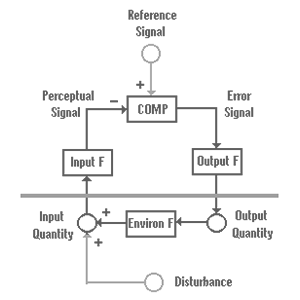
Perceptual control theory (PCT) is a model of behavior based on the principles of negative feedback (when the output of a system acts to oppose changes to the input of a system, acting to stabilize it). It differs in a number of respects from standard engineering control theory, which deals with the behavior of dynamical systems like feedback loops. From the PCT perspective, an organism controls neither its own behavior, nor external environmental variables, but rather its own perceptions.
According to the standard catch-phrase of the field, ‘behavior is the control of perception.’ While the adoption of PCT in the scientific community has not been widespread, it has been applied to a number of areas, and has led to a method of psychotherapy called the Method of Levels.
Continue reading →
Posted in Health, Science, Technology |
Leave a Comment »
June 29, 2012

Control theory is an interdisciplinary branch of engineering and mathematics. It deals with the behavior of dynamical systems. The desired output of a system is called the reference. In a control system a controller manipulates the inputs to a system. In the control systems one or more output variables of a system need to follow a certain reference over time.
By manipulating the input, the controller wants to obtain the desired effect on the output of the system. The usual objective of a control theory is to calculate solutions for the proper corrective action from the controller that result in system stability, that is, the system will hold the set point and not oscillate around it. Continue reading →
Posted in Science, Technology |
Leave a Comment »
June 29, 2012


Cybernetics [sahy-ber-net-iks] is the theory of communication and control based on regulatory feedback. This is the original definition of the term; in popular culture the term refers to the study of cyborgs and robotic implants and prosthetics. Cybernetics is only applicable when the system being analyzed is involved in a closed signal loop; that is, where action by the system causes some change in its environment and that change is fed to the system via information (feedback) that enables the system to change its behavior.
A very simple model of cybernetics is that of a central heating system with four elements: a Sensor (to test the system’s environment); a Goal (the specification of the desired state of the system); Error Detection (a method for finding the difference between the present state and the goal state); and an Effector (operations the system can make to get the environment closer to the goal). A more complicated example is the Honda android ASIMO, which uses sensors and sophisticated algorithms to avoid obstacles and navigate stairs.
Continue reading →
Posted in Health, Science, Technology |
Leave a Comment »
June 29, 2012

In control theory (a theory of sociology that examines controls on societal order), affect control theory proposes that individuals maintain affective meanings through their actions and interpretations of events. The activity of social institutions occurs through maintenance of culturally based affective meanings. Besides a denotative meaning, every concept has an affective meaning, or connotation, that varies along three dimensions: Evaluation (goodness versus badness); Potency (powerfulness versus powerlessness); and Activity (liveliness versus torpidity).
Affective meanings can be measured with semantic differentials yielding a three-number profile indicating how the concept is positioned on evaluation, potency, and activity (EPA). American psychologist Charles E. Osgood demonstrated that an elementary concept conveyed by a word or idiom has a normative affective meaning within a particular culture. A stable affective meaning derived either from personal experience or from cultural inculcation is called a sentiment, or fundamental affective meaning. Continue reading →
Posted in Health, Science |
Leave a Comment »
June 29, 2012
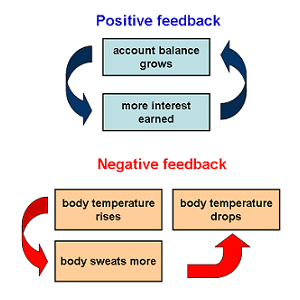
Negative feedback occurs when the output of a system acts to oppose changes to the input of a system, acting to stabilize it. The classic example is a central heating system which cuts off when a (suitably placed) temperature sensor hits a pre-set mark. The negative feedback part is the thermostat. Negative feedback is a basic concept of cybernetics (the theory of communication and control based on regulatory feedback in animals and machines).
In biology negative feedback is known as homeostasis (the property of a system, either open or closed, that regulates its internal environment and tends to maintain a stable, constant condition). Virtually all aspects of living systems involve homeostasis (e.g. blood pressure, glucose level, liver functions, cell division). The disruption of feedback loops can lead to undesirable results: in the case of blood glucose levels, if negative feedback fails, the glucose levels in the blood may begin to rise dramatically, thus resulting in diabetes. Continue reading →
Posted in Health, Science, Technology |
Leave a Comment »
June 29, 2012
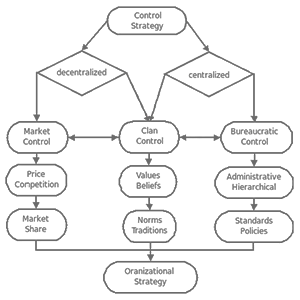
Control Theory is a theory of social order in sociology, which classifies control as centralized or decentralized or neither. Decentralized control is considered market control. Centralized control is considered bureaucratic control. Some types of control such as clan control are considered to be a mixture of both decentralized and centralized control.
Decentralized control or market control is typically maintained through factors such as price, competition, or market share. Centralized control such as bureaucratic control is typically maintained through administrative or hierarchical techniques such as creating standards or policies. Mixed control or clan control is typically maintained by keeping a set of values and beliefs or norms and traditions. Continue reading →
Posted in Politics, Science |
Leave a Comment »



