June 29, 2012
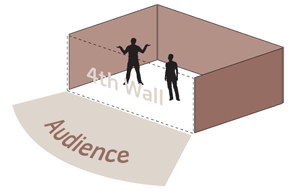
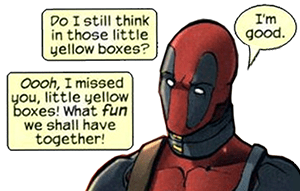
Metareference is a situation in a work of fiction whereby characters display an awareness that they are in such a work. Sometimes it may even just be a form of editing or film-making technique that comments on the show/film/book itself. It is also sometimes known as ‘Breaking the Fourth Wall,’ in reference to the theatrical tradition of playing as if there were no audience, as if a wall existed between them and the actors.
Metareference in fiction is jarring to the reader, but can be comical, as in Jasper Fforde’s novel ‘Lost in a Good Book.’ The character Thursday Next remarks to her husband that she feels uncomfortable having sex in front of so many people, when he is confused because they are alone in their bedroom, she explains, ‘all the people reading us.’ In Fforde’s ‘The Fourth Bear’ two characters lament over a bad joke made by the author, saying, ‘I can’t believe he gets away with that.’ Some novels with first person narration contain instances of metareference when the narrator addresses the reader directly (e.g. Charlotte Brontë’s ‘Jane Eyre’).
Continue reading →
Posted in Art, Language |
Leave a Comment »
June 29, 2012

Mise [meez] en [awn] abyme [ah-beem] is a term originally from the French and means ‘placed into abyss.’ The commonplace usage of this phrase is describing the visual experience of standing between two mirrors, seeing an infinite reproduction of one’s image, but it has several other meanings in the realm of the creative arts and literary theory. In Western art history, ‘mise en abyme’ is a formal technique in which an image contains a smaller copy of itself, the sequence appearing to recur infinitely.
In the terminology of heraldry, the ‘abyme’ is the center of a coat of arms. The term ‘mise en abyme’ then meant literally ‘put in the center.’ It described a coat of arms that appears as a smaller shield in the center of a larger one (the Droste effect). For example, the two-headed eagle on modern coat of arms of Russia has a scepter with coat of arms of Russia on top of it, with the same scepter. Continue reading →
Posted in Art, Language, Philosophy |
Leave a Comment »
June 29, 2012

Mirrored sunglasses are sunglasses with a reflective optical coating (called a mirror coating or flash coating) on the outside of the lenses to make them appear like small mirrors. The lenses typically give the wearer’s vision a brown or grey tint. The mirror coating decreases the amount of light passing through the tinted lens by a further 10–60%, making it especially useful for conditions of sand, water, snow, and higher altitudes.
Mirrored sunglasses are one-way mirrors. The color of the mirror coating is independent of the tint of the lenses. It is determined by the thickness and structure of the layer. Their popularity with police officers in the United States has earned them the nickname ‘cop shades.’ Characters in the cyberpunk genre frequently wear mirrorshades, and they are considered a hallmark of the subculture. Many characters in the movie series ‘The Matrix’ exclusively wear mirrored sunglasses, Morpheus in particular.
Posted in Art, Technology |
Leave a Comment »
June 28, 2012

OSx86 is a collaborative hacking project to run the Mac OS X computer operating system on non-Apple personal computers with x86 architecture and x86-64 compatible processors. The effort started soon after the 2005 Worldwide Developers Conference announcement that Apple would be transitioning its personal computers from PowerPC to Intel microprocessors. Apple uses a Trusted Platform Module, or TPM, to tie Mac OS to the systems it distributed to developers after announcing its switch to Intel’s chips. A computer built to run this type of Mac OS X is also known as a Hackintosh.
Hackintoshed notebook computers are also referred to as ‘Hackbooks.’ The Apple software license does not allow Mac OS X to be used on a computer that is not ‘Apple-branded.’ The legality of this form of tying is disputed. While the methods Apple uses to prevent Mac OS X from being installed on non-Apple hardware are protected from commercial circumvention in the United States by the DMCA, specific changes to the law regarding the concept of jailbreaking has thrown such and similar circumvention methods when carried out by end-users for personal use into a legal grey area.
Posted in Money, Politics, Technology |
Leave a Comment »
June 28, 2012

Asymmetric warfare is war between belligerents whose relative military power differs significantly, or whose strategy or tactics differ significantly. Such struggles often involve strategies and tactics of unconventional warfare (such as subversion and sabotage); the ‘weaker’ combatants use strategy to offset their deficiencies. Such strategies may not necessarily be militarized, involving combatants with widely varying degrees of training and support.
This is in contrast to symmetric warfare, where two powers have similar military forces and resources and rely on tactics that are similar overall, differing only in details and execution. The term is frequently used to describe what is also called ‘guerrilla warfare,’ ‘insurgency,’ and ‘terrorism’ (as well as ‘counterinsurgency’ and ‘counterterrorism’), essentially violent conflict between a formal military and an informal, poorly-equipped, but resilient opponent. Continue reading →
Posted in Technology, War, World |
Leave a Comment »
June 28, 2012

A sixteen-segment display, sometimes called a ‘Union Jack’ display (because it resembles the British Flag), is a type of display based on 16 segments. It is an extension of the more common seven-segment display, adding four diagonal and two vertical segments and splitting the three horizontal segments in half (A fourteen-segment display splits only the middle horizontal segment). A sixteen-segment display can have 65,536 different states; they were were originally designed to display alphanumeric characters (Latin letters and Arabic digits).
Later they were used to display Thai numerals and Persian characters. Before the advent of inexpensive dot-matrix displays, sixteen and fourteen-segment displays were some of the few options available for producing alphanumeric characters on calculators and other embedded systems. However, they are still sometimes used on VCRs, car stereos, microwave ovens, telephone Caller ID displays, and slot machine readouts.
Posted in Language, Technology, World |
Leave a Comment »
June 27, 2012

The human microbiome is the collection of microorganisms (such as bacteria and fungi) which live on and inside humans (on the skin, in the saliva and mouth, in the eyes, and in the gut and the rest of the gastrointestinal tract). Foreign microbes outnumber human cells in the body a wide margin; humans have about 100 trillion cells, and carry ten times as many microorganisms in the intestines alone.
Some of these organisms are useful for humans. However, most have no known effect; they are just symbionts and are referred to as the normal ‘flora.’ Studies in 2009 asked whether our health is damaged if we reduce this biota (collection of organisms in an ecosystem), which is certainly the case with gut flora (which can be restored by a ‘fecal transplant.’ Continue reading →
Posted in Health, Science |
1 Comment »
June 27, 2012
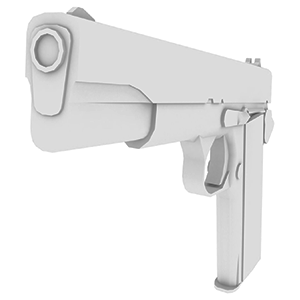
The M1911 is a .45 caliber pistol originally made by Colt, and is now the most copied pistol design in the world. It was made in the early 1900s and was used in World War I, World War II, The Korean War, and in the Vietnam War. It is semi-automatic and can fire a bullet each time the trigger is pulled. It can hold seven rounds inside its magazine and one more in the chamber. It was standard-issue side arm for the United States armed forces from 1911 to 1985 when it was replaced by the 9mm Beretta M9 (though the M1911 is still carried by some U.S. forces).
The M1911 is a common pistol design for police special teams because it is reliable in function, easy to modify by a gunsmith, and effective. The ‘1911’ in the name is because the pistol was adopted by the United States Army in the year 1911. M1911A1 pistols have an ‘A1’ added because they were changed from the original design in the 1920s in military service. Continue reading →
Posted in Money, Technology, War |
Leave a Comment »
June 26, 2012

Speciesism [spee-shee-ziz-uhm] involves assigning different values or rights, or special consideration, to individuals solely on the basis of their species membership. The term was coined in 1973 by British psychologist Dick D. Ryder to denote prejudice against non-humans based on morally irrelevant physical differences.
The term is mostly used by animal rights advocates, who argue that species membership has no moral significance, and that it is both irrational and morally wrong to regard sentient beings as objects or property. Philosopher Tom Regan argues that all animals have inherent rights and that we cannot assign them a lesser value because of a perceived lack of rationality, while assigning a higher value to infants and the mentally impaired solely on the grounds of membership of a certain species. Peter Singer’s philosophical arguments against speciesism are based on the principle of equal consideration of interests. Continue reading →
Posted in Philosophy, Politics |
1 Comment »
June 26, 2012

Boombox is a colloquial expression for a portable music player with two or more loudspeakers. It is a device capable of receiving radio stations and playing recorded music (usually cassettes or CDs), usually at relatively high volume. Many models are also capable of recording (onto cassette) from radio and (sometimes) other sources. Designed for portability, most boomboxes can be powered by batteries, as well as by line current.
The first Boombox was developed by the inventor of the C-Cassette, Philips of the Netherlands. Their first ‘Radiorecorder’ was released in 1969. The Philips innovation was the first time that radio broadcasts could be recorded onto C-Cassette tapes without cables or microphones. Early sound quality of tape recordings was poor but as the C-Cassette technology evolved, with stereo recording, Chromium tapes and noise reduction, soon HiFi quality devices become possible. Several European electronics brands such as Grundig also introduced similar devices.
Continue reading →
Posted in Art, Money, Technology |
Leave a Comment »
June 26, 2012

Nutopia is a conceptual micronation founded by John Lennon and Yoko Ono to address Lennon’s then-ongoing immigration problems though satirical means. There is no leadership and not all citizenships have been recorded. As a result, the population is unknown. It was first announced on April Fool’s Day 1973 at a press conference in New York City. The Lennons were ambassadors of the country and sought (creatively, though unsuccessfully) diplomatic immunity to end Lennon’s ongoing immigration troubles, as he and Ono tried to remain in the United States.
Ono already had a Resident Alien ‘green card’ through her previous husband, Tony Cox, but Lennon had been denied permanent residence status. John talked about the imaginary country, which would live up to the ideals of his song ‘Imagine,’ saying this in the ‘official’ declaration: ‘We announce the birth of a conceptual country, NUTOPIA. Citizenship of the country can be obtained by declaration of your awareness of NUTOPIA. NUTOPIA has no land, no boundaries, no passports, only people. NUTOPIA has no laws other than cosmic. All people of NUTOPIA are ambassadors of the country. As two ambassadors of NUTOPIA, we ask for diplomatic immunity and recognition in the United Nations of our country and its people.
Posted in Humor, Politics, World |
Leave a Comment »
June 26, 2012

The Kama Sutra is an ancient Hindu text widely considered to be the standard work on human sexual behavior in Sanskrit. A portion of the work consists of practical advice on sexual intercourse.
‘Kāma’ which is one of the three goals of Hindu life, means sensual or sexual pleasure, and ‘sūtra’ literally means a thread or line that holds things together, and more metaphorically refers to an aphorism (or line, rule, formula), or a collection of such aphorisms in the form of a manual. Contrary to popular perception, especially in the western world, Kama sutra is not just an exclusive sex manual; it presents itself as a guide to a virtuous and gracious living that discusses the nature of love, family life and other aspects pertaining to pleasure oriented faculties of human life.
Continue reading →
Posted in Language, Philosophy, Sex |
Leave a Comment »



