April 18, 2012

Veganarchism is the political philosophy of veganism (more specifically animal liberation and earth liberation) and anarchism, creating a combined praxis that is designed to be a means for social revolution. This encompasses viewing the state as unnecessary and harmful to animals, both human and non-human, whilst practicing a vegan lifestyle. It is either perceived as a combined theory, or that both philosophies are essentially the same. It is further described as an anti-speciesist perspective on green anarchism, or an anarchist perspective on animal liberation. The philosophy was first popularized by Brian A. Dominick in ‘Animal Liberation and Social Revolution’ and later promoted by anarcho-punk band Virus using symbolism, ‘Roots of Compassion,’ a zine named ‘veganarchy,’ and political prisoner Jonny Albewhite.
Dominick describes veganarchists as either opposed to reformist measures for animals (considering them the task of liberals or progressives), such as granting non-humans suffrage, or include but do not limit their goals to changes within the law. He criticizes the need for the state to stand between humans and non-humans, detailing increased crime and violence due to alcohol prohibition and the war on drugs, believing a government orchestrated ‘War on Meat’ would only cause more problems rather than curb animal abuse and the reinforced desires for animal products; preferring instead a non-coercive approach to eliminating animal consumption.
Posted in Food, Politics |
Leave a Comment »
April 18, 2012
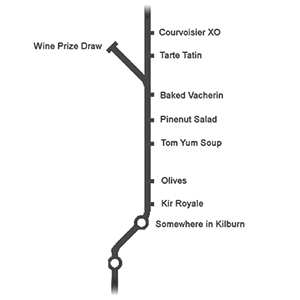
An underground restaurant, sometimes known as a supper club or ‘closed door restaurant,’ is an eating establishment operated out of someone’s home, generally (though not invariably) bypassing local zoning and health-code regulations. They are, in effect, commercial dinner parties. They are usually advertised by word of mouth or guerilla advertising, often on Facebook, and may require references to make a reservation. An underground restaurant is also known as a ‘guestaurant,’ which is a hybrid between being a guest in a dinner party and a restaurant.
Underground restaurants are popular in Latin America, where they’re known as either a ‘paladar’ or a ‘restaurante de puertas cerradas’ (‘closed door restaurant’). Depending on local licensing laws, they may or may not be illegal; either way, they’ve been built into the culture for decades, and often have higher standards than many licensed establishments. The attraction of the underground restaurant for the customer is to sample new food, often at low cost outside the traditional restaurant experience, which can be expensive and disappointing—underground restaurants have been described as ‘anti-restaurants.’
Posted in Food, Games, World |
Leave a Comment »
April 18, 2012

Keep Austin Weird is the slogan adopted by the Austin Independent Business Alliance to promote small businesses in Austin, Texas. The phrase has long been believed to have been coined in 2000 by Red Wassenich, who says he made the comment after giving a pledge to an Austin radio station. He later began printing bumper stickers, and now operates the website keepaustinweird.com and published ‘Keep Austin Weird: A Guide to the Odd Side of Town.’ Despite a challenge from Wassenich, the slogan was later trademarked by Outhouse Designs and used to market T-shirts, hats, and mugs. A recently released book on the topic, ‘Weird City,’ discusses the cultural evolution of the movement as well as its commercialization and socio-political significance.
Austin is the self-proclaimed ‘live music capital of the world’ and the people of Austin reflect a friendly, accepting culture of artistic and individual expression that maintains the city as a vibrant and eclectic creative center and haven for an LGBT community, intellectual community, community of naturalists and environmentalists, and for subcultures and people(s) who are not mainstream. In a mostly conservative Texas, Austin is ‘Weird’ because of that and because it continues to be liberal and progressive politically, socially, in culture, in the arts and in music, among other things. ‘Keep Austin Weird’ moves beyond a mere slogan, to reflect the dynamics that encompass Austin.
Posted in Humor, Money, Politics |
Leave a Comment »
April 18, 2012


Slow Food is an international movement founded by Carlo Petrini in 1986. Promoted as an alternative to fast food, it strives to preserve traditional and regional cuisine and encourages farming of plants, seeds and livestock characteristic of the local ecosystem. It was the first established part of the broader Slow movement, and has since expanded globally. Its goals of sustainable foods and promotion of local small businesses are paralleled by a political agenda directed against globalization of agricultural products.
Slow Food began in Italy with the founding of its forerunner organization, Arcigola, in 1986 to resist the opening of a McDonald’s near the Spanish Steps in Rome. In 1989, the founding Manifesto of the international Slow Food movement was signed in Paris by delegates from 15 countries. This was done not so much a protest against the restaurant chain as a protest against big international business interests. The movement has expanded to include chapters in over 150 countries.
Continue reading →
Posted in Food, Money |
Leave a Comment »
April 18, 2012

A locavore [loh-kuh-vawr] is a person interested in eating food that is locally produced, not moved long distances to market. The locavore movement in the United States and elsewhere was spawned as interest in sustainability and eco-consciousness became more prevalent. ‘Locavore’ was the word of the year for 2007 in the Oxford American Dictionary. The word is the creation of Jessica Prentice of the San Francisco Bay Area at the time of World Environment Day, 2005. Locavore food may be grown in home gardens or by local commercial groups interested in keeping the environment as clean as possible and selling food close to where it is grown. One often cited, but not universal, definition of ‘local’ food is food grown within 100 miles of its point of purchase or consumption.
Farmers’ markets play a role in efforts to eat what is local. Preserving food for those seasons when it is not available fresh from a local source is one approach some locavores include in their strategies. Living in a mild climate can make eating locally grown products very different from living where the winter is severe or where no rain falls during certain parts of the year. Those in the movement generally seek to keep use of fossil fuels to a minimum, thereby releasing less carbon dioxide into the air and preventing greater global warming. Keeping energy use down and using food grown in heated greenhouses locally would be in conflict with each other, so there are decisions to be made by those seeking to follow this lifestyle.
Posted in Food, Politics, World |
Leave a Comment »
April 18, 2012

Food miles is a term which refers to the distance food is transported from the time of its production until it reaches the consumer. Food miles are one factor used when assessing the environmental impact of food, including the impact on global warming. The concept originated in the early 1990s in the UK. It was conceived by Professor Tim Lang, at the Sustainable Agriculture Food and Environment (SAFE) Alliance and first appeared in print in a report ‘The Food Miles Report: The dangers of long-distance food transport,’ by Angela Paxton.
Some scholars believe that an increase in the miles food travels is due to the globalization of trade; the focus of food supply bases into fewer, larger districts; drastic changes in delivery patterns; the increase in processed and packaged foods; and making fewer trips to the supermarket. At the same time, most of the greenhouse gas emissions created by food have their origin in the production phases, which create 83% of overall emissions of CO2. Continue reading →
Posted in Food, Politics, Technology |
Leave a Comment »
April 18, 2012
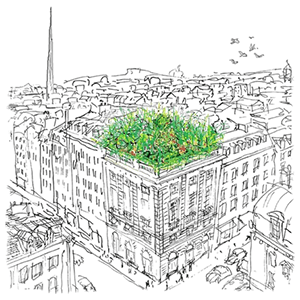
Rooftop farming is the practice of cultivating food on the rooftop of buildings. Rooftop farming is usually done using green roof, hydroponics, aeroponics, or air-dynaponics systems or container gardens. Besides using the already present space at the roof itself, additional platforms could possibly be created between high-rise buildings called ‘aero-bridges.’ Besides the decorative benefit, roof plantings may provide food, temperature control, hydrological benefits, and habitats for wildlife.
‘In an accessible rooftop garden, space becomes available for localized small-scale urban agriculture, a source of local food production.’ At Trent University in Ontario, there is currently a working rooftop garden which provides food to the student café and local citizens.
Continue reading →
Posted in Food, Money, Technology |
Leave a Comment »
April 18, 2012
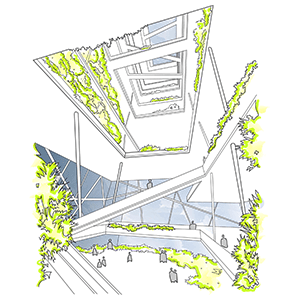
Vertical farming is a concept that argues that it is economically and environmentally viable to cultivate plant or animal life within skyscrapers, or on vertically inclined surfaces.
The idea of a vertical farm has existed at least since the early 1950s and built precedents are well documented by John Hix in his canonical text ‘The Glass House.’
Continue reading →
Posted in Food, Money, Technology |
1 Comment »
April 18, 2012
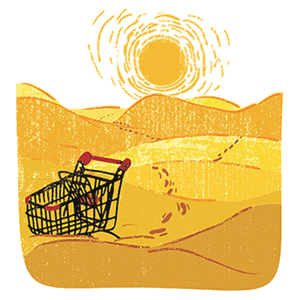
A food desert is any area in the industrialized world where healthy, affordable food is difficult to obtain. Food deserts are prevalent in rural as well as urban areas and are most prevalent in low-socioeconomic minority communities. They are associated with a variety of diet-related health problems. Food deserts are also linked with supermarket shortage.
The food desert concept was first introduced in the United Kingdom in the early 1990s to examine disparities in food pricing and to describe geographical areas with limited access to retail grocery stores. A food desert is a food environment unsupportive of health; it is defined by barriers which restrict access to healthful foods. Barriers may include lack of access to food retailers, availability of nutritious foods, or affordability of foods. Research has defined food deserts quantitatively or by neighborhood characteristics such as economic and social barriers.
Continue reading →
Posted in Food, Health, Money |
1 Comment »
April 18, 2012

A spectrum auction is a process whereby a government uses an auction system to sell the rights (licences) to transmit signals over specific bands of the electromagnetic spectrum and to assign scarce spectrum resources. Depending on the specific auction format used, a spectrum auction can last from a single day to several months from the opening bid to the final winning bid.
With a well-designed auction, resources are allocated efficiently to the parties that value them the most, the government securing revenue in the process. Spectrum auctions are a step toward market-based spectrum management, and are a way for governments to allocate scarce resources. Alternatives to auctions include administrative licensing, such as the comparative hearings conducted historically (sometimes referred to as ‘beauty contests’), or lotteries.
Continue reading →
Posted in Money, Politics, Technology |
Leave a Comment »
April 18, 2012

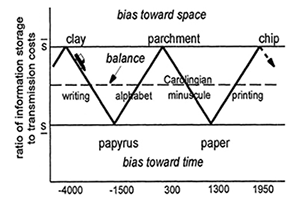
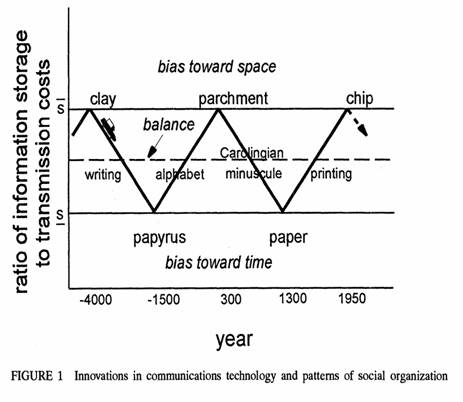
The Canadian economic historian Harold Innis developed the concept of monopolies of knowledge in his later writings on communications; they arise when ruling classes maintain political power through control of key communications technologies. In ancient Egypt, for example, a complex writing system conferred a monopoly of knowledge on literate priests and scribes. Mastering the art of writing and reading required long periods of apprenticeship and instruction, confining knowledge to this powerful class.
This theory suggests that monopolies of knowledge gradually suppress new ways of thinking. Entrenched hierarchies become increasingly rigid and out of touch with social realities. Challenges to elite power are often likely to arise on the margins of society. The arts, for example, are often seen as a means of escape from the sterility of conformist thought. Continue reading →
Posted in Education, Money, Politics |
Leave a Comment »
April 17, 2012

Media Consolidation is a process whereby progressively fewer individuals or organizations control increasing shares of the mass media. As of 2010, The Walt Disney Company is the largest media conglomerate in the US, with News Corporation, Time Warner, and Viacom ranking second, third and fourth respectively. Net neutrality is at stake when media mergers are occurring. Net neutrality involves a lack of restrictions on content on the internet, however, with big businesses supporting campaigns financially they tend to have influence over political issues, which can translate into their mediums.
Critics of consolidation raise the issue of whether monopolistic or oligopolistic control of a local media market can be fully accountable and dependable in serving the public interest. On the local end, reporters have often seen their stories refused or edited beyond recognition. An example would be the repeated refusal of networks to air ‘ads’ from anti-war advocates to liberal groups like MoveOn.org, or religious groups like the United Church of Christ. Journalists and their reports may be directly sponsored by parties who are the subject of their journalism leading to reports which favor the sponsor. Consequently, if the companies dominating a media market choose to suppress stories that do not serve their interests, the public suffers, since they are not adequately informed of some crucial issues that may affect them.
Posted in Money, Politics, World |
Leave a Comment »