April 17, 2012

Eric Klinenberg is an American sociologist and a scholar of urban studies, culture, and media. He is best known for his contributions as a public sociologist. He is currently Professor of Sociology, Public Policy, and Media, Culture, and Communications at New York University, as well as the editor of the journal ‘Public Culture.’ Klinenberg’s first book, ‘Heat Wave: A Social Autopsy of Disaster in Chicago,’ was published by the University of Chicago Press in 2002.
It was praised as ‘trenchant, persuasive tale of slow murder by public policy.’ Klinenberg’s second book, ‘Fighting for Air: The Battle to Control America’s Media,’ was called ‘a must-read for those who wonder what happened to good radio, accurate reporting and autonomous public interest.’ Since its publication, he has testified before the FCC and briefed Congress on his findings. His latest book, ‘Going Solo: The Extraordinary Rise and Surprising Appeal of Living Alone,’ was published in 2012.
Posted in Language, Politics, Science |
Leave a Comment »
April 17, 2012
Katie Piper (b. 1983) is a former model and television presenter from the UK. Piper had hoped to have a full-time career in the media, but in 2008 sulfuric acid was thrown in her face. The attack, which blinded Piper in one eye, was arranged by Piper’s ex-boyfriend, Daniel Lynch, and carried out by an accomplice, Stefan Sylvestre. Lynch and Sylvestre were arrested and are serving life sentences in prison for their crimes.
Surgeons removed all the skin from her face before rebuilding it with a skin substitute and then a skin graft. The procedure was the first of its kind to be completed in a single operation. In 2009, Piper chose to give up her anonymity and attempt to increase awareness about burn victims. The Channel 4 documentary ‘Katie: My Beautiful Face’ was first aired that autumn.
Posted in Health, Politics |
Leave a Comment »
April 17, 2012

Lorin Ashton, better known by the stage name Bassnectar, is a freeform electronic music and dubstep artist, DJ, and producer based in San Francisco. He is best known for his live performances, light shows, and community engagement. Bassnectar was originally influenced by heavy metal and grunge groups such as Metallica, Megadeth, and Nirvana, bringing these influences with him into his own musical career. He’s also mentioned that early IDM and Ambient artists like Orbital also played a major influence.
He has been creating genre-bending music since the 1990s, using a variety of programs such as Vision/OpCode, Reason, and Ableton Live. Bassnectar describes his music as amorphous and ever-changing, which is reflected in the distinct sounds and personalities of his numerous albums, EPs, and podcasts. He has collaborated with and remixed a host of artists and producers, including Lupe Fiasco, Ellie Goulding, Gogol Bordello, Sound Tribe Sector 9, Datsik, ill.Gates, and Jantsen, among others.
Posted in Art, Technology |
1 Comment »
April 17, 2012
Electric Daisy Carnival is an annual electronic dance music festival held in the South West United States on the last weekend of June. The first Electric Daisy Carnival was held in 1997 at the Shrine Expo Hall in Southern California. The name usage was acquired by Insomniac’s partner Philip Blaine. This refers to the name borrowed from Steve Kool-Aid’s original creation from several years prior whom Philip knew through his colleague Gary (Steve’s partner) at 1500 Records.
In 2010, the event drew criticism from local authorities and promoters alike after minors gained entrance and numerous people were taken to the hospital by paramedics, and as well after an underage (15 year old female) attendee who died of an overdose of ecstasy. The city of Los Angeles began to consider banning all raves from being held in the city. The Coliseum Commission put a moratorium on booking any future events, pending the outcome of the use of new security and safety provisions. Those new provisions include a minimum age of 18 on all future events and the presence of on-site doctors.
Posted in Art, Drugs, Money |
Leave a Comment »
April 17, 2012

Prison–industrial complex is a term used to attribute the rapid expansion of the US inmate population to the political influence of private prison companies and businesses that supply goods and services to government prison agencies. The term is analogous to the military–industrial complex that President Dwight D. Eisenhower warned of in his famous 1961 farewell address.
Such groups include corporations that contract prison labor, construction companies, surveillance technology vendors, lawyers, and lobby groups that represent them. Activists have described the prison industrial complex as perpetuating a belief that imprisonment is a quick fix to underlying social problems such as homelessness, unemployment, drug addiction, mental illness, and illiteracy.
Continue reading →
Posted in Money, Politics |
Leave a Comment »
April 17, 2012
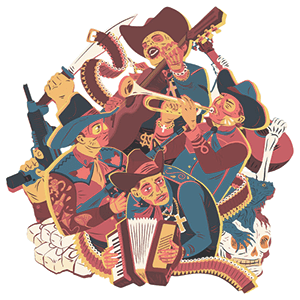
A Narcocorrido [nahr-koh-koh-ree-doh] is a type of Mexican music and song tradition which evolved out of the norteño folk corrido tradition. This type of music is heard on both sides of the US–Mexican border. It uses a danceable, accordion-based polka as a rhythmic base. The first corridos that focus on drug smugglers dated to the 1930s. Early corridos (non-narco) go back as far to the Mexican Revolution of 1910, telling the stories of revolutionary fighters. Music critics have compared narcocorrido music to gangster rap. Narcocorrido lyrics refer to particular events and include real dates and places. The lyrics tend to speak approvingly of illegal criminal activities such as murder, torture, racketeering, extortion, drug smuggling, illegal immigration, and sometimes political protest due to government corruption.
Among the earliest exponents of narcocorrido music were Los Alegres de Teran, who recorded many. In the 1980s, Rosalino ‘Chalino’ Sánchez contributed to narcocorridos. Known throughout Mexico as ‘l Pelavacas’ (‘Cow Skin Peeler’), El Indio (The Indian, from his corrido ‘El Indio Sánchez’), and ‘Mi Compa’ (‘My Friend’), Sánchez was a Mexican immigrant living in Los Angeles. He then began distributing his music. His lyrics composed of heartbreak, revolution, and socioeconomic issues. Soon he was selling mass copies. Chalino Sánchez was murdered in 1992 after a concert in Culiacán. In death, he became a legend and one of the most influential musicians to emerge from California, he was known throughout Mexico and United States as El Rey del Corrido (‘The King of the Corrido’).
Posted in Art, Death, Drugs |
1 Comment »
April 17, 2012

The terms empathogen [em-path-uh-jen] and entactogen are used to describe a class of psychoactive drugs that produce distinctive emotional and social effects similar to those of MDMA (‘Ecstasy’) characterized by increased empathy (the ability to understand and share the feelings of another). Putative members of this class include 2C-B, 2C-I, MDMA, MDA, MDEA, MBDB, 2C-T-7, and 2C-T-2, among others.
The chemical structure of many entactogens contains a substituted amphetamine core, and most belong to the phenethylamine class of psychoactive drugs, although several (AET and AMT) are tryptamines. When referring to MDMA and its counterparts, the term ‘MDxx’ is often used with the exception of MDPV. Continue reading →
Posted in Drugs, Health, Language |
Leave a Comment »
April 17, 2012


The Second Summer of Love is a name given to the period in 1988-89 in Britain, during the rise of acid house music and the euphoric explosion of unlicensed MDMA (‘Ecstasy’)-fuelled rave parties. The term generally refers to the summers of both 1988 and 1989, when electronic dance music and MDMA exploded in popularity, culminating in mass free parties and the era of the rave.
LSD was also widely available and popular again. The music of this era fused dance beats with a psychedelic, 1960s flavor, and the dance culture drew parallels with the hedonism and freedom of the ‘Summer of Love’ in San Francisco two decades earlier. Similarities with the Sixties included fashions such as Tie-dye. The smiley logo is synonymous with this period in the UK.
Posted in Drugs, Love, World |
Leave a Comment »
April 17, 2012

Madchester was a music scene that developed in Manchester, England, towards the end of the 1980s and into the early 1990s. The music that emerged from the scene mixed alternative rock, psychedelic rock, and dance music. Artists associated with the scene included New Order, The Stone Roses, Happy Mondays, Inspiral Carpets, Northside, 808 State, James, The Charlatans, The Fall, and A Guy Called Gerald.
At that time, the Haçienda nightclub was a major catalyst for the distinctive musical ethos in the city that was called the ‘Second Summer of Love.’ The music scene in Manchester immediately before the Madchester era had been dominated by bands such as The Smiths, New Order, The Fall and James. These bands were to become a significant influence on the Madchester scene. Continue reading →
Posted in Art, Drugs, World |
Leave a Comment »
April 17, 2012

Paisley Underground is an early genre of alternative rock, based primarily in Los Angeles, which was at its most popular in the mid-1980s. The term refers to a comment made by Michael Quercio of the band The Three O’Clock during a radio interview. Paisley Underground bands incorporated psychedelia, rich vocal harmonies, and guitar interplay in a folk rock style that owed a particular debt to The Byrds, but more generally referenced the whole range of 1960s West Coast pop and garage rock, from the Seeds to the Beach Boys.
The Dream Syndicate channeled Crazy Horse and Creedence Clearwater Revival via The Velvet Underground, while The Bangles recalled The Mamas & the Papas, Green on Red came on as a cousin to The Doors, The Long Ryders honored Gram Parsons and Buffalo Springfield, The Three O’Clock owed debt to the Bee Gees and The Monkees, and so on. The 1970s Memphis cult band Big Star, whose ‘eptember Gurls’ was covered by The Bangles, was also influential, as were Britain’s Soft Boys. Although there were accomplished musicians among them, it was also rooted—as was the punk rock that preceded it—in an inspired amateurism. Continue reading →
Posted in Art |
Leave a Comment »
April 17, 2012

Neo-psychedelia is music that emulates or is heavily influenced by the psychedelic music of the 1960s. It began to be revived among British post-punk bands of the later 1970s and early 1980s and was taken up by groups including bands of the Paisley Underground and Madchester scenes, as well as occasional interest from mainstream artists and bands into the new millennium.
Neo-psychedelic acts borrowed a variety of elements from 1960s psychedelic music. Some emulated the psychedelic pop of bands like The Beatles and early Pink Floyd, others adopted the jangly guitars of folk rock bands like the Byrds-influenced guitar rock, or distorted free-form jams and sonic experimentalism of late 1960s acid rock. Some neo-psychedelia has been explicitly focused on drug use and experiences, while other bands have used it to accompany surreal or political lyrics.
Continue reading →
Posted in Art, Drugs, World |
Leave a Comment »
April 16, 2012

The Residents are an American art collective best known for avant-garde music and multimedia works. The first official release under the name of The Residents was in 1972, and the group has since released over sixty albums, numerous music videos and short films, three CD-ROM projects and ten DVDs. They have undertaken seven major world tours and scored multiple films. Throughout the group’s existence, the individual members have ostensibly attempted to operate under anonymity, preferring instead to have attention focused on their art output.
Much outside speculation and rumor has focused on this aspect of the group. In public, the group appears silent and costumed, often wearing eyeball helmets, top hats and tuxedos – a long-lasting costume now recognized as their signature iconography. Their albums generally fall into two categories: deconstructions of Western popular music, or complex conceptual pieces, composed around a theme, theory or plot. They are noted for surrealistic lyrics and sound, disregard for conventional music composition, and the over the top, theatrical spectacle of their live performances.
Continue reading →
Posted in Art, Humor |
Leave a Comment »



