March 27, 2012
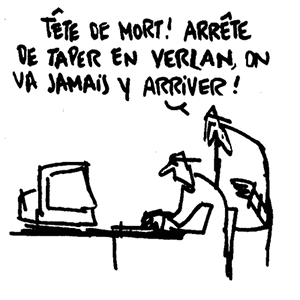
Verlan [veyr-lahn] is a French argot (secret language) featuring inversion of syllables in a word, and is common in slang and youth language. It rests on a long French tradition of transposing syllables of individual words to create slang words.
The name verlan is an example: it is derived from inverting the syllables in ‘l’envers’ [lan-ver](‘the inverse’). Different rules apply for one-syllable words, and words with more than one syllable may be verlanized in more than one way. For example, ‘cigarette’ may yield ‘garetsi’ or ‘retsiga.’
Continue reading →
Posted in Drugs, Language, Sex |
Leave a Comment »
March 27, 2012


Valspeak is a common name for an American sociolect (social dialect), originally of the San Fernando Valley in Southern California, in particular Valley girls. This stereotype, which originated in the 1970s, became an international fad for a certain period.
Many phrases and elements of Valleyspeak, along with surfer slang and skateboarding slang, are stable elements of the California English dialect lexicon, and in some cases wider American English (such as the use of ‘like’ as a hedge, a mitigating device used to lessen the impact of an utterance).
Continue reading →
Posted in Language, Money |
Leave a Comment »
March 27, 2012

The high rising terminal (HRT), also known as uptalk, upspeak, rising inflection, or high rising intonation, is a feature of some accents of English where statements have a rising intonation pattern in the final syllable or syllables of the utterance.
The origins of HRT remain uncertain. Geographically, anecdotal evidence places the conception of the American English variety on the West Coast – anywhere from Southern California to the Pacific Northwest. Others have suggested it originated in New Zealand, and it is unclear whether the American English varieties and the Oceanic varieties had any influence on each other regarding the spread of HRT.
Continue reading →
Posted in Language, World |
Leave a Comment »
March 27, 2012
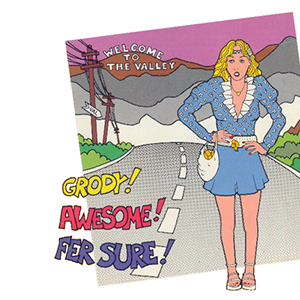
Valley Girl is a stereotype leveled at a socio-economic and ethnic class of American women who can be described as colloquial English-speaking and materialistic. Valspeak is also a form of this trait, based on an exaggerated version of ’80s California English.
The term originally referred to the ever increasing number of semi-affluent and affluent middle-class and upper-middle class girls living in the bedroom community neighborhoods of San Fernando Valley. Due to the Valley’s proximity to the Hollywood media machine, the demographic group which the term stereotyped garnered large exposure to the rest of the world.
Continue reading →
Posted in Language, Money |
Leave a Comment »
March 27, 2012

Vagina dentata is Latin for ‘toothed vagina.’ Various cultures have folk tales about women with toothed vaginas, frequently told as cautionary tales warning of the dangers of sex with strange women and to discourage the act of rape. Jung disciple Erich Neumann relays one such myth in which ‘a fish inhabits the vagina of the Terrible Mother; the hero is the man who overcomes the Terrible Mother, breaks the teeth out of her vagina, and so makes her into a woman.’ The legend also appears in the mythology of the Chaco and Guiana tribes.
In some versions, the hero leaves one tooth. An Ainu language (of Japan and Russia) tale containing this element was published as ‘The Island of Women’ by Basil Hall Chamberlain, where it was described as a well known Japanese tale by E. B. Tylor. In his book, ‘The Wimp Factor,’ Stephen J. Ducat expresses the view that these myths express the threat sexual intercourse poses for men who, although entering triumphantly, always leave diminished. The grain of truth in these stories is that dermoid cysts, which can occur anywhere in the body, often contain teeth. Although there are no documented sightings, it is theoretically possible for a tooth-containing dermoid cyst to develop in a woman’s vagina.
Posted in Politics, Sex, World |
Leave a Comment »
March 27, 2012

A vacuum bed is a device sometimes used in BDSM (bondage, domination, sadomasochism) play. A person is placed in a latex envelope spanned by a frame and a suction pump or floor vacuum removes most of the air in the envelope. The frame is often a simple rectangle of pierced PVC pipes, joined by PVC joints. There are several ways that the vacuum bed can be designed to facilitate breathing. The most common is a tube running from outside of the vacuum bed into the person’s mouth. A second option is a reinforced hole that is positioned so that the mouth protrudes. A third option is a reinforced gasket through which one forces the entire head. Incorporating a related fetish, some vacuum beds use a gas mask to facilitate respiration.
The vacuum bed is both a bondage and sensation device. The user is unable to move significantly (although some wiggling is possible), and is unable to speak or see, depending on the breathing hole used. In addition, though, the sensation of the vacuum bed itself, as well as any other play (stroking, percussion, vibrations) are quite pleasurable, and some are much more intense than what would be experienced without the vacuum bed. The vacuum bed must be used with the aid of another person, as the user cannot control the vacuum itself, nor escape the vacuum bed unaided.
Posted in Games, Money, Sex |
Leave a Comment »
March 27, 2012

Inkie is a London based painter and street artist, originally from Bristol. He is cited as being part of Bristol’s graffiti heritage, along with Banksy, 3D and Nick Walker. Inkie began working as part of Crime Incorporated Crew (CIC) in 1983, along with Felix and Joe Braun. He was one of many arrested in 1989 during ‘Operation Anderson,’ the UK’s largest ever graffiti bust. He arranged 1998’s ‘Walls On Fire’ event with Banksy, on the site of the future At-Bristol center.
He has subsequently worked in the video game industry, including some time as head of creative design at Sega, where his work featured in ‘Jet Set Radio.’ Inkie was one artist present to do live painting at the launch of Banksy’s book ‘Bristol: Home Sweet Home.’ Inkie has likened the time spent training as a graffiti artist to that of classical musicians.
Posted in Art, Games, World |
Leave a Comment »
March 27, 2012

BS 2000 is the name of a musical side project of Beastie Boys’ Adam ‘Adrock’ Horovitz and Amery ‘AWOL’ Smith also with tracks featuring Janay North. In 1997, BS 2000 released their vinyl-only self-titled debut.
BS 2000 later released a limited-edition vinyl/CD, ‘Buddy,’ in 2000 and ‘Simply Mortified’ on vinyl and CD in 2001. Their song ‘The Scrappy’ was featured on the American and European versions of the Xbox video game, ‘Jet Set Radio Future.’
Posted in Art |
Leave a Comment »
March 27, 2012

Jet Set Radio Future is a video game developed by Smilebit and the sequel to ‘Jet Set Radio’ (also known as ‘Jet Grind Radio’). It was published by Sega in 2002 in the US, near the beginning of the Xbox’s lifespan. Similar to the original, it depicts a future Tokyo where freedom of expression is outlawed. The user plays a character in the GG’s, a gang of in-line skating graffiti artists who skate around Tokyo covering up rival gangs’ graffiti, knocking over Rokkaku police, and dancing to the eclectic soundtrack.
The game uses a cel-shaded style of animation, and has been widely acclaimed for its unique music style, detailed art, and gameplay. The soundtrack introduces artists that are either foreign, not found mainstream, or work under gaming licenses such as Guitar Vader, BS 2000 (the side project of Adrock of the Beastie Boys), Hideki Naganuma, Scapegoat Wax, The Latch Brothers (including Mike D of the Beastie Boys, Richard Jacques, Chris ‘Wag’ Wagner and Kenny Tick Salcido), Cibo Matto, and The Prunes.
Posted in Art, Games, World |
Leave a Comment »
March 26, 2012


Librarian.net was founded in 1999 by Jessamyn Charity West (b. 1968), an American librarian and blogger. West characterizes librarian.net as generally ‘anti-censorship, pro-freedom of speech, pro-porn (for lack of a better way to explain that we don’t find the naked body shameful), antiglobalization, anti-outsourcing, anti-Dr. Laura, pro-freak, pro-social responsibility, and just generally pro-information and in favor of the profession getting a better image.’
‘Wired’ described her as ‘on the front lines in battling the USA PATRIOT Act,’ particularly the provisions that allow warrantless searches of library records. The act not only prohibits libraries from notifying the subjects of such searches, it prohibits them from disclosing to the public whether any such searches have been made. In protest, West created a number of notices that libraries can post which she suggests are ‘technically legal.’ One of them, for example, reads: ‘The FBI has not been here. Watch very closely for the removal of this sign.’ The Vermont Library Association provided copies of this sign to every public library in Vermont.
Posted in Language, Politics, War |
2 Comments »
March 26, 2012

John Lurie (b. 1952) is an American actor, musician, painter, director and producer. He is co-founder of The Lounge Lizards, a jazz ensemble. Lurie has acted in 19 films including ‘Stranger than Paradise’ and ‘Down by Law,’ composed and performed music for 20 television and film works, and he produced and starred in ‘Fishing with John,’ a 1991 television series.
In 1996 his soundtrack for ‘Get Shorty’ was nominated for a Grammy Award. For five years he appeared in the HBO television show ‘Oz.’ Suffering from chronic Lyme disease since 2000, Lurie refocused his attention on painting. His primitivist art works have shown in galleries around the world. His painting ‘Bear Surprise’ became an internet meme in Russia in 2006.
Continue reading →
Posted in Art |
Leave a Comment »
March 26, 2012

Fishing with John is a 1991 television series conceived, directed by and starring actor and musician John Lurie, which earned a cult following. On the surface, the series resembles a standard travel or fishing show: in each episode, Lurie takes a famous guest on a fishing expedition.
Since Lurie has no expert knowledge of fishing, the interest is in the interaction between Lurie and his guests, all of whom are his friends. Nothing particularly unusual actually happens, but the show is edited and narrated in a way to suggest that Lurie and his guest are involved in dramatic and even supernatural adventures. Guests included Jim Jarmusch, Matt Dillon, Tom Waits, Willem Dafoe, and Dennis Hopper. Each episode has voice-over narration by Robb Webb, which is sometimes bizarre and off-topic. The soundtrack is by Lurie, with several guest performers.
Posted in Food, Games, Humor |
1 Comment »