January 6, 2012

The Latin maxim ignoramus et ignorabimus, meaning ‘we do not know and will not know,’ stood for a position on the limits of scientific knowledge, in the thought of the nineteenth century. It was given credibility by Emil du Bois-Reymond, a German physiologist, in his book ‘On the limits of our understanding of nature,’ published in 1872.
In 1930, mathematician David Hilbert pronounced his disagreement with the maxim in a celebrated address to the Society of German Scientists and Physicians: ‘We must not believe those, who today, with philosophical bearing and deliberative tone, prophesy the fall of culture and accept the ignorabimus. For us there is no ignorabimus, and in my opinion none whatever in natural science. In opposition to the foolish ignorabimus our slogan shall be: Wir müssen wissen — wir werden wissen! (‘We must know — we will know!’).’ Continue reading →
Posted in Education, Philosophy, Science |
1 Comment »
January 6, 2012

Sapere [sap-er-reh] aude [ow-day] is a Latin phrase meaning ‘dare to be wise,’ or more precisely ‘dare to know.’ Originally used by Horace, it is a common motto for universities and other institutions, after becoming closely associated with The Enlightenment by Immanuel Kant in his seminal essay, ‘What is Enlightenment?’
Kant claimed it was the motto for the entire period, and used it to explore his theories of reason in the public sphere. Later, Michel Foucault took up Kant’s formulation in an attempt for a place for the individual in his post-structuralist philosophy and come to terms with the problematic legacy of the Enlightenment.
Continue reading →
Posted in Education, Philosophy, Science |
Leave a Comment »
January 5, 2012


Emergent gameplay refers to complex situations in video games, board games, or role-playing games that emerge from the interaction of relatively simple game mechanics. More recently game designers have attempted to encourage emergent play by providing tools to players such as placing web browsers within the game engine, providing programming languages, and fixing exchange rates.
These cases constitute intentional emergence, where creative uses of the game are intended by the designers. Since the 1970s and 1980s board games and table top role playing games such as ‘Dungeons & Dragons’ have featured intentional emergence as a primary game function by supplying players with relatively simple rules or frameworks for play that intentionally encourage them to explore creative strategies or interactions and exploit them toward victory or goal achievement. Continue reading →
Posted in Games, Money, Technology |
Leave a Comment »
January 5, 2012
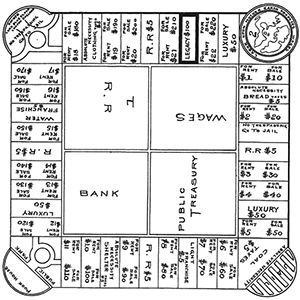
The Landlord’s Game is a board game patented in 1904 by Elizabeth Magie. It is a realty and taxation game, which is considered to be a direct inspiration for the board game ‘Monopoly.’
Though many similar home-made games were played at the beginning of the 20th century, it is the first of its kind to have an attested patent. Magie designed the game to be a ‘practical demonstration of the present system of land grabbing with all its usual outcomes and consequences.’ Continue reading →
Posted in Games, Money, Politics |
Leave a Comment »
January 5, 2012

Wardrobing [wawr-droh-bing] is the practice of purchasing an item, using it, and then returning it to the store for a refund. It is most often done with expensive clothing – hence the name – but the practice is also common with tools, electronics, and even computers.
Perhaps one of the most notorious examples of wardrobing comes from the film ‘My Date With Drew,’ which was filmed entirely on a wardrobed video camera. The filmmaker purchased the camera from Circuit City, used it for 30 days to film his movie, and then returned the camera for a full refund.
Posted in Money, Politics |
Leave a Comment »
January 5, 2012
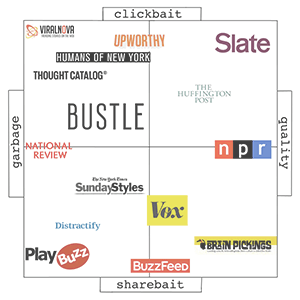
Betteridge’s Law of Headlines is an adage that states, ‘Any headline which ends in a question mark can be answered by the word ‘no.” It is based on a point made by journalist Ian Betteridge about sensational headlines that end in a question mark: ‘The reason why journalists use that style of headline is that they know the story is probably bullshit, and don’t actually have the sources and facts to back it up, but still want to run it.’ The maxim trends towards being universally true because of a simple principle of headline writing: if a story has enough sources to have a high chance of accuracy, a headline will be assertive. If sources are weak, or only a single source is found, headline writers will hedge their bets by posing the headline as a question.
It was among UK journalist Andrew Marr’s suggestions for how to read a newspaper if you really want to know what is going on: ‘If the headline asks a question, try answering ‘no.’ Is This the True Face of Britain’s Young? (Sensible reader: No.) Have We Found the Cure for AIDS? (No; or you wouldn’t have put the question mark in.) Does This Map Provide the Key for Peace? (Probably not.) A headline with a question mark at the end means, in the vast majority of cases, that the story is tendentious or over-sold. It is often a scare story, or an attempt to elevate some run-of-the-mill piece of reporting into a national controversy and, preferably, a national panic. To a busy journalist hunting for real information a question mark means ‘don’t bother reading this bit.”
Posted in Humor, Language, Money |
Leave a Comment »
January 4, 2012

Harold Williams (1876 – 1928) was a New Zealand journalist, foreign editor of ‘The Times’ and is considered one of the most accomplished polyglots in history, said to have known over 58 languages and other related dialects. Like most youngsters his age, Harold wasn’t possessed by a voracious appetite for learning, but he recalled that, when he was about seven, ‘an explosion in his brain’ occurred and from that time his capacity to learn, in particular languages, grew to an extraordinary degree. He began with the study of Latin, one of the great root languages, and hungrily acquired others.
As a schoolboy he constructed a grammar and vocabulary of the New Guinea language Dobuan from a copy of St. Mark’s Gospel written in that language. Next he compiled a vocabulary of the dialect of Niue Island, again from the Gospel written in that language, and was published in the ‘Polynesian Journal.’ Continue reading →
Posted in Language, Politics, World |
Leave a Comment »
January 4, 2012
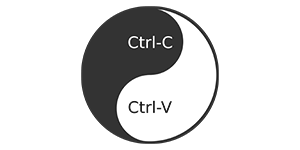

The Missionary Church of Kopimism is a congregation of file sharers which hold that copying information as a sacred virtue. The sect, which is based in Sweden, is petitioning the Swedish government to have their church officially recognized as a religion.
The sect’s followers are called Kopomists from ‘copy me.’ According to the church, ‘In our belief, communication is sacred.’
Posted in Humor, Money, Philosophy |
Leave a Comment »
January 4, 2012

Fatima Al Qadiri (b. 1981) is music producer born in Senegal and raised in Kuwait during the Gulf War, who now resides in Brooklyn.
She previously released an EP under the name Ayshay, featuring spectral chanting of traditional Islamic songs in Arabic.
Posted in Art |
Leave a Comment »
January 4, 2012


The OP-1 is a synthesizer, sampler, and sequencer designed and manufactured by the Stockholm-based company Teenage Engineering. The OP-1 is Teenage Engineering’s first product; it was released in 2011. The OP-1 is well known for its unconventional design, OLED display, and eight synthesizer engines. It has received some criticism for its physical limitations; however, according to Teenage Engineering cofounder Jesper Kouthoofd, these limitations were programmed into the synthesizer in order to stimulate the design process and the creativity of the user.
The design of the OP-1 was influenced by the VL-Tone, a synthesizer and pocket calculator manufactured by Casio in 1980 that is known for its toy-like novelty sounds and cheap build quality, as well as its inorganic design. In an interview with Damian Kulash of OK Go, Kouthoofd explained that he worked in a music store when he was young, and he was inspired by Japanese synthesizers of the 1980s. He has also stated that ‘limitations are OP-1’s biggest feature.’ The synthesizer’s designers attempted to use the limitation of physical hardware to encourage the unit to stimulate creativity, which might become unfocused in a limitless environment, such as a digital audio workstation.
Posted in Art, Money, Technology |
Leave a Comment »
January 3, 2012

Trip sitter is a term used by recreational or spiritual drug users to describe a person who remains sober to ensure the safety of the drug user while he or she is under the influence of a drug; they are especially common with first-time experiences or when using psychedelics, dissociatives, and deliriants. This practice can be qualified as a means of harm reduction. Also called a Psychedelic Guide, this latter term is more often used to describe someone who takes an active role in shaping a drug user’s experiences as opposed to a sitter who merely remains present, ready to discourage bad trips and handle emergencies, but not otherwise uninvolved. Guides are more common among spiritual users of entheogens and were strongly encouraged by psychedelic researcher Timothy Leary.
Although an ideal sitter is one who is both personally experienced with the substance being used, as well as trained to deal with psychological or medical issues that may arise, arguably the most important qualities may be the willingness to help, the discipline to stay sober enough to be fully present, and the ability to be relaxed, accepting, and not interfere with the experience beyond the wishes of the user. When using a short-acting substance such as smoked DMT or Salvia divinorum, it may be possible for two people to take turns, with one being the sitter while the other takes the psychedelic.
Posted in Drugs, Health |
1 Comment »
January 3, 2012

Set and setting describes the context for psychedelic drug experiences: one’s mindset and the setting in which the user has the experience. The term was coined by Timothy Leary, and became widely accepted by researchers in psychedelic psychotherapy.
‘Set’ is the mental state a person brings to the experience, like thoughts, mood and expectations. ‘Setting’ is the physical and social environment. Social support networks have shown to be particularly important in the outcome of the psychedelic experience. They are able to control or guide the course of the experience, both consciously and subconsciously. Stress, fear, or a disagreeable environment, may result in an unpleasant experience (bad trip). Conversely, a relaxed, curious person in a warm, comfortable and safe place is more likely to have a pleasant experience. Continue reading →
Posted in Drugs, Health |
1 Comment »