January 3, 2012
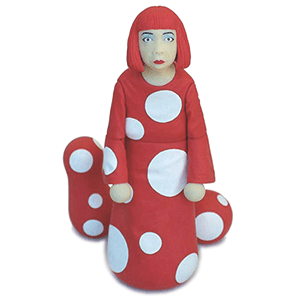
Yayoi [yah-yoy] Kusama [koo-sah-muh] (b. 1929) is a Japanese artist whose paintings, collages, soft sculptures, performance art and environmental installations all share an obsession with repetition, pattern, and accumulation (she has described herself as an ‘obsessive artist’). Kusama’s work is based in Conceptual art (in which the concepts or ideas involved in the work take precedence over traditional aesthetic and material concerns) and shows some attributes of feminism, minimalism, surrealism, Art Brut, pop art, and abstract expressionism, and is infused with autobiographical, psychological, and sexual content.
Kusama is also a published novelist and poet, and has created notable work in film and fashion design. She has long struggled with mental illness, and has experienced hallucinations and severe obsessive thoughts since childhood, often of a suicidal nature. She claims that as a small child she suffered physical abuse by her mother. In 2008, a work by her sold for $5.1 million, a record for a living female artist.
Continue reading →
Posted in Art, Health, Money |
1 Comment »
January 3, 2012
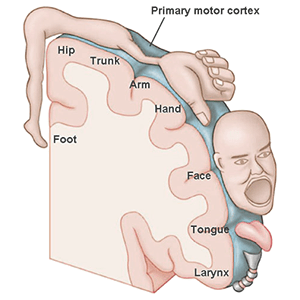
A cortical [kawr-ti-kuhl] homunculus [huh-muhng-kyuh-luhs] is a pictorial representation of the size of the brain areas for various parts of human anatomy. It is a visual representation of the concept of ‘the body within the brain’ that one’s hand or face exists as much as a series of nerve structures or a ‘neuron concept’ as it does a physical form. This concept relates to many neuro-biological phenomena including ‘phantom limb’ and ‘body integrity identity disorder’ (a psychological disorder wherein sufferers feel they would be happier living as an amputee).
There are two types of homunculus: sensory and motor. Each one shows a representation of how much of its respective cortex innervates certain body parts. The reason for the bizarre, distorted appearance of the homunculus is that the amount of cerebral tissue or cortex devoted to a given body region is proportional to how richly innervated and sensitive, or the number of muscles and motor units within that region is, not to its size. The resulting image is a grotesquely disfigured human with disproportionately huge hands, lips, and face in comparison to the rest of the body.
Posted in Health, Science |
Leave a Comment »
January 2, 2012
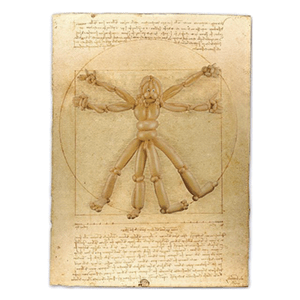
Balloon modelling is the shaping of special modelling balloons into almost any given shape, often a balloon animal. People who create balloon animals and other twisted balloon sculptures are called Twisters, Balloon Benders and Balloon Artists. Twisters often perform in restaurants, at birthday parties, fairs and at public and private events or functions. Two of the primary design styles are single balloon modelling, which restricts itself to the use of one balloon per model, and multiple balloon modelling, which uses more than one balloon.
Each style has its own set of challenges and skills, but few twisters who have reached an intermediate or advanced skill level limit themselves to one style or another. Depending on the needs of the moment, they might easily move between the one-balloon or multiple approaches, or they might even incorporate additional techniques such as ‘weaving’ and ‘stuffing.’ Modelling techniques have evolved to include a range of very complex moves, and a highly specialized vocabulary has emerged to describe the techniques involved and their resulting creations.
Posted in Art, Humor |
Leave a Comment »
January 2, 2012
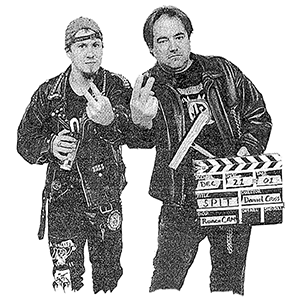
A squeegee [skwee-jee] man is a person who, washcloth and squeegee in hand, wipes windshields of cars stopped in traffic and then solicits money from drivers. While squeegee men are a feature of life in many cities around the world, the phenomenon first became prevalent in New York City in the 1980s.
Although some merely provided a service, in other cases the windshield-washing would be carried out without asking, often perfunctorily, and with subsequent demands for payment, sometimes with added threats of smashing the car’s windshield if their demands were not met. Upon his election, mayor Rudy Giuliani famously embarked on a crusade against squeegee men as part of his quality-of-life campaign, claiming that their near-ubiquitous presence created an environment of disorder that encouraged more serious crime to flourish.
Posted in Money, Politics, World |
Leave a Comment »
January 2, 2012
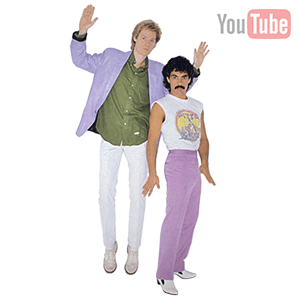
‘I Can’t Go for That (No Can Do)‘ is a 1981 song recorded by Daryl Hall and John Oates. It was the fourth number-one hit single of their career and second hit single from their album ‘Private Eyes.’ It features Charles DeChant on saxello. Daryl Hall sketched out the basic song one evening at a music studio in New York City in 1981 after a recording session for the ‘Private Eyes’ album. Hall began to play a bass line on a Korg organ, and sound engineer Neil Kernon recorded the result. Hall then came up with a guitar riff, which he and Oates worked on together. The next day, Hall and Sara Allen worked on the lyrics.
Thanks to heavy airplay on urban contemporary radio stations, it topped the U.S. R&B chart, a rare feat for a non-African American act. According to the Hall and Oates biography, Hall, upon learning that it had gone to number one wrote in his diary, ‘I’m the head soul brother in the U.S. Where to now?’ Also according to Hall, during the recording of ‘We Are the World,’ Jackson approached him and admitted to lifting the bass line for ‘Billie Jean’ from ‘I Can’t Go For That (No Can Do).’ Hall says that he told Jackson that he had lifted the bass line from another song himself, and that it was ‘something we all do.’
Posted in Art |
Leave a Comment »
January 2, 2012
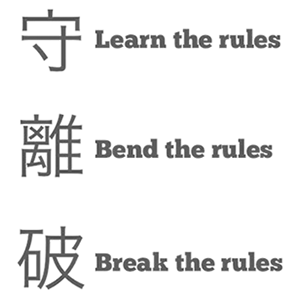
Shuhari is a Japanese martial art concept, and describes the stages of learning to mastery. It is sometimes applied to other Japanese disciplines, such as the board game Go. Shuhari roughly translates to ‘first learn, then detach, and finally transcend.
The Shuhari concept was first presented by Fuhaku Kawakami as Jo-ha-kyū in ‘Tao of Tea.’ Then, Zeami Motokiyo, the master of Noh plays, extended this concept to his dance as Shuhari, which then became a part of the philosophy of Aikido.
Posted in War, World |
Leave a Comment »
January 2, 2012

Jo-ha-kyū is a concept of modulation and movement applied in a wide variety of traditional Japanese arts. Roughly translated to ‘beginning, break, rapid,’ it essentially means that all actions or efforts should begin slowly, speed up, and then end swiftly. This concept is applied to elements of the Japanese tea ceremony, kendō and other martial arts, dramatic structure in Japanese theater and film, and traditional collaborative linked verse forms. The concept originated in court music, specifically in the ways in which elements of the music could be distinguished and described. Though eventually incorporated into a number of disciplines, it was most famously adapted, and thoroughly analyzed and discussed by the great playwright Zeami, who viewed it as a universal concept applying to the patterns of movement of all things.
Zeami described the first act as ‘Love’; the play opens auspiciously, using gentle themes and pleasant music to draw in the attention of the audience. The second act is described as ‘Warriors and Battles.’ Though it need not contain actual battle, it is generally typified by heightened tempo and intensity of plot. The third act, the climax of the entire play, is typified by pathos and tragedy. The plot achieves its dramatic climax. The fourth is a michiyuki (journey), which eases out of the intense drama of the climactic act, and often consists primarily of song and dance rather than dialogue and plot. The fifth act, then, is a rapid conclusion. All loose ends are tied up, and the play returns to an auspicious setting.
Posted in Art, Language, World |
Leave a Comment »
January 2, 2012
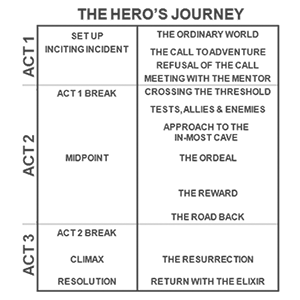
The Three-Act Structure is a model used in writing and evaluating modern storytelling which divides a screenplay into a three parts called the ‘Setup,’ ‘Confrontation,’ and ‘Resolution.’ The first act is used to establish the main characters, their relationships and the normal world they live in.
Early in the first act, a dynamic, on-screen incident occurs to the main character (the protagonist), whose response leads to a second and more dramatic situation, known as the first ‘turning point,’ which (a) signals the end of the first act, (b) ensures life will never be the same again for the protagonist, and (c) raises a dramatic question that will be answered in the climax of the film. Continue reading →
Posted in Art, Language |
Leave a Comment »
January 2, 2012
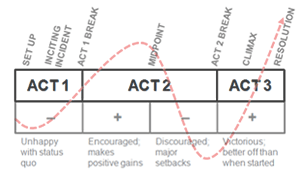
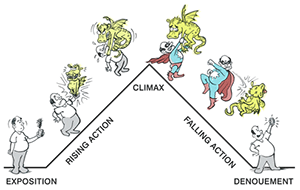
Act structure explains how a plot of a film story is composed. Just like plays (Staged drama) have ‘Acts,’ critics and screenwriters tend to divide films into acts; though films don’t require to be physically broken down as such in reality.
Whereas plays are actual performances that need ‘breaks’ in the middle for change of set, costume, or for the artists’ rest; films are recorded performances shown mechanically and therefore don’t need actual breaks. Still they are divided into acts for reasons that are in aesthetic and structural conformation with the original idea of Act in theater. Continue reading →
Posted in Art, Language, Money |
Leave a Comment »
January 2, 2012

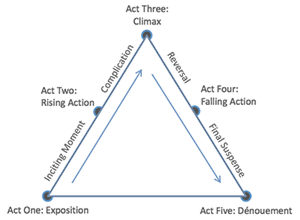
Dramatic structure is the structure of a dramatic work such as a play or film. Many scholars have analyzed dramatic structure, beginning with Aristotle in his ‘Poetics’ (c. 335 BCE). In ‘Poetics,’ Aristotle put forth the idea that ‘A whole is what has a beginning and middle and end.’ This three-part view of a plot structure (with a beginning, middle, and end – technically, the protasis, epitasis, and catastrophe) prevailed until the Roman drama critic Horace advocated a 5-act structure in his ‘Ars Poetica.’ After falling into disuse, renaissance dramatists revived the use of the 5-act structure.
Gustav Freytag’s analysis of ancient Greek and Shakespearean drama is canonical. Although Freytag’s description of dramatic structure is based on five-act plays, it can be applied (sometimes in a modified manner) to short stories and novels as well. Nonetheless it does not always translate well, especially in modern plays such as Alfred Uhry’s ‘Driving Miss Daisy,’ which is actually divided into 25 scenes without concrete acts.
Continue reading →
Posted in Art, Language |
Leave a Comment »
January 2, 2012
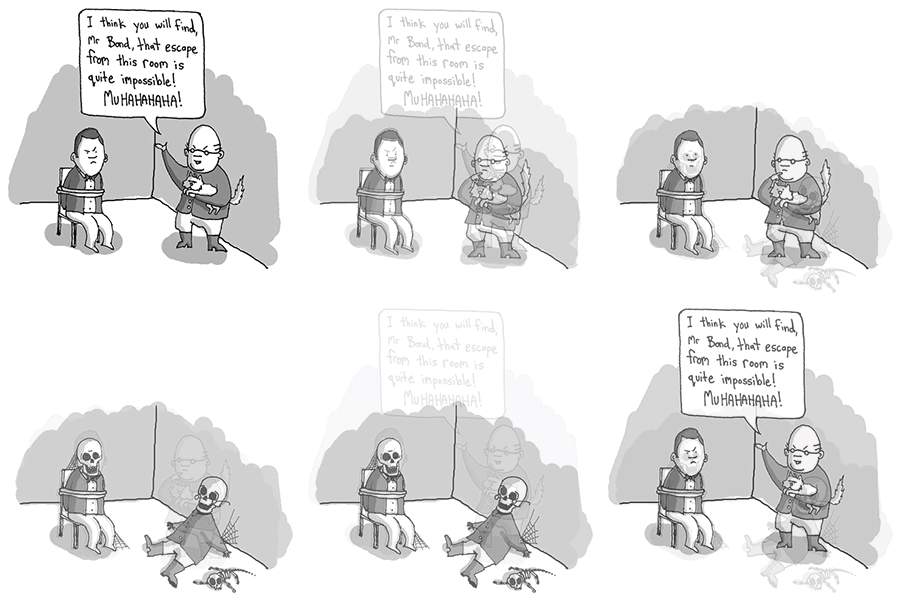
A deathtrap is a literary and dramatic plot device in which a villain, who has captured the hero or another sympathetic character, attempts to use an elaborate and usually sadistic method of murdering him/her. It is often used as a means to create dramatic tension in the story and to have the villain reveal important information to the hero, confident that the hero will shortly not be able to use it. It may also be a means to show the hero’s resourcefulness in escaping, or the writer’s ingenuity at devising a last-minute rescue or deus ex machina.
This plot device is generally believed to have been popularized by movie serials and 19th century theatrical melodramas. A well known example is the cliché of the moustache-twirling villain leaving the heroine tied to railroad tracks. Its use in the James Bond film series and superhero stories is well known.
Continue reading →
Posted in Death, Humor, Language |
1 Comment »
January 2, 2012
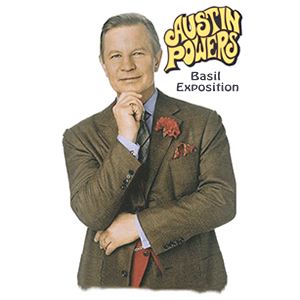
When the presentation of information in fiction becomes wordy, it is sometimes referred to as an ‘information dump.’ It is expressed by characters in dialogue or monologue and sometimes referred to as ‘idiot lectures.’ They are sometimes placed at the beginning of stories as a means of establishing the premise of the plot.
They also appear in science fiction, but it is considered poor writing when characters explain things to each other that they would already know. For example, if you need to call someone, you don’t stop to explain to a colleague that you are now going to use a device controlled with digital circuits to use radio waves to transmit your voice. Why? Because your contemporaries already know how cellular radio telephones work. Continue reading →
Posted in Art, Humor, Language |
Leave a Comment »