December 20, 2011


‘Monkey Tennis‘ is a British pop culture phrase, first used in the late 1990s and popular throughout the 2000s. Originating as a joke in a television sitcom, it has come to be commonly used as an example of the hypothetical lowest common denominator television program that it is possible to make.
The term originates from the opening episode of the sitcom ‘I’m Alan Partridge,’ originally broadcast on BBC Two in 1997. In one scene the eponymous character of Partridge, a failed chat show host, desperately attempts to pitch program ideas to uninterested BBC executive who cancelled his first series. After failing to interest him in ideas plucked from thin air such as ‘Arm Wrestling With Chas & Dave,’ ‘Youth Hostelling with Chris Eubank,’ ‘Inner-City Sumo’ and ‘Cooking in Prison,’ Partridge comes up with a final spur-of-the-moment suggestion, ‘Monkey Tennis?,’ which is met with similar disdain.
Posted in Art, Humor, Money |
Leave a Comment »
December 20, 2011

Space opera is a subgenre of science fiction that emphasizes romantic, often melodramatic adventure, set mainly or entirely in outer space, generally involving conflict between opponents possessing advanced technologies and abilities. The term has no relation to music and it is analogous to ‘soap opera.’ Perhaps the most significant trait of space opera is that settings, characters, battles, powers, and themes tend to be very large-scale.
Sometimes the term is used pejoratively to denote bad quality science fiction, but its meaning can differ, often describing a particular science fiction genre without any value judgement. The genre’s varying definitions were affected by literary politics, ‘what used to be science fantasy is now space opera, and what used to be space opera is entirely forgotten.’ Continue reading →
Posted in Art, Language, Technology |
Leave a Comment »
December 20, 2011

A horse opera, or hoss opera, is a western movie or television series that is extremely clichéd or formulaic (in the manner of a soap opera). The term, which was originally coined by silent film-era Western star William S. Hart, is used variously to convey either disparagement or affection.
The name “horse opera” was also derived in part from the musical sequences frequently featured in these films and TV series which depicted a cowboy singing to his horse on-screen. The term “horse opera” is quite loosely defined; it does not specify a distinct sub-genre of the western (as “space opera” does with regard to the science fiction genre).
Posted in Art, Money |
Leave a Comment »
December 20, 2011
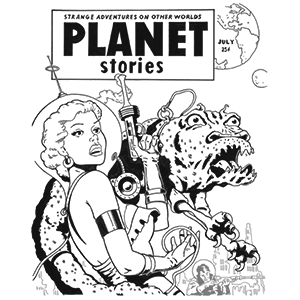
Planetary romance is a type of science fiction or science fantasy story in which the bulk of the action consists of adventures on one or more exotic alien planets, characterized by distinctive physical and cultural backgrounds. Some planetary romances take place against the background of a future culture where travel between worlds by spaceship is commonplace; others, particularly the earliest examples of the genre, do not, and invoke flying carpets, astral projection, or other methods of getting between planets. In either case, it is the planetside adventures which are the focus of the story, not the mode of travel.
As the name of the genre suggests, the planetary romance is an extension of late 19th and early 20th century adventure novels and pulp romances to a planetary setting. The pulp romance (of writers like H. Rider Haggard and Talbot Mundy) featured bold characters in exotic settings and ‘lost worlds’ such as South America, Africa, the Middle or Far East; a variant type took place in real or fictional countries of ancient and medieval times, and eventually contributed to the modern fantasy genre. Continue reading →
Posted in Art, Language, Love |
Leave a Comment »
December 20, 2011
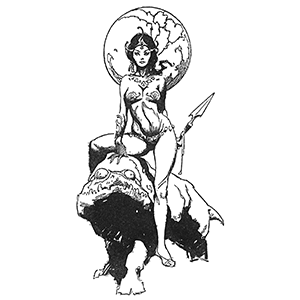
Sword and Planet is a subgenre of science fantasy that features rousing adventure stories set on other planets, and usually featuring Earthmen as protagonists. The name derives from the heroes of the genre engaging their adversaries in hand to hand combat primarily with simple melee weapons such as swords, even in a setting that often has advanced technology.
Though there are works that herald the genre such as Percy Greg’s ‘Across The Zodiac’ (1880) and Edwin Lester Arnold’s ‘Lieutenant Gullivar Jones: His Vacation’ (1905; published in the US in 1964 as ‘Gulliver of Mars’), the prototype for the genre is ‘A Princess of Mars’ by Edgar Rice Burroughs originally serialized by ‘All-Story’ in 1912. Continue reading →
Posted in Art, Language |
Leave a Comment »
December 19, 2011

Barsoom is a fictional representation of the planet Mars created by American pulp fiction author Edgar Rice Burroughs, who wrote close to 100 action adventure stories in various genres in the first half of the 20th century, and is now best known as the creator of the character Tarzan. The first Barsoom tale was serialized as ‘Under the Moons of Mars’ in 1912, and published as a novel as ‘A Princess of Mars’ in 1917. Ten sequels followed over the next three decades, further extending his vision of Barsoom and adding other characters.
The world of Barsoom is a romantic vision of a dying Mars, based on now-outdated scientific ideas made popular by Astronomer Percival Lowell in the early 20th century. While depicting many outlandish inventions, and advanced technology, it is a savage world, of honor, noble sacrifice and constant struggle, where martial prowess is paramount, and where many races fight over dwindling resources. It is filled with lost cities, heroic adventures and forgotten ancient secrets.
Continue reading →
Posted in Art, Language |
Leave a Comment »
December 19, 2011
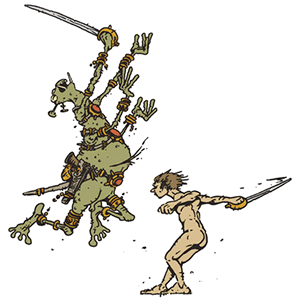
John Carter is a fictional character, created by Edgar Rice Burroughs, who appears in the ‘Barsoom’ novels. Although he is actually a Virginian from Earth and only a visitor to Mars, he is sometimes known as ‘John Carter of Mars,’ in reference to the setting in which his major deeds are recorded, in the tradition of other real-world heroes such as Lawrence of Arabia and Scipio Africanus. His character is enduring, having appeared in various media since his 1912 debut in a magazine serial.
John Carter first appeared in ‘A Princess of Mars,’ the first Burroughs novel set on a fictionalized version of Mars known as ‘Barsoom.’ His character and courtesy exemplify the ideals of the antebellum South. A Virginian, he served as a captain in the American Civil War on the side of the Confederacy. While hiding from Apaches in a cave, he appears to die; leaving his inanimate body behind, he is mysteriously transported by a form of astral projection to the planet Mars, where he finds himself re-embodied in a form identical to his earthly one. Accustomed to the greater gravity of Earth, he is much stronger and more agile than the natives of Mars due to its gravity.
Posted in Art, Language |
3 Comments »
December 19, 2011
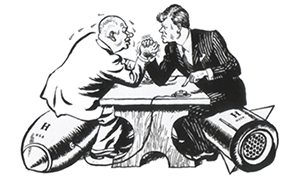

The game of chicken, also known as the hawk-dove or snowdrift game, is an influential model of conflict for two players in game theory. The principle of the game is that while each player prefers not to yield to the other, the worst possible outcome occurs when both players do not yield.
The name ‘chicken’ has its origins in a game in which two drivers drive towards each other on a collision course: one must swerve, or both may die in the crash, but if one driver swerves and the other does not, the one who swerved will be called a ‘chicken,’ meaning a coward; this terminology is most prevalent in political science and economics. Continue reading →
Posted in Games, Politics, Science |
Leave a Comment »
December 19, 2011

A nazar is an eye-shaped amulet believed to protect against the evil eye. In Central Asia, during the ages of Tengrism (a shamanistic religion of that region), people held similar superstitions like horseshoes, garlic, wolf’s tooth, dried thorn, lead, stones; but the crystal blue eye has always been the most popular one.
It is common in Turkey, Armenia, Iran, Greece, Cyprus and Azerbaijan. In Turkey, the nazar is often hung in homes, offices, cars, children’s clothing, or incorporated in jewelry. A typical nazar is made of handmade glass featuring concentric circles or teardrop shapes in dark blue, white, light blue and black, occasionally with a yellow/gold edge.
Posted in Philosophy |
Leave a Comment »
December 19, 2011

Taubman Sucks is an award-winning short documentary about a precedent-setting intellectual property lawsuit. The documentary was written and directed by filmmaker Theo Lipfert. The six-minute film explores Taubman v. WebFeats, a lawsuit that involved the complex relationships between domain names, trademarks, and free speech.
As the first ‘sucks.com’ case to reach the level of the United States Court of Appeals, the decision in Taubman v. WebFeats established precedents concerning the non-commercial use of trademarks in domain names.
Posted in Money, Politics, Technology |
Leave a Comment »
December 19, 2011

Article spinning is a search engine optimization technique by which blog or website owners post a unique version of relevant content on their sites by rewriting and replacing elements to provide a slightly different perspective on the topic. Many article marketers believe that article spinning helps avoid the feared penalties in the Search Engine Results pages (SERP) for using duplicate content. If the original articles are plagiarized from other websites or if the original article was used without the copyright owner’s permission, such copyright infringements may result in the writer facing a legal challenge, while writers producing multiple versions of their own original writing need not worry about such things.
Website owners may pay writers to perform spinning manually, rewriting all or parts of articles. Writers also spin their own articles, manually or automatically, allowing them to sell the same articles with slight variations to a number of clients or to use the article for multiple purposes (e.g. content and marketing). There are also a number of software applications which will automatically replace words or phrases in articles.
Posted in Money, Politics, Technology |
Leave a Comment »
December 19, 2011


In computing, spamdexing (also known as search spam or Search Engine Poisoning) is the deliberate manipulation of search engine indexes. The earliest known reference to the term is by Eric Convey in 1996 in an article, ‘Porn sneaks way back on Web,’ for ‘The Boston Herald.’ It involves a number of methods, such as repeating unrelated phrases, to manipulate the relevance or prominence of resources indexed in a manner inconsistent with the purpose of the indexing system.
Common spamdexing techniques can be classified into two broad classes: content spam (or term spam) and link spam. Content spam methods include keyword stuffing, hidden or invisible text, meta-tag stuffing, doorway pages, scraper sites, and article spinning. Link spamming methods include link farms, hidden links, Sybil attacks, spam blogs, page hijacking, buying lapsed domains (cybersquatting), and cookie stuffing. Continue reading →
Posted in Money, Technology |
Leave a Comment »



