December 20, 2011

Nettime is an internet mailing list that was founded in 1995 during the second meeting of the Medien Zentral Kommittee at the Venice Biennale. Founded by Geert Lovink and Pit Schultz, the list was meant to provide a space for a new form of critical discourse on and with the nets. Since 1995, Nettime has been recognized for building up the discourse of Netzkritik or Net Critique, providing a backdrop and context for the emergence of net.art and influencing critical net culture in general.
Often understood as a European ‘online salon,’ Nettime was initially a pre-publishing platform for international critical thinkers. Originally a mainly English language mailing list, other lists have been created for other languages. While the subscribers have changed over time, the list and lists have had the regular participation of such notable figures as: American poet John Perry Barlow, political writer Hakim Bey, art professor Ricardo Dominquez, Russian artist Alexei Shulgin, and DJ Spooky, among others. The lists has around 3500 subscribers.
Posted in Language, Politics, Technology |
Leave a Comment »
December 20, 2011
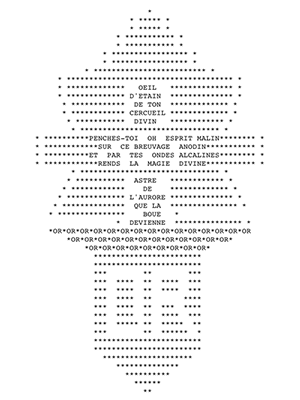
Internet art (often referred to as net art) is a form of digital artwork distributed via the Internet. Artists working in this manner are sometimes referred to as net artists. Internet art can happen outside the technical structure of the Internet, such as when artists use specific social or cultural Internet traditions in a project outside of it. Internet art is often—but not always—interactive, participatory, and multimedia-based. Internet art can be used to spread a message, either political or social, using human interactions.
The term Internet art typically does not refer to art that has been simply digitized and uploaded to be viewable over the Internet. Rather, this genre relies intrinsically on the Internet to exist, taking advantage of such aspects as an interactive interface and connectivity to multiple social and economic cultures and micro-cultures. Theoriest and curator Jon Ippolito defines it as distinct from commercial web design, and touching on issues of permanence, archivability, and collecting in a fluid medium.
Continue reading →
Posted in Art, Technology |
Leave a Comment »
December 20, 2011

Tradigital art most commonly refers to art (including animation) that combines both traditional and computer-based techniques to implicate an image.
Artist and teacher Judith Moncrieff first coined the term in the early 1990s, while an instructor at the Pacific Northwest College of Art. The school held a competition of Moncrieff’s students, who used the medium to electronically combine everything from photographs of costumes to stills from videotapes of performing dancers. Continue reading →
Posted in Art, Language, Technology |
Leave a Comment »
December 20, 2011

Bulletism is an artistic process that involves shooting ink at a blank piece of paper. The result is a type of ink blot. The artist can then develop images based on what is seen.
Salvador Dalí claimed to have invented this technique. Leonardo da Vinci, however, suggested that ‘just as one can hear any desired syllable in the sound of a bell, so one can see any desired figure in the shape formed by throwing a sponge with ink against the wall.’
Posted in Art, Language |
1 Comment »
December 20, 2011

‘Series of tubes‘ is a phrase coined originally as an analogy by then Senator Ted Stevens (R-Alaska) to describe the Internet in the context of opposing network neutrality.
In 2006, he used this metaphor to criticize a proposed amendment to a committee bill that would have prohibited Internet service providers such as AT&T and Verizon Communications from charging fees to give some companies higher priority access to their networks or their customers. This metaphor has been widely ridiculed as demonstrating Stevens’s poor understanding of the Internet, despite the fact that he was in charge of regulating it. Continue reading →
Posted in Humor, Politics, Technology |
1 Comment »
December 20, 2011

Ram Dass (b. 1931) is an American contemporary spiritual teacher, originally named Richard Alpert, and the author of the seminal 1971 book ‘Be Here Now.’
He is known for his personal and professional associations with Timothy Leary at Harvard University in the early 1960s, for his travels to India and his relationship with the Hindu guru Neem Karoli Baba, and for founding the charitable organizations Seva Foundation and Hanuman Foundation.
Continue reading →
Posted in Drugs, Language, Philosophy |
Leave a Comment »
December 20, 2011

Be Here Now is a seminal 1971 book on spirituality, yoga and meditation by the Western born yogi and spiritual teacher Ram Dass. The title comes from a statement his guide, Bhagavan Das, made during Ram Dass’s journeys in India. The cover features a Mandala incorporating the title, a chair, radial lines, and the word ‘remember.’
It is one of the first guides, for those not born as Hindus, to becoming a yogi, by a person himself not born a Hindu. For its influence on the Hippie movement and subsequent spiritual movements, it has been described as a ‘countercultural bible.’ In addition to introducing its title phrase into common use, the book has influenced numerous other writers and yoga practitioners, including Wayne Dyer and Michael Crichton.
Continue reading →
Posted in Language, Philosophy |
1 Comment »
December 20, 2011
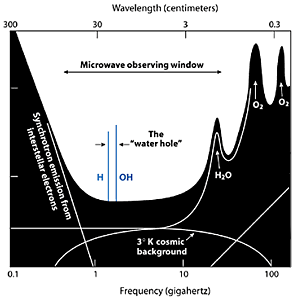
The waterhole refers to an especially quiet band of the electromagnetic spectrum between 1,420 and 1,666 megahertz, corresponding to wavelengths of 21 and 18 centimeters respectively. The term was coined by American scientist Bernard Oliver. The strongest hydroxyl radical spectral line radiates at 18 centimeters, and hydrogen at 21 centimeters. These two combined form water, and water is currently thought to be essential to extraterrestrial life advanced enough to generate radio signals.
Bernard M. Oliver theorized that the waterhole would be a good, obvious band for communication with extraterrestrial intelligence, hence the pun, in English a watering hole is a vernacular reference to a common place to meet and talk. Several programs involved in the search for extraterrestrial intelligence, including SETI@home, search in the waterhole.
Posted in Science, Technology |
Leave a Comment »
December 20, 2011
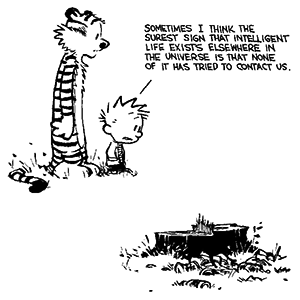
The Great Filter, in the context of the Fermi paradox, is whatever prevents ‘dead matter’ from giving rise, in time, to ‘expanding lasting life.’ The concept originates in Robin Hanson’s argument that the failure to find any extraterrestrial civilizations in the observable universe implies the possibility something is wrong with one or more of the arguments from various scientific disciplines that the appearance of advanced intelligent life is probable.
This observation is conceptualized in terms of a ‘Great Filter’ which acts to reduce the great number of sites where intelligent life might arise to the tiny number of intelligent species actually observed (currently just one: human). This probability threshold, which could lie behind us or in front of us, might work as a barrier to the evolution of intelligent life, or as a high probability of self-destruction. The main counter-intuitive conclusion of this observation is that the easier it was for life to evolve to our stage, the bleaker our future chances probably are. Continue reading →
Posted in Science, Technology |
Leave a Comment »
December 20, 2011

In 2010, a new rule for the next NCAA football season, dubbed ‘The Tebow Rule‘ by media because it would have affected him, banned messages on eye paint. During his college football career, Tebow frequently wore references to biblical verses on his eye black. In the 2009 BCS Championship Game, he wore John 3:16 on his eye paint, and as a result, 92 million people searched ‘John 3:16’ on Google during or shortly after the game. Tebow stated of the searches ‘It just goes to show you the influence and the platform that you have as a student-athlete and as a quarterback at Florida.’
The NFL already has a rule prohibiting players from wearing messages on eye black; so, Tebow is not able to continue the practice in the NFL. Despite the media label, the NCAA denies the rule was influenced by Tebow particularly, since many other notable players (Reggie Bush and Terrelle Pryor for example) wear or have worn messages on eye black. An NCAA spokesman said ‘When this rule was proposed the committee did not focus on any one team or student athlete. That measure reinforces what the intended use of eye black is, which is to shade the eyes from the sun.’
Posted in Games, Philosophy, Politics |
Leave a Comment »
December 20, 2011

Ron Popeil (b. 1935) is an American inventor and marketing personality, best known for his direct response marketing company Ronco. He is well known for his appearances in infomercials for the Showtime Rotisserie (‘Set it, and forget it!’) and for using the phrase, ‘But wait, there’s more!’ on television as early as the mid-1950s. Popeil learned his trade from his father, Samuel, who was also an inventor and carny salesman of kitchen-related gadgets such as the Chop-O-Matic and the Veg-O-Matic. The Chop-O-Matic retailed for US$3.98 and sold over two million units.
The success of the product caused a problem that marked the entrance of Ron Popeil into television. Chop-O-Matic was efficient at chopping vegetables, but it was impractical for salesmen to carry vegetables for demonstrations. The solution was to tape the demonstration; it was a short step to broadcasting the demonstration as a commercial. Some of his better-known products include: Mr. Microphone (a short-range hand-held radio transmitter that broadcast over FM radios), Showtime Rotisserie (a small rotisserie oven designed for cooking smaller sized portions of meat such as whole chicken and lamb),GLH-9 Hair in a Can Spray, and an Electric Food Dehydrator.
Posted in Money |
Leave a Comment »
December 20, 2011

Ronco is an American company that manufactures and sells a variety of items and devices, most commonly those used in the kitchen. Ron Popeil founded the company in 1964, and commercials for the company’s products soon became pervasive and memorable, in part thanks to Popeil’s personal sales pitches. The names ‘Ronco’ and ‘Popeil’ and the suffix ‘-O-Matic’ (used in many early product names) became icons of American popular culture and were often referred to by comedians introducing fictional gadgets.
In the beginning, the company chiefly sold inventions developed by Popeil’s father, Samuel ‘S.J.’ Popeil. Products include the Veg-O-Matic and the Popeil Pocket Fisherman. During the 1970s, Ron Popeil began developing products on his own to sell through Ronco. Ronco became a household name with its commercials for kitchen products including the Ginsu knife and Armorcote non-stick pans. Aired frequently, especially during off-hour TV viewing times, these commercials became known for their catchphrases such as ‘…but wait, there’s more!’, ’50-year guarantee’ (later expanded to a ‘lifetime guarantee’), and ‘…now how much would you pay?’
Posted in Money |
Leave a Comment »



