November 8, 2011
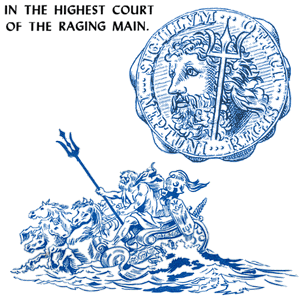
The ceremony of Crossing the Line is an initiation rite in several navies that commemorates a sailor’s first crossing of the Equator. Originally, the tradition was created as a test for seasoned sailors to ensure their new shipmates were capable of handling long rough times at sea. Sailors who have already crossed the Equator are nicknamed (Trusty) Shellbacks, often referred to as Sons of Neptune; those who have not are nicknamed (Slimy) Pollywogs. Equator-crossing ceremonies, typically featuring King Neptune, are also sometimes carried out for passengers’ entertainment on civilian ocean liners and cruise ships. They are also performed in the merchant navy and aboard sail training ships.
The two-day event (evening and day) is a ritual of reversal in which the older and experienced enlisted crew essentially takes over the ship from the officers. Physical assaults in keeping with the spirit of the initiation are tolerated, and even the inexperienced crew is given the opportunity to take over. The transition flows from established order to the controlled ‘chaos’ of the Pollywog Revolt, the beginnings of re-order in the initiation rite as the fewer but experienced enlisted crew converts the Wogs through physical tests, then back to, and thereby affirming, the pre-established order of officers and enlisted.
Continue reading →
Posted in Humor, War, World |
Leave a Comment »
November 8, 2011

Blood wings is a traditional initiation rite that is endured by many graduates of the United States Army Airborne School and sometimes practiced in other elite military training environments, including the Army Aviation and Aviation Logistics community. It is called ‘blood pinning’ in the United States Marine Corps. Although it is rare, some Air Force Academy cadets receive their upper-class Prop and Wings insignia via the blood wings tradition. Upon receiving the Parachutist Badge, an instructor or comrade of the graduate places the pins of the badge pointing into the chest of the graduate. The badge is then slammed against the graduate’s chest, resulting in the pins being driven into the flesh. If the graduation is affiliated with a particular unit number (unit 15, for example), then the pin will often be pounded deeper into the muscle the same number of times (15 times in this case).
The origins of this tradition are unknown, but most likely date back to World War II paratrooper training. This practice is fairly secretive and sparked controversy recently when knowledge of it reached the public, which is often critical about painful forms of hazing. Blood wings are against Armed Forces Policy and are prohibited. Recipients of blood wings consider it a highly honorable rite of passage. The offer of blood wings is usually presented by a superior to an elite soldier who has reached a significant career transition point. The superior would probably have had the same honor at his own graduation in the past. The risky offer of blood wings to a transitioning soldier is considered an honor, but the graduate nearly always has the option to reject the offer.
Posted in Education, War |
Leave a Comment »
November 8, 2011

Hazing is a term used to describe various ritual and other activities involving harassment, abuse or humiliation used as a way of initiating a person into a group. Hazing is seen in many different types of groups, including in gangs, clubs, sports teams, military units, and workplaces. In the United States it is often associated with fraternities and sororities.
Hazing is often prohibited by law and may be either physical (violent) or mental (degrading) practices. It may also include nudity or sexually oriented activities. Hazing often serves a deliberate purpose, of building solidarity. Persons who go through a great deal of trouble or pain to attain something tend to value it more highly than persons who attain the same thing with a minimum of effort.
Continue reading →
Posted in Education, Games, Politics |
Leave a Comment »
November 3, 2011

Movember is an annual, month-long event involving the growing of moustaches during the month of November. The event was conceived in 1999 by a group of Australian men from Adelaide. It is also known as ‘Novembeard.’ Since 2004, the Movember Foundation charity has run events to raise awareness and funds for men’s health issues, such as prostate cancer and depression, in Australia and New Zealand. In 2007, events were launched in Ireland, Canada, Cyprus, Czech Republic, Denmark, Greece, Spain, the United Kingdom, Israel, South Africa, and the United States.
The rules for participants as given on the official movember website are as follows: Once registered each bro must begin the 1st Movember with either a clean shaven face or facial growth dependant on your usual style. For the entire month of Movember each bro must shape grow and groom a moustache. There is to be no joining of the mo to the sideburns (that is considered a beard). There is to be no joining of the handlebars to your chin (that is considered a goatee). Each bro must conduct himself like a true country gentleman. Also shaving a beard to provide a ready-made mustache is cheating and not in the spirit of movember. A small growth of hair under the bottom lip (aka a tickler) is permitted as long as it is not connected to any other region.
Posted in Health, Humor |
Leave a Comment »
November 3, 2011

Blackout usually relates to the broadcasting of sports events, television programming, that is prohibited in a certain media market. The purpose is theoretically to generate more revenue by obliging certain actions from fans, either by making them buy tickets or watch other games on TV.
While financially a logical procedure on the part of those providing the programming, blackouts are frequently unpopular with the affected audience as it will cause some fans to miss the game completely even if they were willing to enter the stadium and pay. A similar term, known as preemption, often refers to stations blacking out a program for other than regulatory or governmental reasons, such as when a local station preempts a television network program for local news or a special program. Continue reading →
Posted in Games, Money |
Leave a Comment »
November 3, 2011

Since 1973, the NFL has maintained a blackout policy that states that a home game cannot be televised locally if it is not sold out 72 hours prior to its start time. The policy is intended to encourage full attendance. Prior to 1973, all games were blacked out in the home city of origin regardless of whether they were sold out. This policy, dating back to the NFL’s emerging television years, resulted in home-city blackouts even during championship games.
For instance, the 1958 ‘Greatest Game Ever Played’ between the Baltimore Colts and New York Giants was unavailable to New York fans despite the sellout. Many fans rented hotel rooms in Connecticut to watch the game on Hartford TV, a practice that continued for Giants games through 1972. Similarly, all Super Bowl games prior to the seventh edition were unavailable in the host city’s market.
Continue reading →
Posted in Games, Money |
Leave a Comment »
November 3, 2011

The lipstick effect is the theory that when facing an economic crisis consumers will be more willing to buy less costly luxury goods. Instead of buying expensive fur coats, people will buy expensive lipstick. In the time after the 9/11 attacks on the USA lipstick sales rose precipitously.
The underlying assumption is that consumers will buy luxury goods even if there is a crisis. When consumer trust in the economy is dwindling, consumers will buy goods that have less impact on their available funds. Outside the cosmetics market, consumers could be tempted by expensive beer or smaller, less costly gadgets.
Posted in Money |
Leave a Comment »
November 3, 2011

Lipstick is a cosmetic product containing pigments, oils, waxes, and emollients that applies color, texture, and protection to the lips. Ancient Mesopotamian women were possibly the first to wear lipstick. They crushed semi precious jewels and used them to decorate their lips.
Ancient Egyptians extracted purplish-red dye from seaweed, iodine, and toxic bromine, which resulted in serious illness. Cleopatra had her lipstick made from crushed carmine beetles, which gave a deep red pigment, and ants for a base. Lipsticks with shimmering effects were initially made using a pearlescent substance found in fish scales.
Continue reading →
Posted in Health, Sex |
Leave a Comment »
November 3, 2011

Norepinephrine [nawr-ep-uh-nef-rin] is a hormone and a neurotransmitter. Areas of the body that produce or are affected by norepinephrine are described as noradrenergic. The terms noradrenaline (from the Latin) and norepinephrine (derived from Greek) are interchangeable, with noradrenaline the common name in most parts of the world. However, to avoid confusion and achieve consistency medical authorities have promoted norepinephrine as the favored nomenclature.
One of the most important functions of norepinephrine is its role as the neurotransmitter released from the sympathetic neurons (part of the subconscious, autonomic nervous system) affecting the heart. An increase in norepinephrine from the sympathetic nervous system increases the rate of contractions. As a stress hormone, norepinephrine affects parts of the brain, such as the amygdala, where attention and responses are controlled. Continue reading →
Posted in Drugs, Health, Science |
Leave a Comment »
November 3, 2011
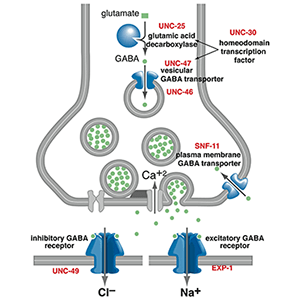
GABA (Gamma-Aminobutyric acid) is a neurotransmitter in the central nervous system of mammals. Its role changes from excitatory to inhibitory as the brain develops into adulthood. Normally, when a neuron receives an impulse, it will make the signal stronger, an inhibiting neurotransmitter prevents the cell from receiving the impulse, and the signal as a whole is weakened. In mammals, GABA regulates the extent to which neurons in the central nervous system will be stimulated.
It plays a role in regulating neuronal excitability throughout the nervous system. In humans, GABA is also directly responsible for the regulation of muscle tone. Even though chemically it is an amino acid, GABA is rarely referred to as such in the scientific or medical communities. The term ‘amino acid,’ used without a qualifier, refers to the alpha amino acids, which GABA is not. GABA is also not incorporated into proteins. Continue reading →
Posted in Drugs, Health, Science |
Leave a Comment »
November 3, 2011

The Magic Castle in Hollywood is a nightclub for magicians and magic enthusiasts, as well as the clubhouse for the Academy of Magical Arts. It bills itself as ‘the most unusual private club in the world.’ The facility is a performance venue, restaurant and private club. A typical evening features several magic and sometimes variety arts performances, as well as a full service dining room and several bars in a nightclub atmosphere. A dress code of formal party attire is strictly enforced. Entry is only allowed to members and their guests, although low-cost, 30-day memberships are openly offered to the general public, with the savings in door charges often being sufficient to cover the membership fee.
The lobby of the Castle has no visible doors to the interior, and visitors must say a secret phrase to a sculpture of an owl to gain access, exposing the entrance to the club. Nightly, five different magic performances are showcased in three different theaters, with additional performances added on weekends. Magicians perform in several different theaters, including the intimate Close-Up Gallery, a larger Parlor of Prestidigitation, and stage illusions in the Palace of Mystery. Informal performance areas around the five bars give magician members the space for impromptu magic for guests and other patrons. In the music room, a piano is played by invisible ‘Irma,’ the Castle’s ‘resident ghost,’ who takes requests.
Posted in Art, Humor |
1 Comment »
November 3, 2011

The third-person effect hypothesis states that a person exposed to a persuasive communication in the mass media sees it as having a greater effect on others than on himself or herself. This is known as the perceptual hypothesis, but there is also a behavioral hypothesis predicting that perceiving others as more vulnerable increases support for restrictions on mass media. The third-person effect hypothesis also argues that people are compelled to take action after being exposed to a persuasive message but this action might not be due to the message itself but to the anticipation of the reaction of others. This action is unpredictable and it might be either in conformity with the message or counter to it.
Usually, the effects considered are about general media influence, but type of the message also affects the effect size. Messages implying undesirable consequences increase the effect size and messages with desirable consequences decrease or even reverse the effect, as in someone believing that they are more able than others to follow a promoted healthy diet. The third-person effect, specially its behavioral hypothesis, is important to issues of censorship. Censors seldom admit to having been adversely affected by the information they prohibit even if they have been exposed to it numerous times. Usually, they claim, it is the general public that needs to be protected, not them.
Posted in Money, Science |
1 Comment »



