November 9, 2011

Sleep-learning (also known as hypnopædia [hip-noh-pee-dee-uh]) attempts to convey information to a sleeping person, typically by playing a sound recording to them while they sleep. This now-discredited technique was supposed to be moderately effective at making people remember direct passages or facts, word for word. Since the electroencephalography studies by Charles W. Simon and William H. Emmons in 1956, learning by sleep has not been taken seriously. The researchers concluded that learning during sleep was ‘impractical and probably impossible.’ They reported that stimulus material presented during sleep was not recalled later when the subject awoke unless alpha wave activity occurred at the same time the stimulus material was given. Since alpha activity during sleep indicates the subject is about to awake, the researchers felt that any learning occurred in a waking state.
In Aldous Huxley’s 1932 novel ‘Brave New World,’ hypnopaedia is used for the conditioning of children by future culture. In the novel, sleep-learning was discovered by accident when a Polish boy named Reuben Rabinovitch was able to recite an entire radio broadcast in English after a radio receiver was left on in his sleep. The boy was unable to comprehend what he had heard via hypnopædia, but it was soon realized that it could be used to effectively make suggestions about morality.
Posted in Education, Humor, Language |
1 Comment »
November 9, 2011

The development of the airliner has had a big effect on the wine business. It has made it easier for individuals to directly supervise viticulture and winemaking in different countries across the globe, rather than exchanging ideas by mail as they have for centuries. This means closer control of the wine, and has seen new technologies such as Drip irrigation, trellis systems, and other developments spread rapidly. This all leads to a homogenous product, influenced more by the winemaker’s background than the local terroir and history.
On the other hand, that ‘history’ often included overoaking and dirty facilities that partly oxidized the wines, which are rapidly fixed by flying winemakers. Many of the early flying winemakers were Australians who had been educated in modern techniques, and used the fact that their autumn was six months ahead of the Northern Hemisphere to ‘moonlight’ when things were quiet at home. They have had some dramatic success in improving the quality of Old World wines, particularly in the South of France and in the former Communist countries. Continue reading →
Posted in Food, Money, Technology |
Leave a Comment »
November 9, 2011

The term ‘Super Tuscan‘ describes any Tuscan red wine that does not adhere to traditional blending laws for the region. For example, Chianti Classico wines are made from a blend of grapes with Sangiovese as the dominant variety in the blend. Super Tuscans often use other grapes, especially cabernet sauvignon, making them ineligible for classification under the traditional rules.
In 1968 Azienda Agricola San Felice produced the first ever ‘Super Tuscan’ called Vigorello, and in the 1970s Piero Antinori, whose family had been making wine for more than 600 years, also decided to make a richer wine by eliminating the white grapes from the Chianti blend, and instead adding Bordeaux varietals (namely, Cabernet Sauvignon and Merlot). Continue reading →
Posted in Food, Money, World |
Leave a Comment »
November 9, 2011

‘Maus: A Survivor’s Tale,’ by Art Spiegelman, is a biography of the author’s father, Vladek Spiegelman, a Polish Jew and Holocaust survivor. It alternates between descriptions of Vladek’s life in Poland before and during the Second World War and Vladek’s later life in the Rego Park neighborhood of New York City.
The work is a graphic narrative in which Jews are depicted as mice, while Germans are depicted as cats. It is the only comic book ever to have won a Pulitzer Prize. Continue reading →
Posted in Art, Language, War |
Leave a Comment »
November 9, 2011

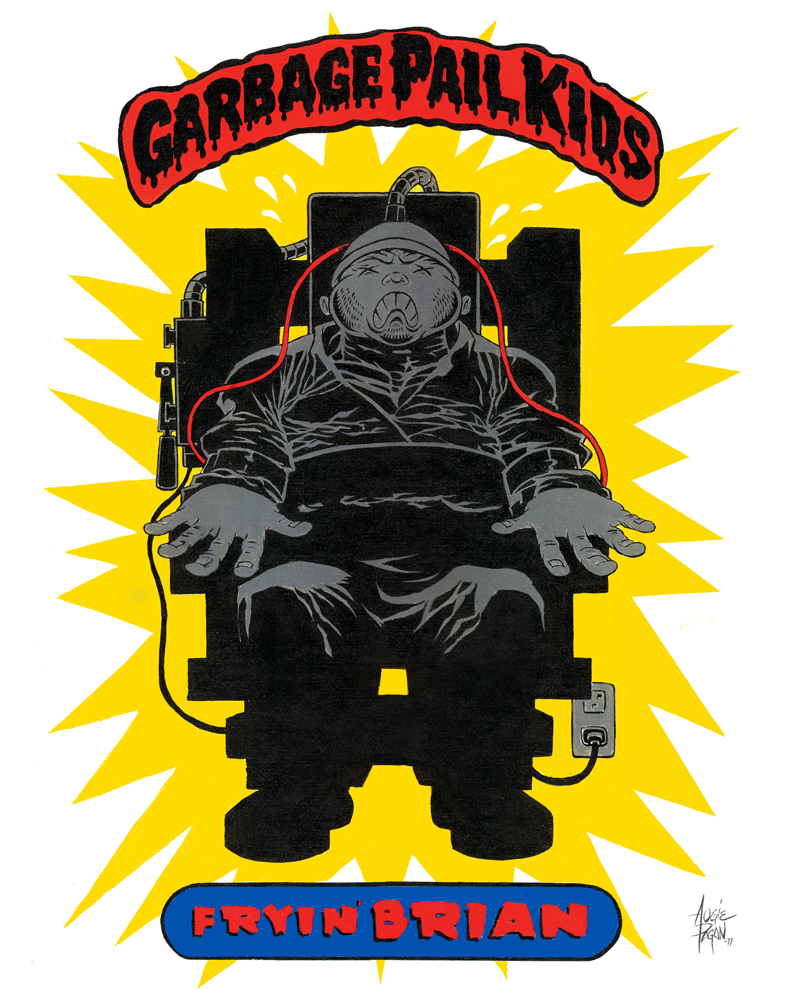
Garbage Pail Kids (also known as ‘Basuritas’ in Latin America, ‘Gang do Lixo’ in Brazil, ‘Sgorbions’ in Italy, ‘Les Crados’ in France and ‘Die total kaputten Kids’ in Germany) is a series of trading cards produced by the Topps Company, originally released in 1985 and designed to parody the Cabbage Patch Kids dolls, which were immensely popular at the time.
Each sticker card features a character with a comical abnormality and/or suffering some terrible fate, and punning name, such as ‘Glandular Angela’ or ‘Half-Nelson.’ Fifteen series of regular trading cards were released in the United States, with various sets released in other countries. Continue reading →
Posted in Art, Humor, Language |
Leave a Comment »
November 9, 2011

Ruin value (German: Ruinenwert) is the concept that a building be designed such that if it eventually collapsed, it would leave behind aesthetically pleasing ruins that would last far longer without any maintenance at all. The idea was pioneered by German architect Albert Speer while planning for the 1936 Summer Olympics and published as ‘The Theory of Ruin Value’ (‘Die Ruinenwerttheorie’), although he was not its original inventor. The intention did not stretch only to the eventual collapse of the buildings, but rather assumed such buildings were inherently better designed and more imposing during their period of use.
The idea was supported by Adolf Hitler, who planned for such ruins to be a symbol of the greatness of the Third Reich, just as Ancient Greek and Roman ruins were symbolic of those civilizations.
Continue reading →
Posted in Language, Technology |
Leave a Comment »
November 9, 2011
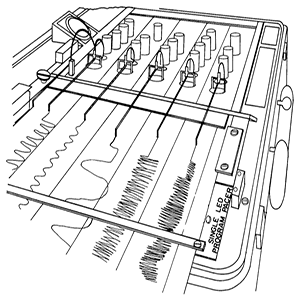
A polygraph (popularly referred to as a lie detector) measures and records several physiological indices such as blood pressure, pulse, respiration, and skin conductivity while the subject is asked and answers a series of questions. The belief is that deceptive answers will produce physiological responses that can be differentiated from those associated with non-deceptive answers. The polygraph was invented in 1921 by John Augustus Larson, a medical student at the University of California at Berkeley and a police officer of the Berkeley Police Department.
Many members of the scientific community consider polygraphy to be pseudoscience. Nonetheless, in some countries polygraphs are used as an interrogation tool with criminal suspects or candidates for sensitive public or private sector employment. US federal government agencies such as the FBI and the CIA and many police departments use polygraph examinations to interrogate suspects and screen new employees. Within the US federal government, a polygraph examination is also referred to as a psychophysiological detection of deception (PDD) examination.
Continue reading →
Posted in Politics, Technology |
1 Comment »
November 9, 2011

Thought identification refers to the empirically verified use of technology to, in some sense, read people’s minds. Recent research using Neuroimaging has provided some early demonstrations of the technology’s potential to recognize high-order patterns in the brain. In some cases, this provides meaningful (and controversial) information to investigators.
With brain scanning technology becoming increasingly accurate, experts predict important debates over how and when it should be used. One potential area of application is criminal law. Haynes explains that simply refusing to use brain scans on suspects also prevents the wrongly accused from proving their innocence.
Continue reading →
Posted in Health, Politics, Technology |
1 Comment »
November 9, 2011

A body swap is a storytelling device seen in a variety of fiction, most often in television shows and movies, in which two people (or beings) exchange minds and end up in each other’s bodies. Alternatively, their minds may stay where they are as their bodies adjust. The two people usually keep their voices in cartoons, for purposes of knowing who is who. There are three distinct types of body swapping. Switches can be caused by magic items such as amulets, heartfelt wishes, or just strange quirks of the universe. The switches typically reverse after the subjects have expanded their world views, gained a new appreciation for each other’s troubles by literally ‘walking in another’s shoe’ and/or caused sufficient amounts of farce. Notable examples include the books ‘Vice Versa’ (1882) and ‘Freaky Friday’ (1972), as well as the film versions of both.
Switches accomplished by technology, exempting gadgets advanced sufficiently to appear as magic, are the fare of mad scientists. Body-swapping devices are characterized by highly experimental status, straps, helmets with complicated cables that run to a central system and a tendency to direly malfunction before their effects can be reversed. Those without such means may resort to brain transplants. Such experiments can have overtones of horror; evil mad scientists seldom use willing test subjects.
Posted in Art, Humor, Language |
Leave a Comment »
November 8, 2011


Urban exploration (often shortened as urbex or UE) is the examination of the normally unseen or off-limits parts of urban areas or industrial facilities. It is also commonly referred to as ‘infiltration,’ although that term is be more closely associated with the exploration of active or inhabited sites. It may also be referred to as ‘draining’ (when exploring drains) ‘urban spelunking,’ ‘urban caving,’ or ‘building hacking.’
The nature of this activity presents various risks, including both physical danger and the possibility of arrest and punishment. Many, but not all, of the activities associated with urban exploration could be considered trespassing or other violations of local or regional laws, including—but not limited to—invasion of privacy and certain broadly-interpreted anti-terrorism laws.
Continue reading →
Posted in Games, Politics |
Leave a Comment »
November 8, 2011

Comfort food is food prepared traditionally that may have a nostalgic or sentimental appeal. Many comfort foods are flavorful and easily eaten, having soft consistencies. American comfort foods include apple pie, chicken soup, chili, chocolate chip cookies, fried chicken, macaroni & cheese, mashed potatoes, meatloaf, and potato salad. Australian comfort foods include vegemite, meat pies, fish and chips, chiko rolls, dim sims, and potato cakes.
In Chinese culture the comfort foods might differ between each households. Nevertheless the common theme is usually invoked nostalgic sentiments of home and family. Chinese comfort foods usually served warm, have soft texture and it might be soupy. Some of common Chinese comfort foods are: baozi, rice congee, chinese noodles, and dim sum. Continue reading →
Posted in Food, Language, World |
Leave a Comment »
November 8, 2011

A secret society is a club or organization whose activities and inner functioning are concealed from non-members. The society may or may not attempt to conceal its existence. The term usually excludes covert groups, such as intelligence agencies or guerrilla insurgencies, which hide their activities and memberships but maintain a public presence.
The exact qualifications for labeling a group as a secret society are disputed, but definitions generally rely on the degree to which the organization insists on secrecy, and might involve the retention and transmission of secret knowledge, denial of membership in or knowledge of the group, the creation of personal bonds between members of the organization, and the use of secret rites or rituals which solidify members of the group.
Continue reading →
Posted in Games, Language, Money |
Leave a Comment »