August 14, 2011
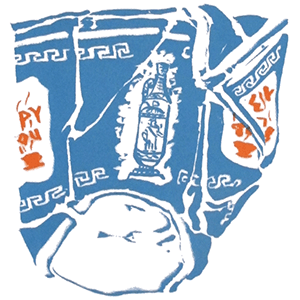
The Anthora is a paper coffee cup design that has become iconic of New York City daily life — its name is a play on the word amphora (ceramic container with two handles and a long neck narrower than the body). The cup was originally designed by Leslie Buck of the Sherri Cup Co. in 1963, to appeal to Greek-owned coffee shops in New York City — and was later copied heavily by other companies. The genuine Anthora depicts an image of an Ancient Greek amphora, a meander design on the top and bottom rim, and the words ‘WE ARE HAPPY TO SERVE YOU’ in a font that resembles ancient Greek writing. The blue and white colors were inspired by the flag of Greece.
Buck never made royalties from his design, but as a salesman he was remunerated handsomely from the success of the product. When he retired from Sherri Cup Co. in 1992, he was presented with 10,000 Anthoras printed with a testimonial inscription. On the occasion of Buck’s death in 2010, a New York Times writer described the motto on the cup as having ‘welcome intimations of tenderness, succor and humility.’ The trademark is currently held by the Solo Cup Company, which licenses sales of the cup.
Posted in Food, Money |
1 Comment »
August 14, 2011
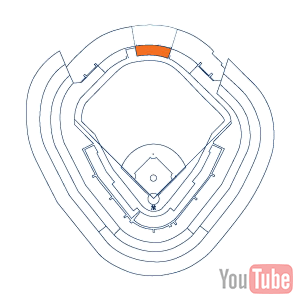
The batter’s eye is a solid-colored, usually dark area beyond the center field wall of a baseball stadium, that is the visual backdrop directly in the line of sight of a baseball batter, while facing the pitcher and awaiting a pitch. This dark surface allows the batter to see the pitched ball against a sharply contrasted and uncluttered background. Its primary purpose is the safety of the batter.
The use of a batter’s background has been standard in baseball (as well as cricket) since at least the late 19th century. The Batter’s Eye performs the same role at a baseball venue as the sightscreen does at a cricket venue, except that a cricket sightscreen is usually white in order to contrast with the dark red cricket ball. Alternatively a black screen is used to contrast the white Kookaburra Limited Overs cricket ball.
Continue reading →
Posted in Games, Health |
Leave a Comment »
August 14, 2011

Cow tipping is the purported activity of sneaking up on a sleeping, upright cow and pushing it over for fun. As cattle do not sleep standing up, cow tipping is a myth. Cattle only rest while standing up, rather than sleeping that way, and they are easily disturbed.
Additionally, they represent over a half ton of weight that would easily resist a lesser tipping force. Horses, however, do regularly sleep standing up due to a locking mechanism of their stifle joint, a trait cows do not possess.
Posted in Games, Humor |
Leave a Comment »
August 14, 2011

‘Real-Life Superheroes‘ are men and women who, using the thematic device of the costumed superhero, perform services that benefit the community in a variety of ways. Some Real-Life Superheroes (RLSH) hand out supplies to the homeless, while others seek to directly combat crime through community patrols in which suspicious activity is identified and reported to the proper authorities, and some physically confront suspected perpetrators themselves.
Real life super heroes wear masks or otherwise disguise themselves in order to perform ‘heroic deeds’ like community services or fighting crime when they come across it. They are often similar to neighborhood watches or militias. Examples include Phoenix Jones and a team of nine others in the Rain City Superhero Movement.
Posted in Games, Humor, Politics |
Leave a Comment »
August 14, 2011

Sousveillance [soo-vay-lance] refers to the recording of an activity by a participant in the activity typically by way of small wearable or portable personal technologies. Sousveillance has also been described as ‘inverse surveillance’ because the term stems from the contrasting French words ‘sur,’ meaning ‘above,’ and ‘sous,’ meaning ‘below,’ i.e. ‘surveillance’ denotes the ‘eye-in-the-sky’ watching from above, whereas ‘sousveillance’ denotes bringing the camera or other means of observation down to human level, either physically (mounting cameras on people rather than on buildings), or hierarchically (ordinary people doing the watching, rather than higher authorities or architectures doing the watching).
While surveillance and sousveillance both generally refer to visual monitoring (i.e. ‘veiller’ being ‘to watch’), the terms also denote other forms of monitoring such as audio surveillance or sousveillance. In the audio sense (e.g. recording of phone conversations) sousveillance is referred to as ‘one party consent.’
Continue reading →
Posted in Language, Politics, Technology |
Leave a Comment »
August 14, 2011

Greenwashing (a compound word modelled on ‘whitewash’), or ‘green sheen,’ is a form of spin in which ‘green’ PR or ‘green’ marketing is deceptively used to promote the perception that a company’s policies or products are environmentally friendly. The term was coined by New York environmentalist Jay Westerveld in a 1986 essay regarding the hotel industry’s practice of placing placards in each room promoting reuse of towels ostensibly to ‘save the environment.’
Westerveld noted that, in most cases, little or no effort toward reducing energy waste was being made by these institutions — as evidenced by the lack of cost reduction this practice effected. Westerveld opined that the actual objective of this ‘green campaign’ on the part of many hoteliers was, in fact, increased profit. Westerveld thus labeled this and other outwardly environmentally conscientious acts with a greater, underlying purpose of profit increase as greenwashing.
Continue reading →
Posted in Money, Politics, Science |
1 Comment »
August 12, 2011

A Mouli grater is a hand-operated cooking tool designed for grating or pureeing small quantities of food. The device consists of a small metal drum with holes that grate the food and a handle for turning the drum. Mouli is a French brand name that later changed into Moulinex. A grating cylinder similar to the one used in this design later turned up in food processors from that company.
The hand-held unit consists of two sections with hinged handles. The end of one handle contains a food hopper with a grating cylinder and a crank for rotating the cylinder. The other section has a rounded surface that acts as a clamp, pressing the food to be grated into the grating cylinder. The hinged handles are held in one hand and squeezed so that the food presses against the grating cylinder. Meanwhile, the other hand turns the crank, causing the cylinder to rotate and the food to be grated.
Posted in Food, Technology |
Leave a Comment »
August 11, 2011

Ferdinand Cheval (1836 – 1924) was a French postman who spent thirty-three years of his life building Le Palais Idéal (‘The Ideal Palace’) in Hauterives. The structure is regarded as an extraordinary example of naïve art architecture. Cheval began the building in April 1879. He claimed that he had tripped on a stone and was inspired by its shape. He returned to the same spot the next day and started collecting stones. For the next thirty-three years, Cheval picked up stones during his daily mail round and carried them home to build with. He spent the first twenty years building the outer walls. At first, he carried the stones in his pockets, then switched to a basket. Eventually, he used a wheelbarrow. He often worked at night, by the light of an oil lamp.
The Palais is a mix of different styles with inspirations from Christianity to Hinduism. Cheval bound the stones together with lime, mortar and cement. He also wanted to be buried in his palace. However, since that is illegal in France, he proceeded to spend eight more years building a mausoleum for himself in the Hauterives cemetery. He died one year after he had finished building it, and is buried there. Just prior to his death, Cheval began to receive some recognition from luminaries like André Breton and Pablo Picasso. His work is commemorated in an essay by Anaïs Nin. In 1932, the German artist Max Ernst created a collage titled ‘The Postman Cheval.’ The work belongs to the Peggy Guggenheim Collection and is on display there.
Posted in Art, Humor, World |
Leave a Comment »
August 11, 2011
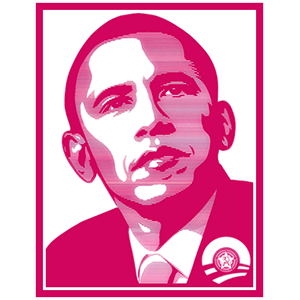
Pinko is a term for a person regarded as sympathetic to communism, though not necessarily a Communist Party member. The term has its origins in the notion that pink is a lighter shade of red, the color associated with communism. The word was coined by Time magazine in 1925 as a variant on the noun and adjective pink, which had been used along with ‘parlor pink’ since the beginning of the 20th century to refer to those of leftish sympathies, usually with an implication of ‘effeteness.’
In the 1920s, for example, a Wall Street Journal editorial described supporters of the progressive politician Robert La Follette as ‘visionaries, ne’er do wells, parlor pinks, reds, hyphenates [Americans with divided allegiance], soft handed agriculturalists and working men who have never seen a shovel.’
Continue reading →
Posted in Language, Politics |
Leave a Comment »
August 10, 2011

Since its premiere in 1968, 2001: A Space Odyssey has been analyzed and interpreted by multitudes of people ranging from professional movie critics to amateur writers and science fiction fans. The director of the film, Stanley Kubrick, wanted to leave the film open to philosophical and allegorical interpretation, purposely presenting the final sequences of the film without the underlying thread being apparent; a concept illustrated by the final frame of the film, which contains the image of the embryonic ‘Starchild.’
Kubrick encouraged people to explore their own interpretations of the film, and refused to offer an explanation of ‘what really happened’ in the movie, preferring instead to let audiences embrace their own ideas and theories. In a 1968 interview with Playboy magazine, Kubrick stated: ‘You’re free to speculate as you wish about the philosophical and allegorical meaning of the film—and such speculation is one indication that it has succeeded in gripping the audience at a deep level—but I don’t want to spell out a verbal road map for ‘2001’ that every viewer will feel obligated to pursue or else fear he’s missed the point.’ Continue reading →
Posted in Art, Philosophy, Technology |
Leave a Comment »
August 9, 2011

Taqwacore [tok-wah-kor] is a genre of punk music dealing with Islam and its culture, originally conceived in Michael Muhammad Knight’s 2003 novel, ‘The Taqwacores.’ The name is a portmanteau of hardcore and the Arabic word Taqwa, which is usually translated as ‘piety’ or the quality of being ‘God-fearing,’ and thus roughly denotes fear and love of the divine. The scene is composed mainly of young Muslim artists living in the US and other western countries, many of whom openly reject traditionalist interpretations of Islam.
Although Muslim punk music dates at least to the 1979 founding of British band Alien Kulture, and in the 90’s, Nation Records act Fun-Da-Mental and Asian Dub Foundation, this is the first example of US Muslim generated punk. Knight’s novel was instrumental in encouraging the growth of a contemporary North American Muslim punk movement. There is not a definitive ‘taqwacore sound,’ and the scene is much more diverse now than the fictional one portrayed in Knight’s novel, with artists incorporating various styles, ranging from punk to hip-hop, and musical traditions from the Muslim world; the Kominas describe their sound as ‘Bollywood punk,’ Sagg Taqwacore Syndicate is rap and techno inspired, and Al-Thawra uses the term ‘raicore,’ based on Arabic Raï music.
Posted in Art, Philosophy, Politics |
Leave a Comment »
August 9, 2011

Moombahton is a genre of electronic dance music that was created by American dj/producer Dave Nada (aka Dave Villegas) at a high school homecoming ‘skipping party’ for his younger cousin in Washington, D.C., in the fall of 2009.
The specific event that stimulated NADA’s development of the Moombahton genre was his slowing the Afrojack remix of the Silvio Ecomo and DJ Chuckie song ‘Moombah’ to 108 beats per minute. Because that tempo nears that of the reggaeton, Nada created the neologism ‘Moombahton.’
Posted in Art, Technology |
Leave a Comment »





