August 9, 2011

Keynesian economics is a school of macroeconomic thought based on the ideas of 20th-century English economist John Maynard Keynes. Most economists today are primarily Keynesian-influenced. According to the theory, there exists a cycle in the economy, in which there are years of growth, followed by years of depression or recession, called the business cycle. Keynes′ theory suggested that active government policy could be effective in managing the economy.
Rather than seeing unbalanced government budgets as wrong, Keynes advocated what has been called countercyclical fiscal policies, that is, policies that acted against the tide of the business cycle: deficit spending when a nation’s economy suffers from recession or when recovery is long-delayed and unemployment is persistently high—and the suppression of inflation in boom times by either increasing taxes or cutting back on government outlays. Continue reading →
Posted in Money, Politics |
Leave a Comment »
August 8, 2011

Hipster is a slang term that first appeared in the 1940s, was revived in the 1990s, and continued to be used in the 2000s and 2010s, to describe young, recently settled urban middle class adults and older teenagers with musical interests mainly in indie rock. Other interests in media would include independent film, magazines such as Vice and Clash, and websites like Pitchfork Media. In some contexts, hipsters are also called scenesters.
‘Hipster’ has been used in sometimes contradictory ways, making it difficult to precisely define ‘hipster culture,’ which has been described as a ‘mutating, trans-Atlantic melting pot of styles, tastes and behavior.’ Hipsterism fetishizes the authentic elements of all of the ‘fringe movements of the postwar era—beat, hippie, punk, even grunge,’ and draws on the ‘cultural stores of every unmelted ethnicity,’ and ‘regurgitates it with a winking inauthenticity.’ Others, like Arsel and Thompson, argue that hipster signifies a cultural mythology, a crystallization of a mass-mediated stereotype generated to understand, categorize, and marketize indie consumer culture, rather than an objectified group of people.
Continue reading →
Posted in Art, Language, Money |
Leave a Comment »
August 8, 2011

In psychogeography, a dérive is an unplanned journey through a landscape, usually urban, in which an individual travels where the subtle aesthetic contours of the surrounding architecture and geography subconsciously direct them with the ultimate goal of encountering an entirely new and authentic experience. Situationist theorist Guy Debord defines the dérive as ‘a mode of experimental behavior linked to the conditions of urban society: a technique of rapid passage through varied ambiances.’ He also notes that ‘the term also designates a specific uninterrupted period of dériving.’ The term is literally translated into English as ‘drift.’
The concept of the dérive has its origins in the Letterist International of the 1940s, an artistic and political collective based in Paris, where it was a critical tool for understanding and developing the theory of psychogeography, defined as the ‘specific effects of the geographical environment (whether consciously organized or not) on the emotions and behavior of individuals.’ The dérive, an unplanned tour through an urban landscape directed entirely by the feelings evoked in the individual by their surroundings, served as the primary means for mapping and investigating the psychogeography of these different areas. Continue reading →
Posted in Games, Science |
Leave a Comment »
August 7, 2011

A false awakening is a vivid dream about awakening from sleep. After a false awakening, subjects often dream they are performing daily morning rituals such as cooking, cleaning and eating. The experience is sometimes called a double dream, or a dream within a dream. A false awakening may occur following an ordinary dream or following a lucid dream (one in which the dreamer has been aware of dreaming). Particularly if the false awakening follows a lucid dream, the false awakening may turn into a ‘pre-lucid dream,’ that is, one in which the dreamer may start to wonder if they are really awake and may or may not come to the correct conclusion.
In a study by Harvard psychologist Deirdre Barrett, 2,000 dreams from 200 subjects were examined and it was found that false awakenings and lucidity were significantly more likely to occur within the same dream or within different dreams of the same night. False awakenings often preceded lucidity as a cue, but they could also follow the realization of lucidity, often losing it in the process. Continue reading →
Posted in Health, Philosophy, Science |
Leave a Comment »
August 7, 2011
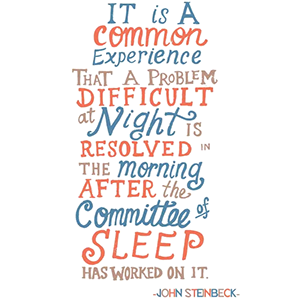
Dream incubation is a practiced technique of learning to ‘plant a seed’ in the mind, in order for a specific dream topic to occur, either for recreation or to attempt to solve a problem. For example, a person might go to bed repeating to themselves that they will dream about a presentation they have coming up, or a vacation they recently took, or a person they are interested in. While somewhat similar to lucid dreaming, dream incubation is simply focusing attention on a specific issue when going to sleep. Several studies have shown this method to be successful over a period of time.
For example, in a study at Harvard Medical School, Dr. Deirdre Barrett had her students focus on a problem, such as an unsolved homework assignment or other objective problem, before going to sleep each night for a week. She found that it was possible to develop novel solutions in dreams that were both satisfactory to the dreamer and rated as objectively solving the problem by an outside observer. In her study, two-thirds of participants had dreams that addressed their chosen problem, and one-third reached some form of solution within their dreams. Continue reading →
Posted in Science |
Leave a Comment »
August 6, 2011

Aposematism [app-uh-sem-uh-tizm], perhaps most commonly known in the context of warning coloration, describes a family of antipredator adaptations where a warning signal is associated with the unprofitability of a prey item to potential predators. It is one form of ‘advertising’ signal, with many others existing such as the bright colors of flowers which lure pollinators. The warning signal may take the form of conspicuous colors, sounds, odors, or other perceivable characteristics. Aposematic signals are beneficial for both the predator and prey, who both avoid potential harm.
This tendency to become highly noticeable and distinct from harmless organisms is the antithesis of crypsis, or avoidance of detection. Aposematism has been such a successful adaptation that harmless organisms have repeatedly evolved to mimic aposematic species, a pattern known as Batesian mimicry. Another related pattern is Müllerian mimicry, where aposematic species come to resemble one another.
Continue reading →
Posted in Science |
Leave a Comment »
August 5, 2011

The handicap principle is a hypothesis originally proposed in 1975 by biologist Amotz Zahavi to explain how evolution may lead to ‘honest’ or reliable signaling between animals who have an obvious motivation to bluff or deceive each other. The handicap principle suggests that reliable signals must be costly to the signaler, costing the signaler something that could not be afforded by an individual with less of a particular trait.
For example, in the case of sexual selection, the theory suggests that animals of greater biological fitness signal this status through handicapping behavior or morphology that effectively lowers this quality. The central idea is that sexually selected traits function like conspicuous consumption, signalling the ability to afford to squander a resource simply by squandering it. Receivers know that the signal indicates quality because inferior quality signalers cannot afford to produce such wastefully extravagant signals.
Continue reading →
Posted in Money, Science, Sex |
Leave a Comment »
August 5, 2011
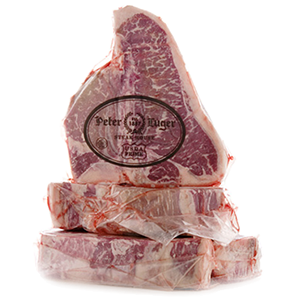
Beef aging is the process of preparing beef for consumption, mainly by breaking down the connective tissue. Dry-aged beef has been hung to dry for several weeks. After the animal is slaughtered and cleaned, either an entire half will be hung, or prime cuts will be placed in a cooler, also known as a ‘hot box.’ This process involves considerable expense, as the beef must be stored near freezing temperatures. Also, only the higher grades of meat can be dry aged, as the process requires evenly distributed fat. For these reasons one seldom sees dry-aged beef outside of steak restaurants and upscale butcher shops. The process changes beef by two means. First, moisture is evaporated from the muscle, concentrating flavor. Second, the beef’s natural enzymes break down the connective tissue in the muscle, which leads to more tender beef.
Dry-aging can promote the growth of certain mold species on the external surface of the meat. This doesn’t cause spoilage, but actually forms an external ‘crust,’ which is trimmed off when the meat is prepared for cooking. These fungal species complement the natural enzymes in the beef by helping to tenderize and increase the flavor of the meat. The genus Thamnidia, in particular, is known to produce collagenolytic enzymes which greatly contribute to the tenderness and flavor of dry-aged meat. Wet-aged beef is beef that has typically been aged in a vacuum-sealed bag to retain its moisture. This is the dominant mode of aging beef in the United States today. Wet-aging is popular because it takes less time (typically only a few days) and none of the weight is lost in the process. In contrast, dry-aging can take 15–28 days, and will see up to a third or more of the weight lost as moisture.
Posted in Food, Money |
Leave a Comment »
August 4, 2011

A stock market crash is a sudden dramatic decline of stock prices across a significant cross-section of a stock market, resulting in a significant loss of paper wealth. Crashes are driven by panic as much as by underlying economic factors. They often follow speculative stock market bubbles.
Stock market crashes are social phenomena where external economic events combine with crowd behavior and psychology in a positive feedback loop where selling by some market participants drives more market participants to sell. Generally speaking, crashes usually occur under the following conditions: a prolonged period of rising stock prices and excessive economic optimism, a market where P/E ratios exceed long-term averages, and extensive use of margin debt and leverage by market participants.
Continue reading →
Posted in Money, Politics, Science |
1 Comment »
August 4, 2011

Recession shapes are used by economists to describe different types of recessions. There is no specific academic theory or classification system for recession shapes; rather the terminology is used as an informal shorthand to characterize recessions and their recoveries. The most commonly used terms are V-shaped, U-shaped, W-shaped, and L-shaped recessions. The letters can also be applied referring to the recoveries (ie ‘V-shaped recovery’).
In a V-shaped recession, the economy suffers a sharp but brief period of economic decline with a clearly defined trough, followed by a strong recovery. V-shapes are the normal shape for recession: ‘There is a strong historical ‘snap back’ relationship between the strength of economic recovery and the severity of the preceding recession. Thus, recessions and their recoveries have a tendency to trace out a ‘V’ shape.’ Continue reading →
Posted in Money, Politics |
Leave a Comment »
August 4, 2011

Whole grains are cereal grains that contain cereal germ, endosperm, and bran, in contrast to refined grains, which retain only the endosperm. Whole Grains can generally be sprouted while refined grains generally will not sprout. Wholemeal products are made by grinding whole grains in order to make whole grain flour. Whole grains are a natural source of protein as well as a source of carbohydrates and are made into many different kinds of foods.
There are multiple grains such as cereal grains (e.g. wheat, brown rice, oats, barley, corn, and rye) as well as pseudocereals (e.g. quinoa and buckwheat) that may be labeled whole grains. Common whole grain products include: whole wheat bread, whole wheat pasta, rolled oats, and popcorn. By contrast, common refined-grain products include: white rice, white bread, hominy, and pasta.
Continue reading →
Posted in Food, Health |
Leave a Comment »
August 4, 2011

Grain milk is a milk substitute made from fermented grain or from flour. Grain milk can be made from oats, spelt, rice, rye, einkorn wheat or quinoa, and looks very similar to cow’s milk. It has a lower protein content and a higher carbohydrate content than cow’s milk. Just as cow’s milk is often fortified, grain milks may have calcium and some vitamins (especially B12) added to them.
Grain milk is low in saturated fat and contains no lactose, which is beneficial for those who are lactose intolerant. Grain milk also lacks milk protein, making it suitable for vegans and people with milk allergies. Flavored grain milk can come in plain, vanilla, chocolate or a variety of other flavors. There are also grain milk cream and desserts available.
Posted in Food, Health |
Leave a Comment »