July 26, 2011

A dubplate is an acetate disc — usually 12, 10, or 7 inches in diameter — used in mastering studios for quality control and test recordings before proceeding with the final master, and subsequent pressing of the record to be mass-produced on vinyl. The ‘dub’ in dubplate is an allusion to the plate’s use in ‘dubbing’ or ‘doubling’ the original version of a track. In music, dubbing is copying of audio recordings from one medium to another.
The name dubplate also refers to an exclusive, ‘one-off’ disc recording pioneered by reggae sound systems but also used by drum and bass and other dance music artists, DJs and sound systems. These dubplates will often be unreleased recordings (which may or may not end up being made available to the general public). They are often used as a market research tool to assess the probable sales of a song once it’s released, as they are far cheaper to produce than a pressed vinyl record. However, because they have a limited life-span they can only be used about fifty times.
Posted in Art, Language, Technology |
Leave a Comment »
July 26, 2011

Biophilia is the musical project and forthcoming eighth full-length studio album from Icelandic singer Björk. The album is ‘partly recorded’ on an iPad and will be released in the form of a series of apps. Biophilia will be the world’s ‘first app album’ in collaboration with Apple. Björk has described the project as a multimedia collection ‘encompassing music, apps, internet, installations, and live shows.’ Scott Snibbe, an interactive artist was commissioned by Björk in the summer of 2010 to produce the app, as well as the images for the live shows (which will combine his visuals with National Geographic imagery, mixed live from iPads on the stage).
For the song, ‘Virus,’ the app will feature a close-up study of cells being attacked by a virus to represent what Snibbe calls: ‘A kind of a love story between a virus and a cell. And of course the virus loves the cell so much that it destroys it.’ The interactive game challenges the user to halt the attack of the virus, although the result is that the song will stop if the player succeeds. In order to hear the rest of the song, the players will have to let the virus take its course. Using some artistic license, the cells will also mouth along to the chorus. Björk is determined to fuse different elements together, be it juxtaposing a female choir from Greenland with the bleeps and glitches of electronic music pioneers Matmos during the Vespertine tour, or meshing soaring strings and jagged beats on ‘Homogenic,’ that ‘helps explain the power and success of Björk’s collaborations.’
Posted in Art, Games, Technology |
Leave a Comment »
July 25, 2011

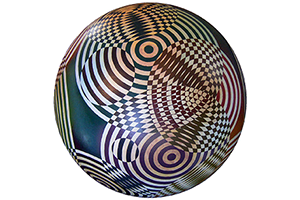
Dick Termes is an innovative American artist who uses a six point perspective system that he devised to create unique paintings on large spheres called Termespheres. They are paintings on spherical canvases that capture an entire environment (Up, Down, Left, Right, Front & Back). Termespheres are typically hung by small chains and rotated with electric ceiling motors to reveal a complete world as the spheres slowly rotate. Optical illusions tend to appear as the spheres rotate.
Although the image is painted on the outside of the convex sphere, the vantage point continuously changes. The rotation also may appear to reverse direction, giving the sensation that the viewer is inside the painting viewing the concave surface of the inside of the rotating sphere. Although the six point perspective appears very non-linear and distorted when viewed on a two-dimensional plane, when the design is superimposed on the sphere, the perspective appears corrected. Termes acknowledges strong influences from M.C. Escher and Buckminster Fuller in developing his technique.
Posted in Art |
Leave a Comment »
July 25, 2011

Wave Twisters (2001) is an animated film, also known as the first turntablism-based musical. It is based on DJ Q-Bert’s album of the same name. The film is entirely scripted to match the DJ Q-Bert recording. As such, it can seem a little disjointed at times. It was produced digitally using Adobe After Effects and a relatively small team of animators. Buckethead makes a short appearance in the film as well, near the beginning.
A crew of heroes is determined to save the lost arts of Hip Hop. Break Dancing, Graffiti, MCing, and DJing from total extinction. The lost arts are being oppressed throughout inner-space by lord Ook and his evil minions the Chinheads. The dental commander Dr. Julio Azul DDS, assumed to be secretary Honey Drips, Dental Hygienist/Robot Rubbish, and Grandpa have a series of adventures, synced to the music. Armed with the ancient relic known as the Wave Twister (a small turntable/wristwatch, the only weapon powerful enough to defeat their enemies), they travel to the far ends of inner-space for a final confrontation with the sinister army of oppressors. The film ends with the team teaching the liberated the lost fundamentals of hip hop.
Posted in Art, Humor, Technology |
Leave a Comment »
July 25, 2011

Idiocracy is a 2006 American film, a satirical science fiction comedy, directed by Mike Judge. The film tells the story of two ordinary people who are taken into a top-secret military hibernation experiment which goes awry, and awaken 500 years in the future. They discover that the world has degenerated into a dystopia where advertising, commercialism, and cultural anti-intellectualism run rampant and dysgenic pressure has resulted in a uniformly stupid human society devoid of intellectual curiosity, social responsibility and coherent notions of justice and human rights. Rather, this future society emphasizes popularity, sexual attraction, and hedonism.
During the prologue, a narrator explains that in our modern society, natural selection does not favor the intelligent (who are very selective and careful in how they have children) and that less-intelligent people procreate freely and easily out-breed the intelligent. This, combined with a general celebration of the cultural ‘lowest common denominator’ and general anti-intellectual cultural mores result in a world that has degenerated into a barely functioning society held together by a rapidly crumbling, mostly automated technological infrastructure that was created by intelligent individuals many years (perhaps centuries) earlier that few, if any, of the members of 26th Century society know how to operate or fix.
Posted in Art, Humor, Politics |
Leave a Comment »
July 25, 2011


Luigi Colani (b. 1928) is a German industrial designer. The prime characteristic of his designs are the rounded, organic forms, which he terms ‘biodynamic’ and claims are ergonomically superior to traditional designs. His ‘kitchen satellite’ from 1969 is the most prominent example of this school of thought. Many of his designs for small appliances are being mass-produced and marketed, but his larger designs have not been built, ‘a whole host of futuristic concepts that will have us living in pods and driving cars so flat that leg amputation is the only option.’
Colani responding to his critics said, ‘The earth is round, all the heavenly bodies are round; they all move on round or elliptical orbits. This same image of circular globe-shaped mini worlds orbiting around each other follows us right down to the microcosmos. We are even aroused by round forms in species propagation related eroticism. Why should I join the straying mass who want to make everything angular? I am going to pursue Galileo Galilei’s philosophy: my world is also round.’
Posted in Art, Money, Technology |
Leave a Comment »
July 25, 2011

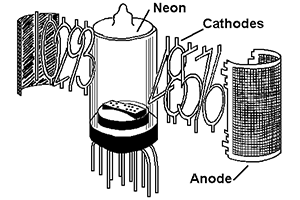
A nixie tube, or cold cathode display, is an electronic device for displaying numerals or other information using glow discharge. The glass tube contains a wire-mesh anode and multiple cathodes, shaped like numerals or other symbols. Applying power to one cathode surrounds it with an orange glow discharge. The tube is filled with a gas at low pressure, usually mostly neon and often a little mercury or argon.
Although it resembles a vacuum tube in appearance, its operation does not depend on thermionic emission of electrons from a heated cathode. It is therefore called a cold-cathode tube (a form of gas-filled tube), or a variant of neon lamp. Such tubes rarely exceed 40 °C (104 °F) even under the most severe of operating conditions in a room at ambient temperature. Vacuum fluorescent displays from the same era use completely different technology – they have a heated cathode together with a control grid and shaped phosphor anodes; Nixies have no heater or control grid, typically a single anode, and shaped bare metal cathodes. Continue reading →
Posted in Money, Technology |
Leave a Comment »
July 25, 2011

Airstream is a brand of luxury recreational vehicle manufactured in Jackson Center, Ohio. It is currently a division of Thor Industries. The company, which now employs fewer than 400, is the oldest in the industry. Airstream trailers are easily recognized for their distinctive rounded aluminum bodies, which originated in the 1930s from designs created by Hawley Bowlus. Bowlus was the chief designer of Charles Lindbergh’s aircraft, the Spirit of St. Louis.
The company was founded by Wally Byam, who began building trailers out of Masonite in his backyard in Los Angeles during the late 1920s. A lawyer by training, Byam published a magazine selling ‘how-to’ kits to customers wishing to build their own trailers. He then acquired the struggling Bowlus Company. In 1936 Byam introduced the ‘Airstream Clipper,’ which was essentially a rebadged 1935 Bowlus, with the door relocated from the front to the side. The design cut down on wind resistance and thus improved fuel efficiency. It was the first of the now familiar sausage-shaped, silver aluminum Airstream trailers. Continue reading →
Posted in Games, Money, Technology |
Leave a Comment »
July 24, 2011


Scraping a chalkboard with the fingernails produces a sound which most people find unpleasant. The basis of this innate reaction has been studied in the field of psychoacoustics. One explanation for the adverse reaction is that the sound is similar to the warning call of a primate.
A 1986 study used a tape-recording of a three-pronged, metal garden tool being ‘grided’ across a chalkboard, which roughly reproduces the sound of fingernails on chalkboard. The recording was then manipulated, removing pitches at the extremities and the median. The results were then played back. It was determined that the median pitches are in fact the primary cause of the adverse reaction, not the highest pitches as previously thought. The authors hypothesized that it was due to predation early in human evolution; the sound bore some resemblances to the alarm call of macaque monkeys, or it may have been similar to the call of some predator.
Posted in Science |
Leave a Comment »
July 24, 2011

Tickle torture is the use of tickling to abuse, dominate, humiliate or otherwise assault someone. The victim laughs even if he or she finds the experience unpleasant because the laughter is an innate reflex rather than social conditioning. The term is often used to describe the act of tickling when prolonged for a long period of time in a sensitive area of the body. The phrase is also sometimes used to describe mock ‘tickle torture,’ where the activity is consensual.
Chinese tickle torture is a term used in Western society to describe an ancient form of torture practiced by the Chinese, in particular the courts of the Han Dynasty. Chinese tickle torture was a punishment for nobility since it left no marks and a victim could recover relatively easily and quickly. Another example of tickle torture was used in ancient Rome, where a person’s feet were dipped in a salt solution, and a goat was brought in to lick the solution off. This type of tickle torture would only start as tickling, eventually becoming extremely painful.
Continue reading →
Posted in Games, Language, War |
Leave a Comment »
July 24, 2011

Knismesis [niz-muh-sis] and gargalesis [gar-gal-uh-sis] are the scientific terms, coined in 1897 by psychologists G. Stanley Hall and Arthur Allin, used to describe the two types of tickling. Knismesis refers to light, feather-like type of tickling, which generally does not induce laughter and is often accompanied by an itching sensation. Knismesis can also be triggered by crawling insects or parasites, prompting scratching or rubbing at the ticklish spot, thereby removing the pest. It is possible that this function explains why knismesis produces a similar response in many different kinds of animals. In a notable example, it is possible to tickle the area just under the snout of a great white shark, putting it into a near-hypnotic trance.
Gargalesis refers to harder, laughter-inducing tickling, and involves the repeated application of high pressure to sensitive areas. This ‘heavy tickle’ is often associated with play and laughter. The gargalesis type of tickle works on humans and primates, and possibly on other species. Because the nerves involved in transmitting ‘light’ touch and itch differ from those nerves that transmit ‘heavy’ touch, pressure and vibration, it is possible that the difference in sensations produced by the two types of tickle are due to the relative proportion of itch sensation versus touch sensation. While it is possible to trigger a knismesis response in oneself, it is usually impossible to produce gargalesthesia, the gargalesis tickle response, in oneself.
Posted in Health, Language, Science |
Leave a Comment »
July 24, 2011

The Selfish Gene is a book on evolution by Richard Dawkins, published in 1976. It builds upon the principal theory of George C. Williams’s first book ‘Adaptation and Natural Selection.’ Dawkins coined the term ‘selfish gene’ as a way of expressing the gene-centred view of evolution as opposed to the views focused on the organism and the group. From the gene-centred view follows that the more two individuals are genetically related, the more sense (at the level of the genes) it makes for them to behave selflessly with each other. Therefore the concept is especially good at explaining many forms of altruism, regardless of a common misuse of the term along the lines of a selfishness gene.
An organism is expected to evolve to maximize its inclusive fitness — the number of copies of its genes passed on globally (rather than by a particular individual). As a result, populations will tend towards an evolutionarily stable strategy. The book also coins the term ‘meme’ for a unit of human cultural evolution analogous to the gene, suggesting that such ‘selfish’ replication may also model human culture, in a different sense. Memetics has become the subject of many studies since the publication of the book.
Continue reading →
Posted in Language, Science, Sex |
Leave a Comment »