July 29, 2011


Scratching is a DJ or turntablist technique used to produce distinctive sounds by moving a vinyl record back and forth on a turntable while optionally manipulating the crossfader on a DJ mixer. While scratching is most commonly associated with hip hop music, since the 1990s, it has been used in some styles of pop and nu metal. Within hip hop culture, scratching is one of the measures of a DJ’s skills.
Scratching was developed by early hip hop DJs from New York such as Grand Wizard Theodore and DJ Grandmaster Flash, who describes scratching as, ‘nothing but the back-cueing that you hear in your ear before you push it out to the crowd.’ Jamaican-born DJ Kool Herc also influenced the early development of scratching; he developed break-beat DJing, where the breaks of funk songs—the most danceable part, often featuring percussion—were isolated and repeated for the purpose of all-night dance parties.
Continue reading →
Posted in Art, Games, Technology |
Leave a Comment »
July 29, 2011

New Wave is a subgenre of rock music that emerged in the mid to late 1970s alongside punk rock. The term at first generally was synonymous with punk rock before being considered a genre in its own right that incorporated aspects of electronic and experimental music, mod subculture, and disco, rock and 1960s pop music.
While it incorporated much of the original punk rock sound and ethos, such as an emphasis on short and punchy songs, it was characterized by greater complexity in both music and lyrics.
Continue reading →
Posted in Art, Language, Money |
Leave a Comment »
July 29, 2011

Grace Jones (b. 1948) is a Jamaican-American singer, model and actress. She secured a record deal with Island Records in 1977, which resulted in a string of dance-club hits. In the late 1970s, she adapted the emerging electronic music style and adopted a severe, androgynous look with square-cut hair and angular, padded clothes. Jones is a contralto, the deepest female classical singing voice. Although her image became equally as notable as her voice, she is a highly stylized vocalist. She sings in two modes: in her monotone speak-sing as in songs such as and in an almost-soprano mode in songs such as ‘La Vie en rose’ and ‘Slave to the Rhythm.’ Her voice spans two and a half octaves.
In 1981, her ‘Pull Up to the Bumper’ became a Top 5 single on the US R&B chart. Jones is also an actress. Her acting occasionally overshadowed her musical output in America; but not in Europe, where her profile as a recording artist was much higher. She appeared in some low-budget films in the 1970s and early 1980s. Her work as an actress in mainstream film began in the 1984 fantasy-action film ‘Conan the Destroyer’ alongside Arnold Schwarzenegger, and the 1985 James Bond movie ‘A View to a Kill.’ Continue reading →
Posted in Art, World |
Leave a Comment »
July 29, 2011

The Full Moon Party is an all-night beach rave that takes place in Haad Rin on the island of Ko Pha Ngan, Thailand on the night before or after every full moon. The first Full Moon Party was improvised at a wooden disco not far from the beach in 1985 for giving thanks to about 20-30 travelers. They quickly gained fame through word of mouth, and the event now draws a crowd about 20,000-30,000 every full moon evening.
The party carries on until the sun rises the next day. The bars on the sunrise beach of Haad Rin town stay open and play music such as R&B, drum and bass, house, dance and reggae. The modern event is characterized by unruly and potentially dangerous attractions such as fire skipping ropes, wildly variable alcohol strength ‘buckets,’ and a drug culture. It is seen by many as the ‘ultimate party experience,’ although drug laws are still strictly enforced.
Posted in Drugs, World |
Leave a Comment »
July 29, 2011


The Melbourne Shuffle (also known as Rocking ) is a rave and club dance that originated in the late 1980s in the underground rave music scene in Melbourne, Australia. The basic movements in the dance are a fast heel-and-toe action with a style suitable for various types of electronic music. Some variants incorporate arm movements. People who dance the shuffle are often referred to as rockers, due in part to the popularity of shuffling to rock music in the early 1990s.
In the late ’80s, the Melbourne Shuffle began to emerge as a distinct dance, incorporating more hand movement than its predecessor, Stomping, which in turn originated from Celtic and Malaysian folk dances. The clog and sword dance can easily be matched to some earlier experimental rave and club dance moves that evolved into Stomping. Continue reading →
Posted in Art, Games, World |
Leave a Comment »
July 29, 2011

LMFAO is an American electro hop duo that formed in 2006 in Los Angeles, consisting of rappers, and DJs Redfoo (Stefan Kendal Gordy, b. 1975) and SkyBlu (Skyler Husten Gordy, b. 1986). They are the son and grandson, respectively, of Motown record label founder Berry Gordy, making them uncle and nephew.
Their music incorporates a theme of partying and drinking, and the group commonly refers to their music style as ‘party rock.’ The name LMFAO is an initialism for ‘Laughing My Fucking Ass Off’ (although it is often sanitised to ‘Loving My Friends and Others’) and is pronounced letter by letter.
Posted in Art, Humor |
Leave a Comment »
July 29, 2011


Berry Gordy, Jr. (b. 1929) is an American record producer, and the founder of the Motown record label, which played an important role in the racial integration of popular music. Motown achieved a crossover success. In the 1960s, Motown and its soul-based subsidiaries were the most successful proponents of what came to be known as The Motown Sound, a style of soul music with a distinct pop influence.
The Motown Sound typically used tambourines to accent the back beat, prominent and often melodic electric bass-guitar lines, distinctive melodic and chord structures, and a call-and-response singing style that originated in gospel music. Pop production techniques such as the use of orchestral string sections, charted horn sections, and carefully arranged background vocals were also used. Complex arrangements and elaborate, melismatic vocal riffs were avoided. Motown producers believed steadfastly in the ‘KISS principle’ (keep it simple, stupid). Continue reading →
Posted in Art, Money |
Leave a Comment »
July 28, 2011
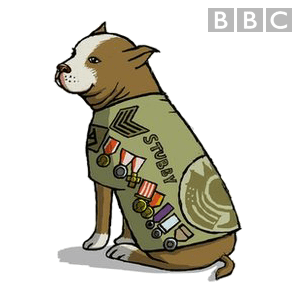
Sergeant Stubby was the most decorated war dog of World War I and the only dog to be promoted to sergeant through combat. While training for combat on the fields of Yale University in 1917, Private J. Robert Conroy found a brindle puppy with a short tail. He named him ‘Stubby,’ and soon the dog became the mascot of the 102nd Infantry, 26th Yankee Division. He learned the bugle calls, the drills, and even a modified dog salute as he put his right paw on his right eyebrow when a salute was executed by his fellow soldiers. Stubby had a positive effect on morale, and was allowed to remain in the camp, even though animals were forbidden.
When the division shipped out for France aboard the SS Minnesota, Private Conroy smuggled Stubby aboard. Hidden in the coal bin until the ship was far at sea, Stubby was brought out on deck where the sailors were soon won over by the canine soldier. Stubby was once again smuggled off the ship and was soon discovered by Pvt. Conroy’s commanding officer. The CO allowed Stubby to remain after Stubby gave him a salute. Continue reading →
Posted in Humor, Politics, War |
Leave a Comment »
July 27, 2011

Captain America is a superhero that appears in Marvel Comics. The character first appeared in 1941, from Marvel Comics’ predecessor, Timely Comics, and was created by Joe Simon and Jack Kirby. For nearly all of the character’s publication history, Captain America was the alter ego of Steve Rogers, a sickly young man who was enhanced to the peak of human perfection by an experimental serum in order to aid the United States war effort. Captain America wears a costume that bears an American flag motif, and is armed with an indestructible shield that can be thrown as a weapon.
An intentionally patriotic creation who was often depicted fighting the Axis powers of World War II, Captain America was Timely Comics’ most popular character during the wartime period. After the war ended, the character’s popularity waned and he disappeared by the 1950s. He was reintroduced during the Silver Age of comics when he was revived from suspended animation by the superhero team the Avengers in 1964.
Continue reading →
Posted in Art, Politics, War |
Leave a Comment »
July 26, 2011


Dub is a genre of music which grew out of 1960’s reggae. Music in this genre consists predominantly of instrumental remixes of existing recordings which have been manipulated and reshaped, usually by removing the vocals, and emphasizing the drum and bass elements (this stripped down track is sometimes referred to as a ‘riddim’). Other techniques include dynamically adding extensive echo, reverb, panoramic delay, and occasional dubbing of vocal or instrumental snippets from the original version or other works. Dub also sometimes features electronically generated sound effects, or the use of distinctive instruments such as the melodica by artists such as Augustus Pablo.
Dub was pioneered by Osbourne ‘King Tubby’ Ruddock, Lee ‘Scratch’ Perry, Errol Thompson and others in the late 1960s. Similar experiments with recordings at the mixing desk outside of the dancehall environment were also done by producers Clive Chin and Herman Chin Loy. These producers, especially Ruddock and Perry, looked upon the mixing desk as an instrument, manipulating tracks to come up with something new and different. Dub has influenced many genres of music, including punk, hip hop, disco, house, and trip hop, and has become a basis for jungle/drum’n’bass and dubstep music.
Continue reading →
Posted in Art, Language, World |
Leave a Comment »
July 26, 2011

A dubplate is an acetate disc — usually 12, 10, or 7 inches in diameter — used in mastering studios for quality control and test recordings before proceeding with the final master, and subsequent pressing of the record to be mass-produced on vinyl. The ‘dub’ in dubplate is an allusion to the plate’s use in ‘dubbing’ or ‘doubling’ the original version of a track. In music, dubbing is copying of audio recordings from one medium to another.
The name dubplate also refers to an exclusive, ‘one-off’ disc recording pioneered by reggae sound systems but also used by drum and bass and other dance music artists, DJs and sound systems. These dubplates will often be unreleased recordings (which may or may not end up being made available to the general public). They are often used as a market research tool to assess the probable sales of a song once it’s released, as they are far cheaper to produce than a pressed vinyl record. However, because they have a limited life-span they can only be used about fifty times.
Posted in Art, Language, Technology |
Leave a Comment »
July 26, 2011

Biophilia is the musical project and forthcoming eighth full-length studio album from Icelandic singer Björk. The album is ‘partly recorded’ on an iPad and will be released in the form of a series of apps. Biophilia will be the world’s ‘first app album’ in collaboration with Apple. Björk has described the project as a multimedia collection ‘encompassing music, apps, internet, installations, and live shows.’ Scott Snibbe, an interactive artist was commissioned by Björk in the summer of 2010 to produce the app, as well as the images for the live shows (which will combine his visuals with National Geographic imagery, mixed live from iPads on the stage).
For the song, ‘Virus,’ the app will feature a close-up study of cells being attacked by a virus to represent what Snibbe calls: ‘A kind of a love story between a virus and a cell. And of course the virus loves the cell so much that it destroys it.’ The interactive game challenges the user to halt the attack of the virus, although the result is that the song will stop if the player succeeds. In order to hear the rest of the song, the players will have to let the virus take its course. Using some artistic license, the cells will also mouth along to the chorus. Björk is determined to fuse different elements together, be it juxtaposing a female choir from Greenland with the bleeps and glitches of electronic music pioneers Matmos during the Vespertine tour, or meshing soaring strings and jagged beats on ‘Homogenic,’ that ‘helps explain the power and success of Björk’s collaborations.’
Posted in Art, Games, Technology |
Leave a Comment »




