April 1, 2011
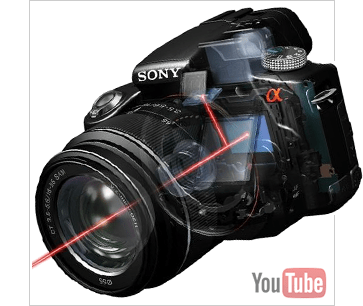
A Single-Lens Translucent (SLT) camera is similar to a Digital Single-Lens Relex (DSLR) but uses a beam splitter instead of a solid mirror. Unlike DSLRs SLT cameras do not have an optical viewfinder, instead they rely on an electronic viewfinder, using the image collected by the sensor. A DSLR mirror allows the user to directly view the image that is passing through the lens; in a SLT the mirror is only used for focusing.
A semi-translucent mirror allows the majority of the light to pass through to the sensor while reflecting a portion of the light onto a phase-detection autofocus sensor in the top of the camera, allowing the camera to take photos without any mirror movement (and associated vibrations), as well as full time auto focus. Since the autofocus array is constantly receiving light, SLT cameras are able to use phase-detection autofocus during video recording, while DSLR’s and other interchangeable lens cameras have to use slower contrast detect autofocus for video and live view.
Posted in Money, Technology |
Leave a Comment »
April 1, 2011


A mirrorless interchangeable lens camera is an emerging class of digital system cameras, intermediate between compact digital cameras and digital single-lens reflex cameras (DSLRs).
They are characterized by large sensors (the same size as entry-level DSLRs), no mirror, and interchangeable lenses, as the name suggests, and provide DSLR-quality pictures in a significantly smaller camera.
Posted in Money, Technology |
Leave a Comment »
April 1, 2011

A molten salt reactor (MSR) is a type of nuclear fission reactor in which the primary coolant is a molten salt mixture, which can run at high temperatures (for higher thermodynamic efficiency) while staying at low vapor pressure for reduced mechanical stress and increased safety, and is less reactive than molten sodium coolant.
The nuclear fuel may be solid fuel rods, or dissolved in the coolant itself, which eliminates fuel fabrication, simplifies reactor structure, equalizes burnup, and allows online reprocessing. One kind of proposed MSR is a liquid fluoride thorium reactor (LFTR). Thorium is a naturally occurring radioactive chemical element estimated to be about three to four times more abundant than uranium in the Earth’s crust.
Posted in Money, Technology |
Leave a Comment »
March 31, 2011

Das Racist is a rap group based in Brooklyn, composed of Heems (Himanshu Suri) and Kool A.D. (Victor Vazquez) joined by hype man Dap (Ashok Kondabolu) for live performances and in music videos. Known for their use of humor, obscure references, and unconventional style, Das Racist has been both dismissed as joke rap and hailed as an urgent new voice in rap. The name derives from a segment on sketch comedy program, ‘Wonder Showzen.’
Posted in Art, Humor |
Leave a Comment »
March 31, 2011

Joe Wong is a Chinese American comedian. He grew up in Jilin Province, China, and came to study chemistry at Rice University in Texas in 1994. He moved to Boston in 2001 and began to perform his comedy.
Posted in Humor, Politics, World |
Leave a Comment »
March 31, 2011
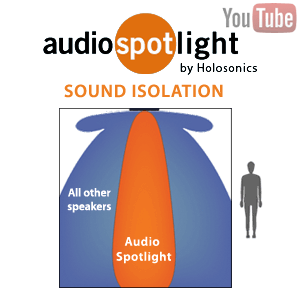
Sound from ultrasound refers to ultrasound (sound pressure with a frequency greater than the upper limit of human hearing, approx. 20 kilohertz) that has been modulated and demodulated. Ultrasound has wavelengths much smaller than audible sound and thus can be aimed in a much tighter narrow beam than any traditional audible loudspeaker system. A narrow beam of modulated ultrasound changes the speed of sound in the air that it passes through. The air within the beam extracts the signal from the ultrasound, resulting in sound that can be heard only along the path of the beam, or that appears to radiate from any surface that the beam strikes.
The practical effect of this technology is that a beam of sound can be projected over a long distance to be heard only in a small well-defined area. A listener outside the beam hears nothing. Anyone or anything that disrupts the path of the beam will interrupt the progression of the beam, like interrupting the illumination of a spotlight. For this reason, most systems are mounted overhead, like lighting. This technology was originally developed by the US Navy and Soviet Navy for underwater sonar in the mid-1960s, and was briefly investigated by Japanese researchers in the early 1980s, but these efforts were abandoned due to extremely poor sound quality (high distortion) and substantial system cost.
Posted in Money, Technology |
Leave a Comment »
March 31, 2011
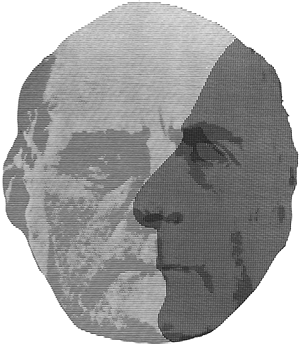
Francis Galton (1822 – 1911) was an English Victorian polymath: anthropologist, eugenicist, tropical explorer, geographer, inventor, meteorologist, and statistician. Galton had a prolific intellect, and produced over 340 papers and books throughout his lifetime. He also created the statistical concept of correlation. He was the first to apply statistical methods to the study of human differences and inheritance of intelligence, and introduced the use of questionnaires and surveys for collecting data on human communities.
He was a pioneer in eugenics, coining the term itself and the phrase ‘nature versus nurture.’ As the initiator of scientific meteorology, he devised the first weather map. He also invented the Dog Whistle for testing differential hearing ability.
Posted in Science, Technology, World |
Leave a Comment »
March 31, 2011

A dog whistle is a type of whistle used in the training of dogs and cats. It was invented by British polymath, Francis Galton. The frequency range of a dog whistle is largely out of the range of human hearing. Typically, a dog whistle is within the range of 16 to 22 kHz with only the frequencies below 20 kHz audible to the human ear.
Some dog whistles have adjustable sliders for active control of the frequency produced. Depending on the way the whistle is used, a trainer may simply gather a dog’s attention or inflict pain for the purpose of behavior modification. The name dog whistle is often used for both lung-powered whistles as well as electronic devices that emit ultrasonic sound via piezoelectric emitters. The electronic variety are sometimes coupled with bark detection circuits in an effort to curb barking behavior.
Posted in Technology |
Leave a Comment »
March 31, 2011

Infrasound [in-fruh-sound] is sound that is lower in frequency than 20 Hz or cycles per second, the ‘normal’ limit of human hearing. Hearing becomes gradually less sensitive as frequency decreases, so for humans to perceive infrasound, the sound pressure must be sufficiently high. The ear is the primary organ for sensing infrasound, but at higher levels it is possible to feel infrasound vibrations in various parts of the body.
The study of such sound waves is sometimes referred to as infrasonics, covering sounds beneath 20 Hz down to 0.001 Hz. This frequency range is utilized for monitoring earthquakes, charting rock and petroleum formations below the earth, and also to study the mechanics of the heart. Infrasound is characterized by an ability to cover long distances and get around obstacles with little dissipation.
Continue reading →
Posted in Art, Health, Science |
Leave a Comment »
March 31, 2011

The Prisoner’s Cinema is a phenomenon reported by prisoners confined to dark cells and by others kept in darkness, voluntarily or not, for long periods of time. It has also been reported by truck drivers, pilots, and practitioners of intense meditation. Astronauts and other individuals that have been exposed to certain types of radiation have reported witnessing similar phenomena.
The ‘cinema’ consists of a light show of various colors that appear out of the darkness. The light has a form, but those that have seen it find it difficult to describe. Sometimes, the cinema lights resolve into human or other figures. Scientists believe it is a result of phosphenes (flashes of light, often associated with inflammation of the optic nerve) combined with the psychological effects of prolonged exposure to darkness.
Posted in Health, Science |
Leave a Comment »
March 31, 2011

Charles Bonnet syndrome (CBS) is a condition that causes patients with visual loss to have complex visual hallucinations, first described by Charles Bonnet in 1760, and first introduced into English-speaking psychiatry in 1982. Sufferers, who are mentally healthy people with often significant visual loss, have vivid, complex recurrent visual hallucinations. Often they come in the form of ‘lilliput hallucinations,’ in which objects are smaller than normal.
Sufferers understand that the hallucinations are not real, and the hallucinations are only visual. People suffering from CBS may experience a wide variety of hallucinations, such as images of complex colored patterns and images of people, or animals, plants or trees and inanimate objects. The hallucinations also often fit into the person’s surroundings. Oliver Sacks, a neurologist and author who suffers from a retinal tumor, gave a TED talk about this and other visual hallucinations.
Posted in Health, Science |
Leave a Comment »
March 31, 2011

Musical ear syndrome (MES) refers to auditory hallucinations subsequent to hearing loss. It is comparable to Charles Bonnet syndrome (visual hallucinations by visually impaired people) and some have suggested this phenomenon could be included under that diagnosis. The occurrence of MES has been suggested to be very high among the hearing impaired. Sufferers typically hear music or singing and the condition is more common in women. The hallucinatory experiences differ from psychotic disorders although there may be some overlap.
The likely cause is a small cerebrovascular event affecting the auditory cortex. The ‘hole’ in the hearing range is ‘plugged’ by the brain confabulating a piece of information – in this case a remembered melody. A similar occurrence is seen with strokes of the visual cortex where a visual field defect occurs and the brain confabulates a piece of visual data to fill the spot. Towards the end of his life, Robert Schumann said he heard angelic music and music from other composers, which formed the basis for his violin concerto (however, his symptoms may also have been caused by syphilis or mercury poisoning).
Posted in Art, Health, Science |
1 Comment »