March 22, 2011

Kustom Kulture is an an aesthetic and lifestyle born out of the hot rod culture of Southern California of the 1960s, associated with artists such as Kenny Howard (also known as Von Dutch), custom car builders such as ‘Big Daddy’ Ed Roth and Dean Jeffries, hot rod and lowrider customizers such as the Barris Brothers, along with numerous tattoo artists, automobile painters, and movies and television shows such as ‘American Graffiti,’ ‘Happy Days,’ ‘The Munsters’ and ‘The Monkees.’
Kustom Kulture is usually identified with the greasers of the 1950s, the drag racers of the 1960s, and the lowriders of the 1970s. Other subcultures that have had an influence on Kustom Kulture are the Skinheads, mods and rockers of the 1960s, the punks of the 1970s, metal and rockabilly music, the scooterboys of the 1980s, and psychobilly of the 1990s. Each has its own style, but common themes include wild pinstriped paintjobs, choptop Mercurys, custom Harley-Davidson and Triumph Motorcycles, metalflake and black primer paint jobs, and monster movies.
Posted in Art, Politics, Technology |
1 Comment »
March 22, 2011
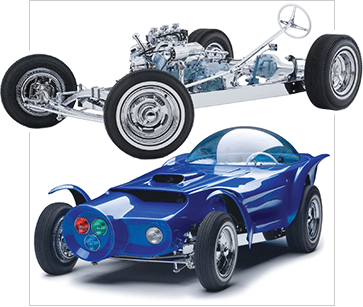
The Orbitron is a custom car built by Ed Roth and feared lost until its rediscovery in Mexico in 2007. Built in 1964, the vehicle was powered by a 1955 or 1956 Chevrolet V8 and was backed by a Powerglide automatic transmission. The body was hand-laid fiberglass which actually hid Roth’s extensive chrome work to the chassis.
The cockpit, set at the extreme rear of the vehicle in the manner of a dragster, was lined with fake fur and featured a General Electric portable television inserted in the console. Topping the cockpit was a custom-made, hydraulically operated plexiglass bubble top. One of a series of ordinary doorbell switches atop the hood activated the top from the outside.
Continue reading →
Posted in Art, Money, Technology |
Leave a Comment »
March 22, 2011

‘Big Daddy‘ Ed Roth (1932 – 2001) was an artist and cartoonist who created the hot-rod icon ‘Rat Fink.’ As a custom car builder, Roth was a key figure in Southern California’s Kustom Kulture and hot-rod movement of the 1960s. He grew up in Bell, California, attending Bell High School, where his classes included auto shop and art. Roth is best known for his grotesque caricatures — typified by Rat Fink — depicting imaginative, out-sized monstrosities driving representations of the hot rods that he and his contemporaries built.
Although Detroit native Stanley Mouse is credited with creating the so-called ‘Monster Hot Rod’ art form, Roth is the individual who popularized it. Roth is also well known for his innovative work in turning hot rodding from crude backyard engineering, where performance was the bottom line, into a refined art form where aesthetics were equally important, breaking new ground with fiberglass bodywork.
Posted in Art, Humor, Money |
Leave a Comment »
March 22, 2011

The Biker Cross is a derivative of the Iron Cross (a Prussian, and later German, military decoration). Bikers started to display the Iron Cross in the mid 1960’s with the advent of outlaw biker gangs. Originally bikers displayed the Iron Cross as a symbol of rebellion to society in general.
Today it is also worn to signify honor, valor, strength and ‘standing up for what you believe.’ Hot rodders (American car customizers) and others also use it as a provocative gesture to offend the public, or as a symbol of rebellion or non-conformity.
Continue reading →
Posted in Art, Language, War |
Leave a Comment »
March 21, 2011
Multivac is the name of a fictional supercomputer in many stories by Isaac Asimov. Like most of the technologies Asimov describes in his fiction, Multivac’s exact specifications vary among appearances. In all cases, it is a government-run computer that answers questions, usually buried deep underground for security purposes. However, Asimov never settles on a particular size for the computer except for mentioning it is very large.
Unlike the artificial intelligences portrayed in his ‘Robot’ Series, Multivac’s interface is mechanized and impersonal, consisting of complex command consoles few humans can operate. Though the technology depended on bulky vacuum tubes, the concept – that all information could be contained on computer(s) and accessed from a domestic terminal – constitutes an early reference to the possibility of the Internet.
Posted in Art, Language, Technology |
1 Comment »
March 21, 2011

‘The Last Question‘ is a science fiction short story by Isaac Asimov. It first appeared in the November 1956 issue of Science Fiction Quarterly. It was Asimov’s favorite short story of his own authorship, and is one of a loosely connected series of stories concerning a fictional computer called Multivac. In conceiving Multivac, Asimov was extrapolating the trend towards centralization that characterised computation technology planning in the 1950s to an ultimate centrally managed global computer.
The story deals with the development of computers called Multivacs and their relationships with humanity through the courses of seven historic settings, beginning in 2061. In each of the first six scenes a different character presents the computer with the same question; namely, how the threat to human existence posed by the heat death of the universe can be averted.
Posted in Art, Technology |
Leave a Comment »
March 21, 2011
Virgin Galactic is a company within Richard Branson’s Virgin Group which plans to provide sub-orbital spaceflights to the paying public, along with suborbital space science missions and orbital launches of small satellites. Further in the future Virgin Galactic hopes to offer orbital human spaceflights as well. Tickets are priced at $200,000 per person with a $20,000 deposit. The vehicle is a six passenger, two pilot craft. Test launches are planned to take place from the Mojave Spaceport, where Scaled Composites is constructing the spacecraft.
The spacecraft, SpaceShipTwo, will be carried to about 16 kilometers or 52000 ft by a carrier aircraft, White Knight II. At that point, when the carrier aircraft reaches its maximum height, the SpaceShipTwo vehicle will separate and continue to over 100 km (the Kármán line, a common definition of where ‘space’ begins). The time from liftoff of the White Knight booster carrying SpaceShipTwo until the touchdown of SpaceShipTwo after the sub-orbital flight will be about 3.5 hours. The sub-orbital flight itself will only be a small fraction of that time. The weightlessness will last approximately 6 minutes.
Posted in Money, Technology |
Leave a Comment »
March 21, 2011

The 2suit is a garment designed to facilitate intimacy in weightless environments such as outer space, or on planets with low gravity. It was invented by American novelist, actress Vanna Bonta in 2006 after an experience in microgravity in 2004 when she flew with the National Space Society.
The garment is made of two components flight suits designed to be worn alone or attached to another 2S model for the purpose of intimacy or sex in space. The 2suit is equipped to fasten to a stable surface. The roominess within the garment is adjustable from within. It also is lined with inner harnesses for optional use that can regulate the garment to adjust proximity of various points of the bodies to one another.
Posted in Sex, Technology |
Leave a Comment »
March 21, 2011

Vernor Vinge (b. 1944) is a computer scientist and science fiction author. He is best known for his Hugo Award-winning novels and novellas A Fire Upon the Deep (1992), as well as his 1993 essay ‘The Coming Technological Singularity,’ in which he argues that the creation of superhuman artificial intelligence will mark the point at which ‘the human era will be ended,’ such that no current models of reality are sufficient to predict beyond it.
Vinge came to prominence in 1981 with his novella ‘True Names,’ perhaps the first story to present a fully fleshed-out concept of cyberspace, which would later be central to cyberpunk stories by William Gibson, Neal Stephenson and others.
Continue reading →
Posted in Art, Technology |
Leave a Comment »
March 21, 2011
Colin Stetson, born in Ann Arbor, Michigan, is a bass saxophone player and touring member of Arcade Fire and Bell Orchestre. In addition to saxophone, he plays clarinet, bass clarinet, french horn, flute, and cornet.
Stetson has worked with dozens of artists, including David Byrne, Tom Waits, TV on the Radio, Sinéad O’Connor, and LCD Soundsystem. His solo album New History Warfare, Vol 1. was released in 2008. The follow up, New History Warfare, Vol. 2: Judges was released in 2011.
Posted in Art, Money |
Leave a Comment »
March 21, 2011
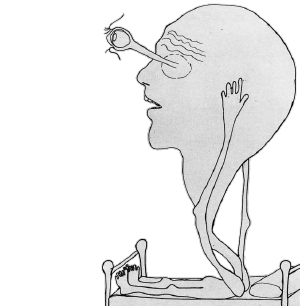
Alice in Wonderland syndrome (AIWS), also known as Todd’s syndrome, is a disorienting neurological condition which affects human perception. Sufferers may experience visual and other sensory distortions. A temporary condition, it is often associated with migraines, brain tumors, and the use of psychoactive drugs.
It can also present as the initial sign of the Epstein-Barr Virus. Anecdotal reports suggests that the symptoms of AIWS are fairly common in childhood, with many people growing out of them in their teens. It appears that AIWS is also a common experience at sleep onset.
Posted in Drugs, Health |
Leave a Comment »
March 21, 2011

Hefty Records is an independent record label based in Chicago, founded in 1995 by John Hughes III (aka Slicker). The label has established itself as a home for innovative electronica, releasing post-rock, IDM, downtempo, nu jazz, experimental music, and hip-hop. The label was formed by Hughes (as well as Bill Ding and Dan Snazelle) as a way of releasing his own music from his Ohio University dorm room in 1995. Soon afterwards a demo was given to Hughes from Scott Herren who was added to the roster under the name Savath and Savalas.
Hefty released the ‘Immediate Action’ series in 2000, a limited collection of six vinyl records from various electronic artists. All the records were hand pressed by Hughes, with sleeves created by the Brooklyn graphics company Graphic Havoc (now known as GHAVA), which used a stencil and spray painting technique to create each album; with different stickers to tell them apart.
Posted in Art, Money |
Leave a Comment »