March 21, 2011
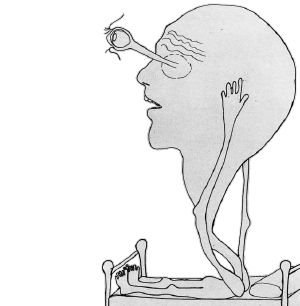
Alice in Wonderland syndrome (AIWS), also known as Todd’s syndrome, is a disorienting neurological condition which affects human perception. Sufferers may experience visual and other sensory distortions. A temporary condition, it is often associated with migraines, brain tumors, and the use of psychoactive drugs.
It can also present as the initial sign of the Epstein-Barr Virus. Anecdotal reports suggests that the symptoms of AIWS are fairly common in childhood, with many people growing out of them in their teens. It appears that AIWS is also a common experience at sleep onset.
Posted in Drugs, Health |
Leave a Comment »
March 21, 2011

Hefty Records is an independent record label based in Chicago, founded in 1995 by John Hughes III (aka Slicker). The label has established itself as a home for innovative electronica, releasing post-rock, IDM, downtempo, nu jazz, experimental music, and hip-hop. The label was formed by Hughes (as well as Bill Ding and Dan Snazelle) as a way of releasing his own music from his Ohio University dorm room in 1995. Soon afterwards a demo was given to Hughes from Scott Herren who was added to the roster under the name Savath and Savalas.
Hefty released the ‘Immediate Action’ series in 2000, a limited collection of six vinyl records from various electronic artists. All the records were hand pressed by Hughes, with sleeves created by the Brooklyn graphics company Graphic Havoc (now known as GHAVA), which used a stencil and spray painting technique to create each album; with different stickers to tell them apart.
Posted in Art, Money |
Leave a Comment »
March 21, 2011

Telefon Tel Aviv is an American electronic music act formed in 1999. Formerly comprising Charles Cooper and Joshua Eustis, Telefon Tel Aviv continues with Eustis as the sole official member since Cooper’s death in 2009 from an accidental overdose of sleeping pills and alcohol. The two were high school friends whose four-song demo was picked up by John Hughes III’s music label, Hefty.
Posted in Art |
Leave a Comment »
March 21, 2011
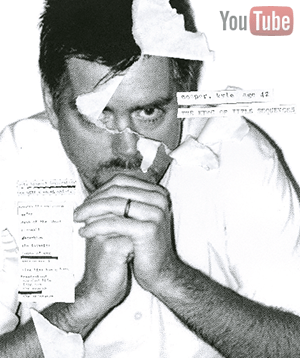
Kyle Cooper is an acclaimed modern designer of motion picture title sequences. He studied graphic design under Paul Rand at Yale University. In 1995 he designed the title sequence for the film Se7en, a seminal work which received critical acclaim and inspired a number of younger designers.
In 1996, he co-founded Imaginary Forces, a design firm, and in 2003 another firm, Prologue, based in Los Angeles. Cooper has also directed a feature film, New Port South (2001), a teen drama produced by John Hughes, based on a script written by Hughes’ son James. The project was filmed in Chicago and scored by Telefon Tel Aviv.
Posted in Art, Money |
Leave a Comment »
March 19, 2011
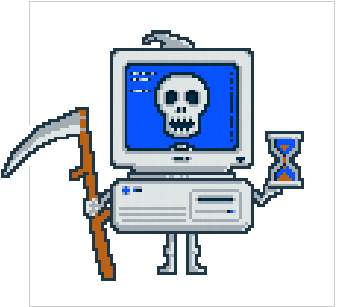
In many computer operating systems a special type of error message will display onscreen when the system has experienced a fatal error. Computer users have dubbed these messages screens of death as they typically result in unsaved work being lost and often indicate serious problems with the system’s hardware or software.
Screens of death are usually the result of a ‘kernel panic’ (an action taken by an operating system upon detecting an internal fatal error from which it cannot safely recover), although the terms are frequently used interchangeably. Most screens of death are displayed on an even background color with a message advising the user to restart the computer.
Posted in Death, Humor, Technology |
Leave a Comment »
March 19, 2011

A kill screen is a stage or level in a video game (often an arcade game) that stops the player’s progress due to a programming error or design oversight. Rather than ‘ending’ in a traditional sense, the game will crash, freeze, or behave so erratically that further play is impossible. Pac-Man has a famous kill screen often referred to as the ‘Pac-Man Bomb Screen.’ The game’s level counter was a single 8-bit byte and could therefore store only 256 distinct values. Reaching the 256th level causes the counter that is used while drawing the fruit to overflow to zero, causing 256 fruits and seven blank spaces to be drawn.
Kill screens were much more common during the Golden Age of Arcade Games. Games from this era were often written with the assumption that the player would stop playing long before the numerical limits of the game code were reached; most games from this period were intended to continue until the players lost all of their lives. Additionally, the limited hardware of these early machines often meant that programmers could not spend memory on logical checks of the game state.
Posted in Games, Language, Technology |
Leave a Comment »
March 19, 2011

The stereographic projection, in geometry, is a particular mapping that projects a sphere onto a plane. The projection is defined on the entire sphere, except at one point — the projection point. Intuitively, then, the stereographic projection is a way of picturing the sphere as the plane, with some inevitable compromises. Because the sphere and the plane appear in many areas of mathematics and its applications, so does the stereographic projection; it finds use in diverse fields including complex analysis, cartography, geology, and photography.
The projection has been used to map spherical panoramas. This results in interesting effects: the area close to the point opposite to the center of projection becomes significantly enlarged, resulting in an effect known as little planet (when the center of projection is the nadir) and tube (when the center of projection is the zenith).
Posted in Art, Technology |
Leave a Comment »
March 19, 2011

Operation Odyssey Dawn is the codename for the United States participation in a Libyan no-fly zone. The United Kingdom counterpart to this is Operation Ellamy, the French Opération Harmattan. The no-fly zone was proposed during the 2011 Libyan uprising to prevent government forces loyal to Muammar Gaddafi from carrying out air attacks on rebel forces.
Allied operations began with surveillance operations, air attacks and missiles aimed at Libyan military targets. It was reported by the Pentagon that the first strike involved the launch of over 100 Tomahawk cruise missile against shoreline air defenses of the Gaddafi regime.
Posted in Politics, War, World |
Leave a Comment »
March 17, 2011

The term foobar is used as a placeholder name in computer programming. It is used to name entities such as variables, functions, and commands whose purpose is unimportant and serve only to demonstrate a concept. The words themselves have no meaning in this usage. Foobar is sometimes used alone; ‘foo,’ ‘bar,’ and ‘baz’ are sometimes used in that order, when multiple entities are needed.
The origins of the terms are not known with certainty, and several anecdotal theories have been advanced to identify them. Foobar may have derived from the military acronym FUBAR (fucked up beyond all recognition) and gained popularity because it is pronounced the same. In this meaning it also can derive from the German word ‘furchtbar,’ which means awful and terrible and described the circumstances of the Second World War.
Posted in Language, Technology |
Leave a Comment »
March 17, 2011

Tuángòu [twangoo], which loosely translates as ‘team buying’ or ‘group buying’ (also known as store mobbing), is a recently developed shopping strategy originating in the People’s Republic of China.
Several people – sometimes friends, but possibly strangers connected over the internet – agree to approach a vendor of a specific product in order to haggle with the proprietor as a group in order to get discounts. The entire group agrees to purchase the same item. The shoppers benefit by paying less, and the business benefits by selling multiple items at once.
Posted in Money, Technology, World |
Leave a Comment »
March 17, 2011

Crowdsourcing is the act of outsourcing tasks, traditionally performed by an employee or contractor, to an undefined, large group of people or community (a ‘crowd’), through an open call. Jeff Howe, one of first authors to employ the term, established that the concept depends essentially on the fact that because it is an open call to an undefined group of people, it gathers those who are most fit to perform tasks, solve complex problems and contribute with the most relevant and fresh ideas.
For example, the public may be invited to develop a new technology, carry out a design task (community-based design and distributed participatory design), refine or carry out the steps of an algorithm (human-based computation), or help capture, systematize or analyze large amounts of data (citizen science). The term has become popular with businesses, authors, and journalists as shorthand for the trend of leveraging the mass collaboration enabled by Web 2.0 technologies to achieve business goals.
Posted in Language, Money, Technology |
Leave a Comment »
March 17, 2011

Kickstarter is an online threshold pledge system for funding creative projects, from indie film and music to journalism to consumer products, and food-related projects. One of a new set of fundraising platforms dubbed ‘crowdfunding,’ Kickstarter facilitates gathering monetary resources from the general public, a model which circumvents many traditional avenues of investment. It was founded in 2009 by Perry Chen, Yancey Strickler, and Charles Adler in Manhattan. Project owners choose a deadline and a target minimum of funds to raise. If the chosen target is not gathered by the deadline, no funds are collected (a provision point mechanism).
Money pledged by donors is collected using Amazon Payments, and initiating projects requires a US bank account. Kickstarter turns a profit by claiming 5% of the funds raised; Amazon takes an additional percentage (around two). Unlike many forums for fundraising or investment, Kickstarter claims no ownership over the projects and the work they produce. However, projects launched on the site are permanently archived and accessible to the public. After funding is completed, projects and uploaded media cannot be edited or removed from the site.
Posted in Art, Money, Technology |
Leave a Comment »