February 21, 2011
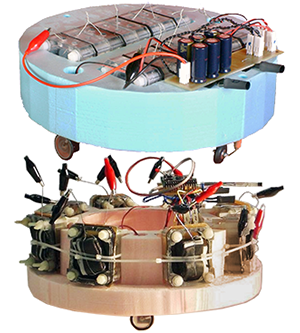
EcoBot refers to a class of robots that can remain self-sustainable by collecting their energy from waste in the environment. The only by-product from this process is carbon dioxide, which would have been produced from biodegradation in the first place. EcoBots do not employ any other form of conventional power supply and do not require any form of initial charging from an external source. Instead, they are powered directly by the on-board microbial fuel cells (MFCs).
EcoBot-I, was developed in 2002 at Bristol Robotics Laboratory (U.K.); it utilized sugar as the fuel to perform phototaxis (move towards the light). EcoBot-II (2004) was the first robot in the world to perform sensing, information processing, communication and phototaxis, by utilizing unrefined biomass (e.g. dead flies, rotten fruits and crustacean shells). EcoBot-II operated continuously for 12 days after having been fed with 8 houseflies.
Posted in Food, Technology |
Leave a Comment »
February 21, 2011
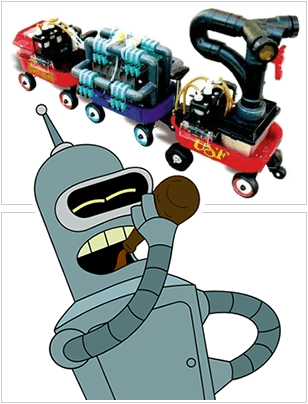
Gastrobot (literally ‘robot with stomach’) was a term coined in 1998 by the University of South Florida Institute’s director, Dr. Stuart Wilkinson. A gastrobot is a machine that derives all its energy from the digestion of food (a mixture of carbohydrates and protein). These molecules are obtained through a microbial fuel cell (MFC) which then converts the food into gases and other potential energy. The gases and liquids are used to help fuel things such as a hydrogen fuel cell which help create more energy, along with other gases that help power the mechanics of the gastrobot.
The future of these robots supposedly is for certain types of so called ‘start and forget’ missions on an ecological plateau which would be Earth at the current period in time. Their optic sensors may have artificial intelligence software that allows them to determine what is edible for consumption and energy conversion. Possible future commercial uses would be a self powered lawnmower that would obtain energy for itself from the cellulose in the grass cuttings.
Posted in Food, Technology |
Leave a Comment »
February 21, 2011


Canard [kuh-nahrd] is the French word for duck. The word also can mean an unfounded or false, deliberately misleading fabrication, a false report, rumor or hoax. That usage derives from the phrase ‘vendre un canard à moitié’ (‘to half-sell a duck’), thus, from some long-forgotten joke, ‘to cheat.’ The Canard Digérateur, or Digesting Duck, was an automaton in the form of a duck, created in 1739 by Jacques de Vaucanson (the French inventor credited with creating the world’s first true robots, as well as the first automated loom).
The mechanical duck appeared to have the ability to eat kernels of grain, and to metabolize and defecate them. While the duck did not actually have the ability to do this – the food was collected in one inner container, and the pre-stored feces was ‘produced’ from a second, so that no actual digestion took place – Vaucanson hoped that a truly digesting automaton could one day be designed.
Posted in Art, Language, Technology |
Leave a Comment »
February 21, 2011
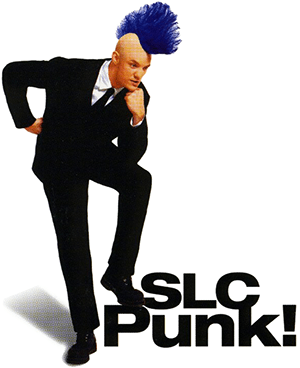
Matthew Lillard (b. 1970) is an American actor known for his roles as Stu Macher in ‘Scream,’ Stevo in ‘SLC Punk,’ and Shaggy Rogers in the ‘Scooby-Doo’ film series – he has taken over the providing the voice of Shaggy in the cartoon series since the reboot ‘Mystery Incorporated.’ Lillard made a dramatic turn in Alexander Payne’s critically acclaimed comedy-drama ‘The Descendants.’
Lillard attended Foothill High school in Santa Ana, California and later the American Academy of Dramatic Arts in Pasadena, California, with fellow actor Paul Rudd, and later, the theater school Circle in the Square in New York City. While still in high school, he was co-host of a short-lived TV show titled ‘SK8 TV.’ After high school, he was hired as an extra for ‘Ghoulies 3: Ghoulies Go to College’ (1991).
Posted in Art, Humor |
Leave a Comment »
February 21, 2011

SLC Punk! is a 1999 American independent film, written and directed by James Merendino. The film is about the young punk rock fan Steven ‘Stevo’ Levy, a college graduate living in Salt Lake City. Merendino created the film based on his experience growing up in Salt Lake City. Although not autobiographical, Merendino has said that many characters were based on people he knew. The film features several cliques presented as ‘tribes’: Punks, Mods (wear suits and ties, and ride scooters), Rednecks, Skinheads, Heavy Metal Guys, and New Wavers (neo-hippies).
Posted in Art, Politics |
Leave a Comment »
February 20, 2011

Small Is Beautiful: Economics As If People Mattered is a collection of essays by British economist E. F. Schumacher. It is often used to champion small, appropriate technologies that are believed to empower people more, in contrast with phrases such as ‘bigger is better.’ First published in 1973, ‘Small Is Beautiful’ brought Schumacher’s critiques of Western economics to a wider audience during the 1973 energy crisis and emergence of globalization.
Schumacher argues that the modern economy is unsustainable. Natural resources (like fossil fuels), are treated as expendable income, when in fact they should be treated as capital, since they are not renewable, and thus subject to eventual depletion. He further argues that nature’s resistance to pollution is limited as well. He concludes that government effort must be concentrated on sustainable development.
Posted in Language, Money, Politics |
Leave a Comment »
February 20, 2011

‘Wicked problem‘ is a phrase originally used in social planning to describe a problem that is difficult or impossible to solve because of incomplete, contradictory, and changing requirements that are often difficult to recognize. Moreover, because of complex interdependencies, the effort to solve one aspect of a wicked problem may reveal or create other problems.
A problem whose solution requires a great number of people to change their mindsets and behavior is likely to be a wicked problem. Therefore, many standard examples of wicked problems come from the areas of public planning and policy. These include global climate change, natural hazards, healthcare, the AIDS epidemic, pandemic influenza, international drug trafficking, homeland security, nuclear weapons, and nuclear energy and waste.
Posted in Language, Money, Politics |
Leave a Comment »
February 20, 2011

‘Bread and Circuses‘ (Latin: panem et circenses) is a metaphor for a superficial means of appeasement. In the case of politics, the phrase is used to describe the creation of public approval, not through exemplary or excellent public service or public policy, but through the mere satisfaction of the immediate, shallow requirements of a populace. The phrase also implies the erosion or ignorance of civic duty amongst the concerns of the common man (l’homme moyen sensuel).
In modern usage, the phrase has become an adjective to deride a populace that no longer values civic virtues and the public life. To many across the political spectrum, left and right, it connotes the triviality and frivolity that in popular culture is supposed to have characterized the Roman Empire prior to its decline.
Posted in Language, Money, Politics |
Leave a Comment »
February 20, 2011


Paul Verhoeven (b. 1938) is a Dutch film director, screenwriter, and producer who has made movies in both the Netherlands and the United States. Explicitly violent and/or sexual content and social satire are trademarks of both his drama and science fiction films. He is best known for directing the American feature films RoboCop (1987), Total Recall (1990), Basic Instinct (1992), Showgirls (1995), Starship Troopers (1997), and Hollow Man (2000).
Posted in Art, Money |
Leave a Comment »
February 17, 2011
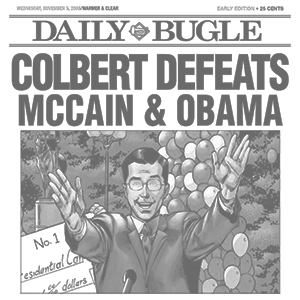
Satire is a literary genre where vices, follies, abuses, and shortcomings are held up to ridicule, ideally with the intent of shaming individuals, and society itself, into improvement. Although satire is usually meant to be funny, its greater purpose is often constructive social criticism, using wit as a weapon.
A common feature of satire is strong irony or sarcasm, but parody, burlesque, exaggeration, juxtaposition, comparison, analogy, and double entendre are all frequently used in satirical speech and writing as well. Satire is not possible under dictatorships. It was not allowed, for example, in the Soviet Union. Anyone trying to make fun of Stalin would have been put to death immediately.
Posted in Humor, Language, Politics |
Leave a Comment »
February 17, 2011

Travis Rice (b. 1982) is a professional snowboarder who grew up and currently resides by Jackson Hole Mountain Resort. He is known for being the ‘Paul Revere’ of the big mountain freestyle movement.
Posted in Games |
Leave a Comment »
February 17, 2011

The Droste [dro-st] effect is a specific kind of recursive picture, one that in heraldry is termed ‘mise en abyme’ (French for ‘placing into infinity’). An image exhibiting the Droste effect depicts a smaller version of itself in a place where a similar picture would realistically be expected to appear. This smaller version then depicts an even smaller version of itself in the same place, and so on. Only in theory could this go on forever; practically, it continues only as long as the resolution of the picture allows, which is relatively short, since each iteration geometrically reduces the picture’s size.
The effect is named after the image on the tins and boxes of Droste cocoa powder, one of the main Dutch brands, which displayed a nurse carrying a serving tray with a cup of hot chocolate and a box with the same image. This image, introduced in 1904 and maintained for decades with slight variations, became a household notion.
Posted in Art, Language, Science |
Leave a Comment »


 The Daily Omnivore