February 16, 2011
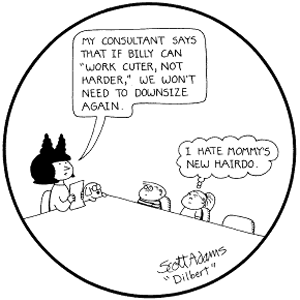
The Comic strip switcheroo was a series of jokes played out between comic strip writers and artists, without the foreknowledge of their editors, on April Fool’s Day 1997. The Switcheroo was masterminded by comic strip creators Rick Kirkman and Jerry Scott, creators of the Baby Blues daily newspaper comic strip.
Posted in Art, Humor |
Leave a Comment »
February 16, 2011

Steal This Book is a book written by Abbie Hoffman in 1970 and published in 1971, which includes advice on growing cannabis, starting a pirate radio station, living in a commune, stealing food, shoplifting, stealing credit cards, preparing a legal defense, making pipe bombs, and obtaining a free buffalo from the Department of the Interior. It discusses various tactics of fighting as well as giving a detailed list of affordable and easy ways to find weapons and armor that can be used in the event of a confrontation with law enforcement. The book advocates rebelling against authority in all forms, governmental and corporate.
In the book, Hoffman referred to America as the ‘Pig Empire’ and stated that it was not immoral to steal from it. In fact, Hoffman wrote, it was immoral not to do so. The term was picked up by the Yippies, and was widely used by what became known as the ‘Woodstock Nation.’ As the book ages, the specific details of the various techniques and advice Hoffman gives have become largely obsolete for technological or regulatory reasons.
Posted in Money, Politics, War |
Leave a Comment »
February 16, 2011

Anti-art is a loosely-used term applied to an array of concepts and attitudes that reject prior definitions of art and question art in general. The term is associated with the Dada movement and is generally accepted as attributable to Marcel Duchamp pre-World War I, when he began to use found objects as art. Anti-art has become generally accepted by fine art collectors, although some still reject Duchamp’s readymades as art, for instance the Stuckist group of artists who are ‘anti-anti-art.’
Posted in Art, Language, Politics |
Leave a Comment »
February 16, 2011

Recuperation [ri-koo-puh-rey-shuhn] is the process by which socially radical ideas are commodified and incorporated into mainstream society. It is the opposite of détournement, in which conventional ideas and images are commodified with radical intentions. Recuperation was first proposed by Marxist theorist Guy Debord and the Situationists. The term sometimes carries a negative connotation among radicals because recuperation often bears the consequence (whether intended or unintended) of fundamentally altering the meanings behind ideas and symbols due to their appropriation into mainstream culture, often to the dismay of the radical groups who originated them.
A dynamic similar to recuperation often occurs in the sphere of the punk rock subculture: many musical styles developed from punk rock (such as Grunge, Thrash metal, Metalcore, Post-punk, Indie rock, New Wave, Emo, and Pop punk) have garnered mainstream popularity; artists of these genres have signed to major labels, and have become household names in the mainstream culture. Kurt Cobain, in his journals, often expressed resentment at how his own band played into this situation. The formerly punk-rock group Chumbawumba, has attempted to subvert the recuperation concept by intentionally ‘selling out’ but then using their earned money to donate to the radical causes.
Posted in Art, Money, Politics |
Leave a Comment »
February 16, 2011

A détournement [deh-tern-eh-mahn] is a variation on a previous media work, in which the newly created one has a meaning that is antagonistic or antithetical to the original. The original media work that is détourned must be somewhat familiar to the target audience, so that it can appreciate the opposition of the new message.
The artist or commentator making the variation can reuse only some of the characteristic elements of the originating work. The term is borrowed from French, and the practice was popularized by Situationist International (an anti-establishment political movement that formed in Italy in the 1950s). A similar term more familiar to English speakers would be ‘turnabout’ or ‘derailment.’
Continue reading →
Posted in Art, Politics |
1 Comment »
February 16, 2011

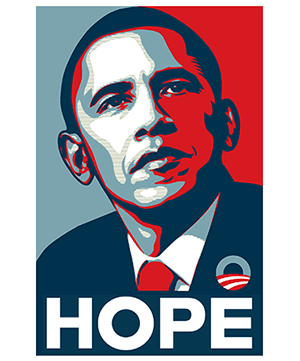
Agitprop [aj-it-prop] (agitation propaganda) refers to highly politicized art. The term originated in Soviet Russia. The term ‘propaganda’ in the Russian language did not bear any negative connotation at the time. It simply meant ‘dissemination of ideas.’ In the case of agitprop, the ideas to be disseminated were those of communism, including explanations of the policy of the Communist Party and the Soviet state. Agitation meant urging people to do what Soviet leaders expected them to do; again, at various levels. In other words, propaganda was supposed to act on the mind, while agitation acted on emotions, although both usually went together, thus giving rise to the cliché ‘propaganda and agitation.’
The term agitprop gave rise to agitprop theatre, a highly-politicized leftist theatre originated in 1920s Europe and spread to America; the plays of Bertolt Brecht being a notable example. Russian agitprop theater was noted for its cardboard characters of perfect virtue and complete evil, and its coarse ridicule. Gradually the term agitprop came to describe any kind of highly politicized art. In the Western world, agitprop has a negative connotation. In the United Kingdom during the 1980s, for example, socialist elements of the political scene were often accused of using agitprop to convey an extreme left-wing message via television programmes or theater.
Posted in Art, Politics |
Leave a Comment »
February 16, 2011
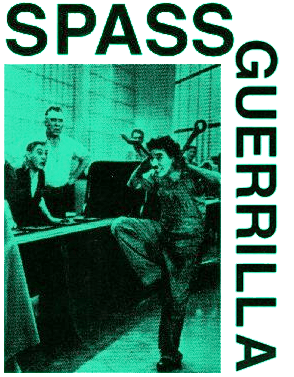
The Spassguerilla (fun guerrilla) was a grouping within the student protest movement of the 1960s in Germany that agitated for social change, in particular for a more libertarian, less authoritarian, and less materialistic society, using tactics characterized by disrespectful humor and provocative and disruptive actions of a minimally violent nature. Events organized by the groups included such actions as attacking politicians or the police with custard pies. One of the main proponents was Fritz Teufel, sometimes referred to as the political clown of the Extraparliamentary Opposition.
The lack of respect for traditional, ‘bourgeois,’ ‘repressive’ forms of authority and ritual, countered by irony and humour, was typified by Fritz Teufel’s reply when told to stand for the judge at a trial: ‘If it helps the search for the truth’ (Wenn’s der Wahrheitsfindung dient). The forms of provocative and disruptive protest invented by the Spassguerilla were later adopted by the peace movement of the 1980s[4] and later by youth protest movements in the reunified Germany. Similar forms of disruption have also been adopted by Cyberspace activists (‘hacktivists’).
Posted in Humor, Politics, War |
Leave a Comment »
February 16, 2011

Buy Nothing Day (BND) is an international day of protest against consumerism observed by social activists. Typically celebrated the Friday after American Thanksgiving in North America and the following day internationally. It was founded by Vancouver artist Ted Dave and subsequently promoted by ‘Adbusters’ magazine in Canada. The first Buy Nothing Day was organized in Vancouver in September 1992. In 1997, it was moved to the Friday after American Thanksgiving, also called ‘Black Friday,’ which is one of the 10 busiest shopping days in the United States.
Outside North America and Israel, Buy Nothing Day is the following Saturday. Adbusters was denied advertising time by almost all major television networks except for CNN, which was the only one to air their ads. Soon, campaigns started appearing in the United States, the United Kingdom, Israel, Austria, Germany, New Zealand, Japan, the Netherlands, France, and Norway. Participation now includes more than 65 nations.
Posted in Humor, Money, Politics |
Leave a Comment »
February 14, 2011
Alphaville: Une étrange aventure de Lemmy Caution (Alphaville: A Strange Adventure of Lemmy Caution) is a 1965 black-and-white French science fiction film directed by Jean-Luc Godard. It combines the genres of dystopian science fiction and film noir (stylish Hollywood crime dramas, particularly those that emphasize cynical attitudes and sexual motivations). Although set far in the future on another planet, there are no special effects or elaborate sets; instead, the film was shot in real locations in Paris, the night-time streets of the capital becoming the streets of Alphaville, while modernist glass and concrete buildings represent the city’s interiors.
Expatriate American actor Eddie Constantine plays Lemmy Caution, a trenchcoat-wearing secret agent. Constantine had already played this or similar roles in dozens of previous films; the character was originally created by British pulp novelist Peter Cheyney. However, in Alphaville, director Jean-Luc Godard moves Caution away from his usual twentieth century setting, and places him in a futuristic sci-fi dystopia, the technocratic dictatorship of Alphaville.
Posted in Art, Politics |
Leave a Comment »
February 14, 2011

Jean-Luc Godard (b. 1930) is a French-Swiss filmmaker. He is often identified with the group of filmmakers known as the Nouvelle Vague, or ‘French New Wave.’ Many of his films challenge the conventions of traditional Hollywood cinema as well as the French equivalent. He is often considered the most extreme or radical of the New Wave filmmakers. His films express his political ideologies as well as his knowledge of film history. In addition, Godard’s films often cite existentialism as he was an avid reader of existential and Marxist philosophy.
His radical approach in movie conventions, politics and philosophies made him the most influential filmmaker of the French New Wave, inspiring directors as diverse as Quentin Tarantino, Martin Scorsese, Bernardo Bertolucci, Paul Thomas Anderson, Arthur Penn, Hal Hartley, Richard Linklater, Gregg Araki, John Woo, Mike Figgis, Robert Altman, Steven Soderbergh, Richard Lester, Jim Jarmusch, Rainer Werner Fassbinder, Brian De Palma, Wim Wenders, Oliver Stone and Ken Loach.
Posted in Art |
Leave a Comment »
February 14, 2011

The New Wave (French: La Nouvelle Vague) was a term coined by critics for a group of French filmmakers of the late 1950s and 1960s, influenced by Italian Neorealism (a style of film characterized by stories set amongst the poor and working class) and classical Hollywood cinema. French New Wave was a product of the social and political upheavals of the era; radical experiments with editing, visual style and narrative broke with the conservative paradigm.
Continue reading →
Posted in Art, Language, World |
Leave a Comment »
February 14, 2011
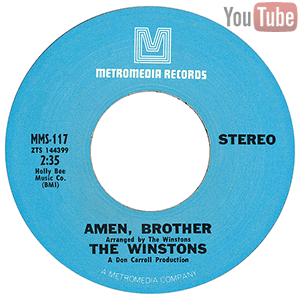
The ‘Amen break‘ was a brief drum solo performed in 1969 by G. C. Coleman in the song ‘Amen, Brother’ performed by the 1960s funk and soul outfit The Winstons. It gained fame from the 1980s onwards when four bars (5.2 seconds) sampled from the drum-solo (or imitations thereof) became very widely used as sampled drum loops in hip hop and other music. The full song is an up-tempo instrumental rendition of Jester Hairston’s ‘Amen,’ which he wrote for the Sidney Poitier film Lilies of the Field (1963) and which was subsequently popularized by The Impressions in 1964.
The Winstons’ version was released as a B-side of the 45 RPM 7-inch vinyl single ‘Color Him Father’ in 1969 on Metromedia. The Amen Break was used extensively in early hiphop and sample-based music, and became the basis for drum-and-bass and jungle music—’a six-second clip that spawned several entire subcultures.’
Posted in Art, Money, Technology |
Leave a Comment »


 The Daily Omnivore