February 7, 2011

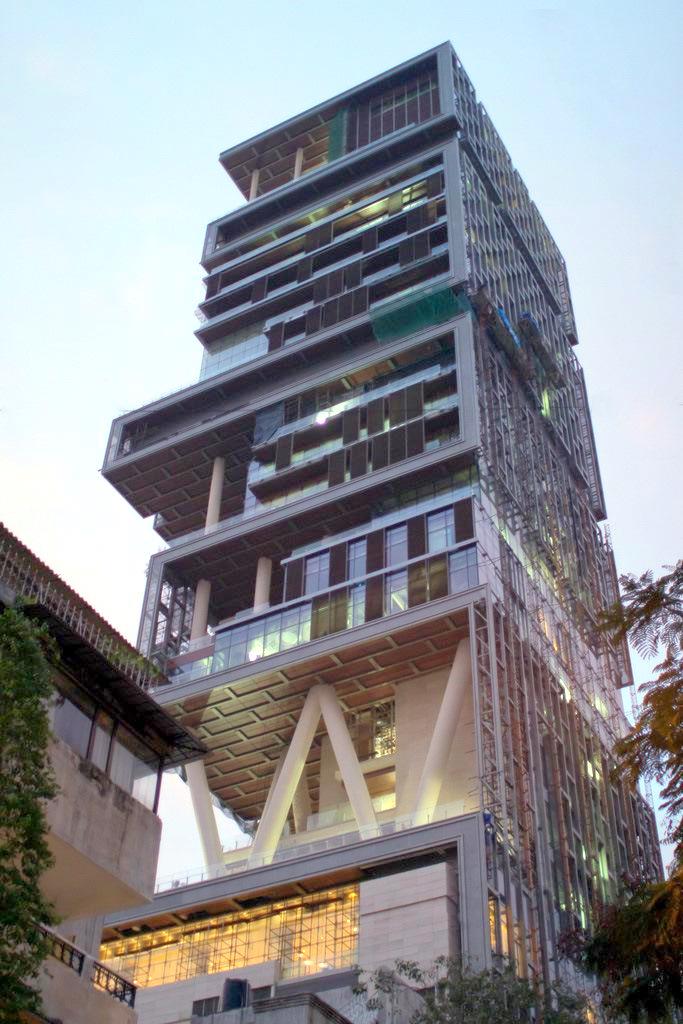
Antilia is the name of a twenty-seven floor personal home in South Mumbai belonging to India’s richest man, Mukesh Ambani, the billionaire Chairman of Reliance Industries (India’s largest private sector conglomerate). The home is staffed by 600 full time employees and houses Ambani, his wife Nita, their three children, and Ambani’s mother. Indian media frequently reported that Antilia is the world’s most expensive home costing US$1 billion. It is named after a mythical island in the Atlantic Ocean. The building is situated on a 4,532 m2 (48,780 sq ft) plot at Altamont Road on the famed Cumballa Hill South Mumbai, where land prices are upward of US$10,000 per square meter.
The structure was designed by U.S. architects using principles of Vaastu, Indian traditional geomancy akin to Chinese feng shui, to maximize ‘positive energy.’ No two floor plans are alike, and the materials used in each level vary widely. The home includes: 400,000 square feet (37,000 m2) of living space; parking space for 168 cars; a one-floor vehicle maintenance facility; 9 elevators in the lobby; 3 helipads and an air traffic control facility; a health spa; a theater with a seating for 50; multiple swimming pools, three floors of hanging gardens, and a ballroom.
Posted in Money, Technology, World |
Leave a Comment »
February 7, 2011
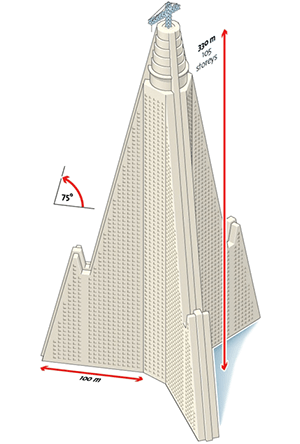
The Ryugyong Hotel is a 105-floor skyscraper under construction in Pyongyang, North Korea. Construction began in 1987, but was halted in 1992 due to the economic disruptions that afflicted the country following the fall of the Soviet Union.
The hotel stood topped out but without windows or interior fittings for the next sixteen years. Construction resumed in April 2008, under the supervision of the Orascom Group of Egypt, which has invested heavily in the North Korean mobile telephony and construction industries.
Posted in Money, Technology, World |
Leave a Comment »
February 7, 2011

A guy-cry film is the masculine version of the chick flick genre, a film that addresses a male audience, but has strong emotional material. Sports films are important to the guy-cry genre, but sports action is not necessarily essential to qualify a film as a genuine guy-cry. Some notable sports films that could be defined as guy-cry would be Field of Dreams, Rudy, Brian’s Song, and The Wrestler.
While it may seem that ‘guy-cry’ is a neologism, it is a genre that has been around for many years and is now receiving critical attention from scholars and trade publications. Early popular guy-cry films date back to the early 1970s with films such as Five Easy Pieces and One Flew Over the Cuckoo’s Nest. Important themes to the guy-cry genre are concepts of brotherhood, sacrifice, loyalty, and family.
Posted in Art, Humor, Language |
Leave a Comment »
February 7, 2011

Full-spectrum light is light that covers the electromagnetic spectrum from infrared through near-ultraviolet, or all wavelengths that are useful to plant or animal life; in particular, sunlight is considered full spectrum, even though the solar spectral distribution reaching Earth changes with time of day, latitude, and atmospheric conditions. ‘Full-spectrum’ is not a technical term when applied to an electrical light bulb but rather a marketing term implying that the product emulates natural light.
Some products marketed as ‘full-spectrum’ may produce light throughout the entire spectrum, but not with an even spectral distribution, and may not even differ substantially from lights not marketed as ‘full-spectrum.’
Continue reading →
Posted in Art, Health, Technology |
Leave a Comment »
February 7, 2011

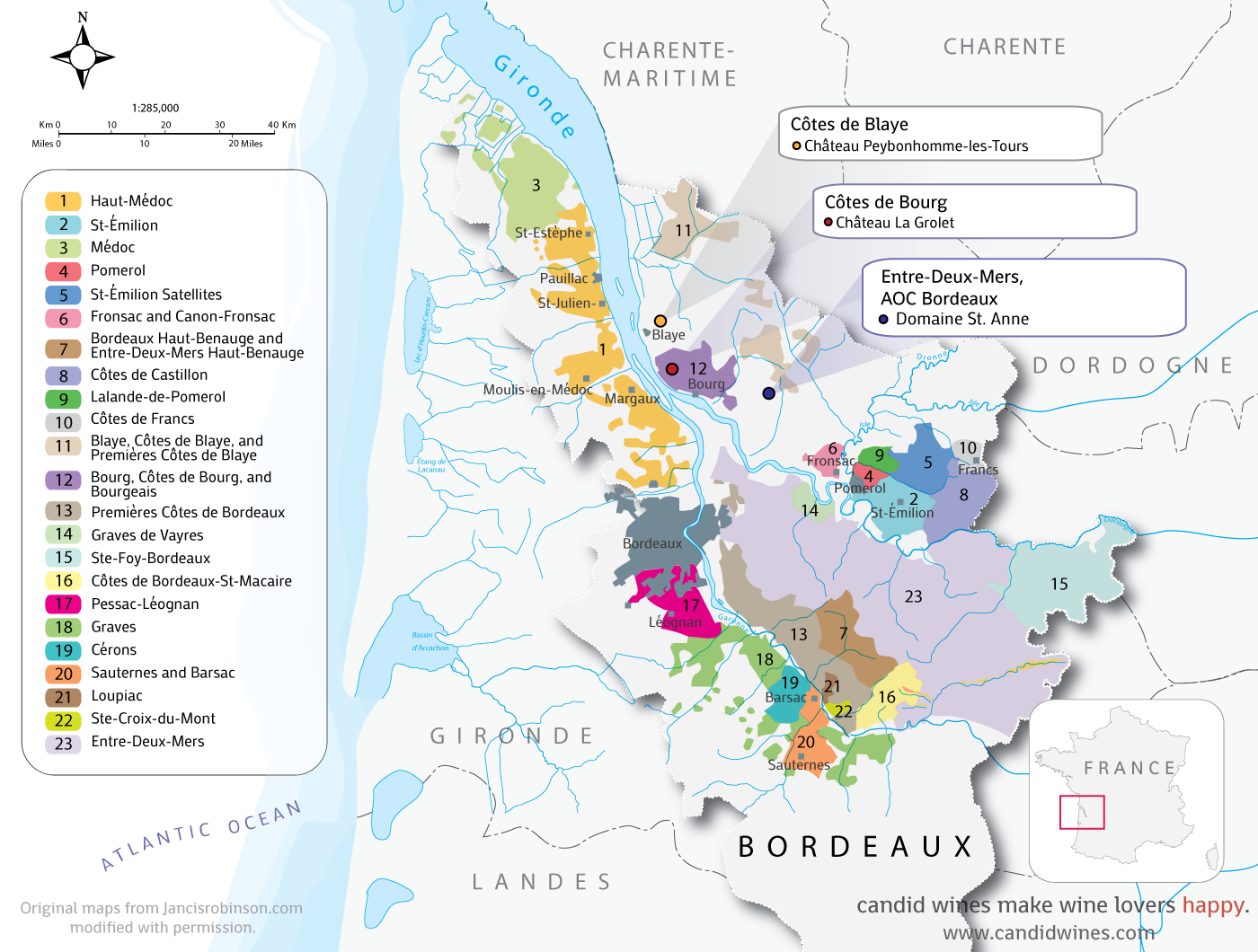
A Bordeaux [bawr-doh] wine is any wine produced in the Bordeaux region of south eastern, France. Average vintages produce over 700 million bottles of Bordeaux wine, ranging from large quantities of everyday table wine, to some of the most expensive and prestigious wines in the world. 89% of wine produced in Bordeaux is red (called ‘claret’ in Britain), with notable sweet white wines such as Chateau d’Yquem, dry whites, rosé and sparkling wines (Crémant de Bordeaux) all making up the remainder.
Continue reading →
Posted in Food, Money, World |
Leave a Comment »
February 7, 2011

Meritage is a proprietary term used to denote Bordeaux-style wines without infringing on the French region’s legally protected designation of origin. Winemakers license the Meritage trademark from its owner, the California-based Meritage Alliance. Most Meritage wines come from California, but there are members in 18 other states and five other countries (Argentina, Australia, Canada, Israel, and Mexico).
Many people, including some wine experts, Frenchify the word ‘Meritage’ by pronouncing its last syllable with a ‘zh’ sound, as in ‘garage,’ but the Meritage Alliance specifically states that the word should be pronounced to rhyme with ‘heritage.’ The Meritage Association was formed in 1988 by a small group of Napa Valley, California vintners increasingly frustrated by regulations stipulating wines contain at least 75% of a specific grape to be labeled as that varietal. Continue reading →
Posted in Food, Language, Money |
Leave a Comment »
February 7, 2011

The Stanford torus is a proposed design for a space habitat capable of housing 10,000 to 140,000 permanent residents. It was proposed during the 1975 NASA Summer Study, conducted at Stanford University, with the purpose of speculating on designs for future space colonies. The concept of a ring-shaped rotating space station was previously proposed by Wernher von Braun and Herman Potočnik.
It consists of a torus, or donut-shaped ring, that is 1.8 km in diameter and rotates once per minute to provide between 0.9g and 1.0g of artificial gravity on the inside of the outer ring via centrifugal force. Sunlight is provided to the interior of the torus by a system of mirrors. The ring is connected to a hub via a number of spokes, which serve as conduits for people and materials travelling to and from the hub. Since the hub is at the rotational axis of the station, it experiences the least artificial gravity and is the easiest location for spacecraft to dock.
Posted in Technology |
Leave a Comment »
February 6, 2011

Time Banking refers to an economic system that uses units of time as currency. A Time Bank, also known as a Service Exchange, is a community which practices time banking. The unit of currency, always valued at an hour’s worth of any person’s labor, used by these groups has various names, but is generally known as a Time Dollar in the U.S. and a Time Credit in the U.K. Time Banking is primarily used to provide incentives and rewards for work such as mentoring children, caring for the elderly, being neighborly—work usually done on a volunteer basis—which a pure market system devalues.
Essentially, the ‘time’ one spends providing these types of community services earns ‘time’ that one can spend to receive services. Time Banking had its intellectual genesis in the U.S. in the early 1980s. Today, 26 countries have active Time Banks. There are 108 Time Banks active in the U.K. and 53 officially recognized Time Banks in the U.S.
Posted in Money, Politics |
Leave a Comment »
February 6, 2011

Terra (The Trade Reference Currency, TRC) is the name of a theorized ‘world currency.’ The concept is currently proposed by Belgian economist Bernard A. Lietaer and is designed to resist currency inflation. The currency is meant to be based on a basket of the 9-12 most important commodities (according to their importance in world wide trade). For example: 100 Terra = 1 barrel of oil + 10 bushels of wheat + 20 kg of copper, etc. The basic principle emerged from early concepts presented in an article in the French newspaper ‘Le Fédériste’ in 1933.
Posted in Money, World |
Leave a Comment »
February 6, 2011

The Liberty Dollar (ALD) was a private currency produced in the United States from 1998 – 2009. The currency was available in coins, gold and silver certificates, and as an electronic currency (eLD). ALD certificates are warehouse receipts for real gold and silver formerly owned by ALD certificate holders. The metal was warehoused at Sunshine Minting in Coeur d’Alene, Idaho prior to a November 2007 raid by the Federal Bureau of Investigation (FBI) and the Secret Service.
Until July 2009, the Liberty Dollar was distributed by Liberty Services (formerly known as NORFED), based in Evansville, Indiana. It was created by Bernard von NotHaus, the co-founder of the Royal Hawaiian Mint Company. In May 2009, von NotHaus and others were charged with federal crimes in connection with the Liberty Dollar and, on July 31, 2009, von NotHaus announced that he had closed the Liberty Dollar operation, pending resolution of the criminal charges.
Posted in Money, Politics |
Leave a Comment »
February 3, 2011
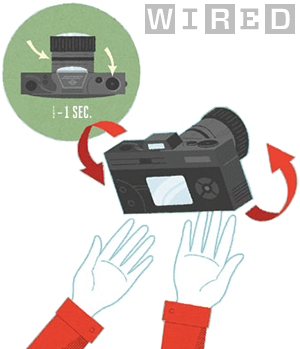
Kinetic photography is an experimental technique such as holding and shaking the wrist strap of the camera, dropping the camera, throwing or spinning the camera up in the air, or rigorously moving the camera while taking a picture. As the photographer has surrendered control over the camera to physical forces, this technique tends to produce abstract, random or blurred-motion photographs.
Perhaps the most risky field of kinetic photography is that of camera tossing, in which the photographer literally throws their equipment into the air in hopes of producing an artistic looking image. Many camera tosses take place at night, when the camera is able to capture light with a long exposure, resulting in streaks of hypnotizing light patterns. The pioneer of camera tossing, Ryan Gallagher, hosts a blog on the subject.
Posted in Art, Technology |
Leave a Comment »
February 3, 2011
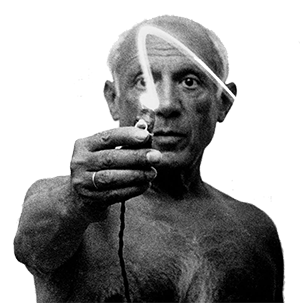
Light painting, also known as light graffiti, is a photographic technique in which exposures are made usually at night or in a darkened room by moving a hand-held light source or by moving the camera. In many cases the light source itself does not have to appear in the image. The first known photographer to use this technique was Man Ray in his series ‘Space Writing’ created in 1935.
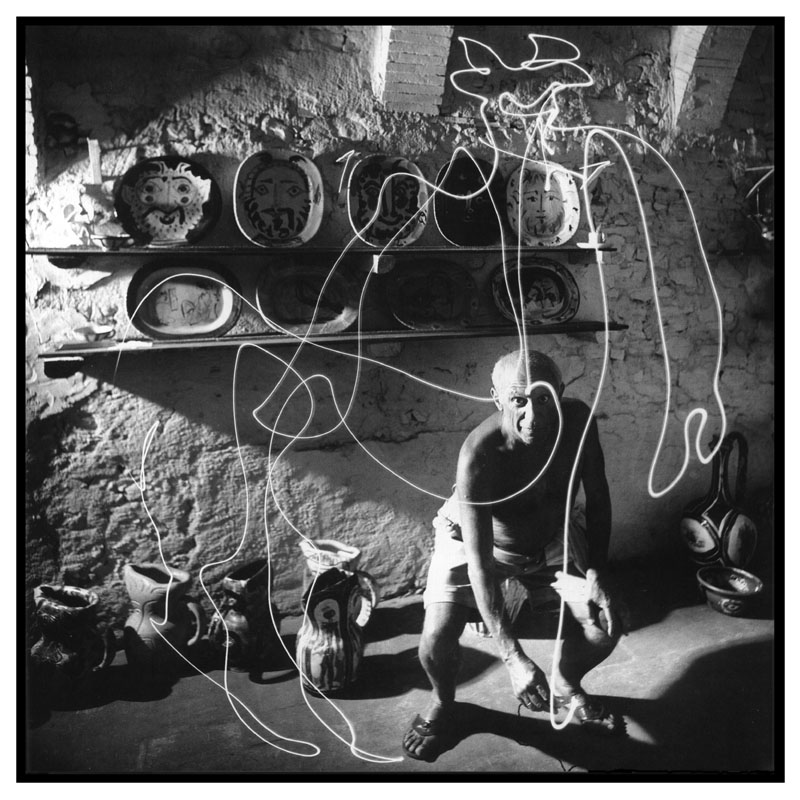
In 1949 Pablo Picasso was visited by Gjon Mili, known photographer and lighting innovator, who introduced him to some of his photographs of ice skaters with lights attached to their skates. Immediately Picasso started making images in the air with a small flashlight in a dark room. This series of photos became known as Picasso’s ‘light drawings.’ Of these photos, the most celebrated and famous is known as ‘Picasso draws a centaur in the air.’
Posted in Art, Technology |
Leave a Comment »



 The Daily Omnivore