January 31, 2011

Exquisite corpse is a method by which a collection of words or images is collectively assembled. Each collaborator adds to a composition in sequence, either by following a rule (e.g. ‘The adjective noun adverb verb the adjective noun’) or by being allowed to see the end of what the previous person contributed. The name is derived from a phrase that resulted when the game was first played, ‘Le cadavre exquis boira le vin nouveau.’ (‘The exquisite corpse will drink the new wine.’) The technique was invented by Surrealists and is similar to an old parlor game called ‘Consequences’ in which players write in turn on a sheet of paper, fold it to conceal part of the writing, and then pass it to the next player for a further contribution.
Surrealist André Breton reported that it started in fun, but became playful and eventually enriching. Breton said the diversion started about 1925, but Pierre Reverdy wrote that it started much earlier, at least before 1918. Later the game was adapted to drawing and collage, producing a result similar to children’s books in which the pages were cut into thirds, the top third pages showing the head of a person or animal, the middle third the torso, and the bottom third the legs, with children having the ability to ‘mix and match’ by turning pages.
Posted in Art, Games, Language |
Leave a Comment »
January 31, 2011

Christian Louboutin (b. 1964) is a footwear designer who launched his line of high-end women’s shoes in France in 1991. Since 1992, his designs have incorporated the shiny, red-lacquered soles that have become his signature. In 2007 Louboutin filed an application for U.S. trademark protection of this red sole design.
Louboutin received inspiration for his lethal-looking stilettos from an incident that occurred in his early 20s. He had visited a museum and noticed that there was a sign forbidding women wearing sharp stilettos from entering for fear of damage to the extensive wood flooring. This image stayed in his mind, and he later used this idea in his designs. ‘I wanted to defy that,’ Louboutin has said. ‘I wanted to create something that broke rules and made women feel confident and empowered.’
Posted in Art, Money |
Leave a Comment »
January 31, 2011
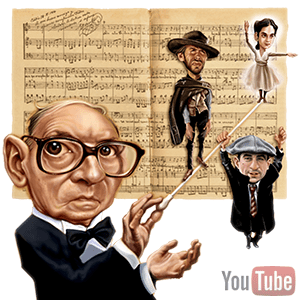
Ennio [en-yo] Morricone [mor-ee-cone-ay] (b. 1928) is an Italian composer and conductor, considered one of the most prolific and influential film composers of his era. He is well-known for his long-term collaborations with international acclaimed directors such as Sergio Leone, Brian De Palma, Barry Levinson, and Giuseppe Tornatore.
He wrote the characteristic film scores of Leone’s Spaghetti Westerns A Fistful of Dollars (1964), For a Few Dollars More (1965), The Good, the Bad and the Ugly (1966) and Once Upon a Time in the West (1968). In the 80s, Morricone composed the scores for John Carpenter’s horror movie The Thing (1982), Leone’s Once Upon a Time in America (1984), Roland Joffé’s The Mission (1986), Brian De Palma’s The Untouchables (1987) and Giuseppe Tornatore’s Cinema Paradiso (1988).
Posted in Art, Money |
Leave a Comment »
January 31, 2011

Spaghetti Western, also known as Italo-western, is a nickname for a broad sub-genre of Western film that emerged in the mid-1960s, so named because most were produced and directed by Italians. The typical team was made up of an Italian director, Italo-Spanish technical staff, and a cast of Italian and Spanish actors, sometimes a fading Hollywood star and sometimes a rising one like the young Clint Eastwood in three of Sergio Leone’s films. The films were typically shot in inexpensive locales resembling the American Southwest, primarily the Andalusia region of Spain, Almería, Sardinia, and Abruzzo.
Because of the desert setting and the readily available low-cost southern Spanish or southern Italian extras, typical themes in spaghetti westerns include the Mexican Revolution, Mexican bandits, and the border region shared by Mexico and the United States. Originally, spaghetti westerns were characterized by their production in the Italian language, low budgets, and a recognizable highly fluid and minimalist cinematography which eschewed many of the conventions of earlier Westerns. This was partly intentional and partly the context of a different cultural background.
Posted in Art, Money, World |
Leave a Comment »
January 30, 2011
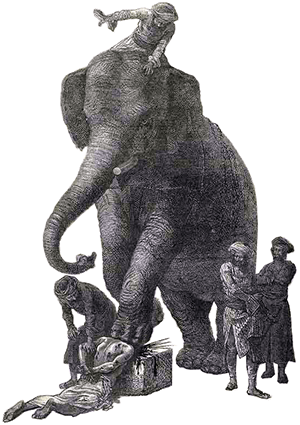
Execution by elephant was, for thousands of years, a common method of capital punishment in South and Southeast Asia, and particularly in India. Asian Elephants were used to crush, dismember, or torture captives in public executions. The animals were trained and versatile, both able to kill victims immediately or to torture them slowly over a prolonged period. Employed by royalty, the elephants were used to signify both the ruler’s absolute power and his ability to control wild animals.
The sight of elephants executing captives attracted the interest of usually horrified European travellers, and was recorded in numerous contemporary journals and accounts of life in Asia. The practice was eventually suppressed by the European empires that colonised the region in the 18th and 19th centuries. While primarily confined to Asia, the practice was occasionally adopted by Western powers, such as Rome and Carthage, particularly to deal with mutinous soldiers.
Posted in Death, War, World |
Leave a Comment »
January 29, 2011
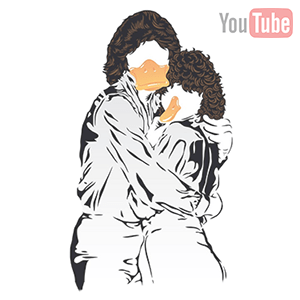
Duck Sauce is an American-Canadian DJ duo consisting of Armand Van Helden and A-Trak. The duo are signed to Fool’s Gold Records.
In the summer of 2010, Duck Sauce released a track ‘Barbra Streisand,’ named for the singer of the same name. The track heavily samples Gotta Go Home by Boney M, which is based upon the original tune Hallo Bimmelbahn by the German band Nighttrain.
Posted in Art |
Leave a Comment »
January 29, 2011

Lifeloggers wear cameras and recording devices in order to capture their entire lives, or large portions of their lives. The first person to capture continuous physiological data together with live first-person video from a wearable camera, was computer scientist Steve Mann in 1994. Mann continuously transmitted his everyday life 24 hours a day, 7 days a week to his website for the world to watch.
Posted in Language, Technology |
Leave a Comment »
January 29, 2011

The multiverse is the hypothetical set of multiple possible universes (including the historical universe we consistently experience) that together comprise everything that exists: the entirety of space, time, matter, and energy as well as the physical laws and constants that describe them. The term was coined in 1895 by the American philosopher and psychologist William James. The various universes within the multiverse are sometimes called parallel universes.
The structure of the multiverse, the nature of each universe within it and the relationship between the various constituent universes, depend on the specific multiverse hypothesis considered. Multiverses have been hypothesized in cosmology, physics, astronomy, religion, and philosophy. In these contexts, parallel universes are also called ‘alternative universes,’ ‘quantum universes,’ and ‘alternative realities,’ among others.
Continue reading →
Posted in Language, Philosophy, Science |
Leave a Comment »
January 29, 2011

The Metaverse is our collective online shared space, created by the convergence of virtually enhanced physical reality and physically persistent virtual space, including the sum of all virtual worlds, augmented reality, and the internet. The term was coined in Neal Stephenson’s 1992 science fiction novel Snow Crash, where humans, as avatars, interact with each other and software agents, in a three-dimensional space that uses the metaphor of the real world. Stephenson coined the term to describe a virtual reality-based successor to the Internet.
Posted in Language, Technology |
Leave a Comment »
January 29, 2011

The universe is commonly defined as the totality of everything that exists, including all physical matter and energy, the planets, stars, galaxies, and the contents of intergalactic space. The term universe may be used in slightly different contextual senses, denoting such concepts as the cosmos, the world, or nature. Observations of earlier stages in the development of the universe, which can be seen at great distances, suggest that the universe has been governed by the same physical laws and constants throughout most of its extent and history.
The word universe derives from the Old French word Univers, which in turn derives from the Latin word universum. The Latin word was used by Cicero and later Latin authors in many of the same senses as the modern English word is used. The Latin word derives from the poetic contraction Unvorsum — first used by Roman poet, Lucretius, to describe ‘everything rolled into one,’ or ‘everything combined into one.’
Posted in Language, Philosophy, Science |
Leave a Comment »
January 29, 2011


The ‘magnitude’ of a mathematical object is its size: a property by which it can be larger or smaller than other objects of the same kind. If two things, an elephant and a rhinoceros for example, have the same order of magnitude they are similar in size. Conversely, an elephant is many orders of magnitude smaller than, for example, a planet.
Orders of magnitude are generally used to make very approximate comparisons. If two numbers differ by one order of magnitude, one is about ten times larger than the other. If they differ by two orders of magnitude, they differ by a factor of about 100. The ‘orders’ describe exponential change (by powers of ten).
Posted in Language, Science |
Leave a Comment »
January 29, 2011


A water pipe percolator a sub chamber within the shaft of a water pipe (or other smoking instrument) that provides smoke-water interaction via heat exchange and dissolution. Percolators come in different forms, such as dome, pedestal, tree, and double helix. Depending upon the form of the percolator, it may or may not be diffused. However, the primary purpose of the percolator is to act as an extra chamber to filter smoke through water. As diffusers can mostly be found on male downstems, the only percolator that diffuses smoke is the tree percolator.
A diffuser works by utilizing a pressure differential between its bottom and top in/outlets. Reduced pressure at the outlet end is usually provided by the users lungs. The fluid at the inlet (i.e.: a smoke, vapor, and air mixture) is directed to the bottom of a column of water, where the pressure differential causes the inlet fluid to pass through the water in small pockets (liquid bubbles), and then rise to the outlet. In short, diffusers make smoke cooler, and rise evenly through the pipe, due to the water bubbles hitting the surface simultaneously.
Posted in Drugs, Health, Technology |
Leave a Comment »




 The Daily Omnivore