January 28, 2011

Cabinet noir (French for ‘black room’) was the name given in France to the office where the letters of suspected persons were opened and read by public officials before being forwarded to their destination. This practice had been in use since the establishment of posts, and was frequently used by the ministers of Louis XIII and Louis XIV; but it was not until the reign of Louis XV that a separate office for this purpose was created. Although declaimed against at the time of the French Revolution, it was used both by the revolutionary leaders and by Napoleon.
Continue reading →
Posted in Politics, Technology, War |
Leave a Comment »
January 28, 2011

Room 641A is an intercept facility operated by AT&T for the U.S. National Security Agency (NSA), beginning in 2003. It is fed by fiber optic lines from beam splitters installed in fiber optic trunks carrying Internet backbone traffic and, therefore, presumably has access to all Internet traffic that passes through the building.The existence of the room was revealed by a former AT&T technician, Mark Klein, and was the subject of a 2006 class action lawsuit by the Electronic Frontier Foundation (EFF) against AT&T. Klein claims he was told that similar black rooms are operated at other facilities around the country.
The EFF suit accused the telecommunication company of violating the law and the privacy of its customers by collaborating with the NSA in a massive, illegal program to wiretap and data-mine Americans’ communications. Room 641A is located in the SBC Communications building at 611 Folsom Street, San Francisco, three floors of which were occupied by AT&T before SBC purchased AT&T. The room was referred to in internal AT&T documents as the SG3 (Study Group 3) Secure Room. The room measures about 24 by 48 feet (7.3 by 15 m) and contains several racks of equipment, including a Narus STA 6400, a device designed to intercept and analyze Internet communications at very high speeds.
Posted in Politics, Technology, War |
Leave a Comment »
January 26, 2011

The Shard is an 87-story skyscraper in London that forms part of the London Bridge Quarter development. The Shard’s construction began in 2009 and finished in late 2012. Standing approximately 306 metrs (1,004 ft) high, it is currently the tallest building in the European Union. It is the second-tallest freestanding structure in the UK, after the concrete tower at the Emley Moor transmitting station.
It was designed by the Italian architect Renzo Piano, and replaced Southwark Towers, a 24-story office block built on the site in Southwark in 1975. The Shard was developed by Sellar Property on behalf of LBQ Ltd, and is jointly owned by Sellar Property and the State of Qatar.
Posted in Art, Money, Technology |
Leave a Comment »
January 26, 2011

In computer terminology, a honeypot is a trap set to detect, deflect, or in some manner counteract attempts at unauthorized use of information systems. Generally it consists of a computer, data, or a network site that appears to be part of a network, but is actually isolated and monitored, and which seems to contain information or a resource of value to attackers.
A honeypot is valuable as a surveillance and early-warning tool. They should have no production value, and hence should not see any legitimate traffic or activity. Whatever they capture is therefore malicious or unauthorized. One practical application of this is a honeypot that thwarts spam by masquerading as a type of system abused by spammers. Honeypots can carry risks to a network, and must be handled with care. If they are not properly walled off, an attacker can use them to break into a system.
Posted in Language, Money, Technology |
Leave a Comment »
January 26, 2011


Henry Charles Bukowski (1920 – 1994) was a German-American poet, novelist and short story writer.
His writing was influenced by the social, cultural and economic ambience of his home city of Los Angeles. It is marked by an emphasis on the ordinary lives of poor Americans, the act of writing, alcohol, relationships with women and the drudgery of work. Bukowski wrote thousands of poems, hundreds of short stories and six novels, eventually having over 60 books in print. In 1986 Time called Bukowski a ‘laureate of American lowlife.’
Continue reading →
Posted in Art, Drugs, Language |
1 Comment »
January 26, 2011

Henry Charles ‘Hank’ Chinaski is a semi-autobiographical protagonist of several works by the American writer Charles Bukowski. He appears in five of Bukowski’s novels, a number of his short stories and poems, the 1987 film ‘Barfly’ (played by Mickey Rourke and featuring a script written by Bukowski), and the 2005 film ‘Factotum’ (portrayed by Matt Dillon).
The works featuring him are ‘Confessions of a Man Insane Enough to Live With the Beasts’ (1965), ‘Post Office’ (1971), ‘South of No North’ (1973), ‘Factotum’ (1975), ‘Women’ (1978), ‘Ham on Rye’ (1982), ‘Hot Water Music’ (1983), ‘Hollywood’ (1989), and ‘Septuagenarian Stew’ (1990). He is also mentioned briefly in the beginning of Bukowski’s last novel, ‘Pulp.’
Posted in Art, Drugs, Language |
Leave a Comment »
January 26, 2011
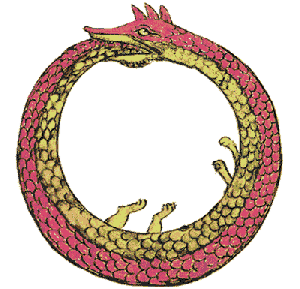
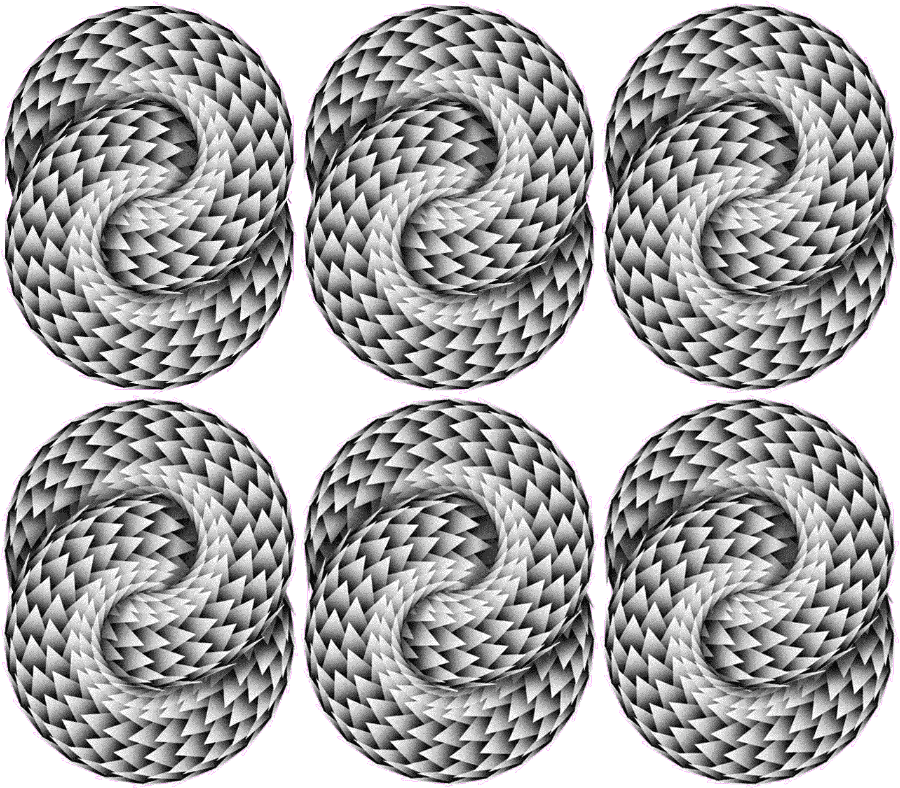
The Ouroboros [or-oh-bohr-ohs] is an ancient symbol depicting a serpent or dragon eating its own tail, which often represents self-reflexivity or cyclicality, especially in the sense of something constantly re-creating itself, the eternal return, and other things perceived as cycles that begin anew as soon as they end (compare with phoenix). It can also represent the idea of primordial unity related to something existing in or persisting before any beginning with such force or qualities it cannot be extinguished.
The ouroboros has been important in religious and mythological symbolism, but has also been frequently used in alchemical illustrations, where it symbolizes the circular nature of the alchemist’s opus. It is also often associated with Gnosticism, and Hermeticism. The earliest known representation of the Ouroboros is contained in the Egyptian Book of the Netherworld. The self-begetting sun god Atum is said to have ascended from chaos-waters with the appearance of a snake, the animal renewing itself every morning, and the deceased wishes to turn into the shape of the snake Sato (‘son of the earth’), the embodiment of Atum.
Posted in Art, Language, Philosophy |
1 Comment »
January 26, 2011
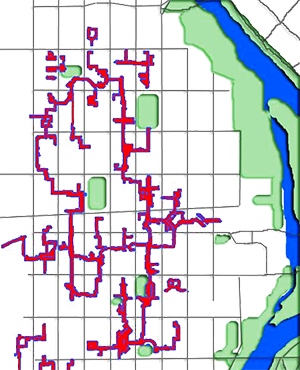
The Plus 15 or +15 Skyway network in Calgary, Alberta, Canada, is the world’s most extensive pedestrian skywalk system with a total length of 16 kilometers (10 mi) and 59 bridges. The system is so named because the skywalks are approximately 15 feet (approximately 4.5 metres) above street level. (Some Plus 15 skywalks are multi-level, with higher levels being referred to as +30’s and +45’s.)
Opening in 1970, the +15 network has expanded to include dozens of downtown Calgary buildings. The central core of the system is a series of enclosed shopping centers, and the city’s flagship department stores. Although there are currently no plans to remove bridges or to discontinue building new ones, the system has been subject to criticism in recent years. It has been identified with a decline in street life in the Downtown Commercial Core. Street life is instead concentrated on streets (such as Stephen Avenue) or in neighbourhoods where there are no bridges (such as Eau Claire and the Beltline).
Posted in Money, Politics, Technology |
Leave a Comment »
January 26, 2011

The term black fax refers to a prank fax transmission, consisting of one or more pages entirely filled with a uniform black tone and often made into a loop the sending machine will transmit endlessly. The sender’s intention is typically to consume as much of the recipient’s fax ink, toner or thermal paper or disk space as possible, thus costing the recipient money and/or denying the recipient the use of their machine (this is similar to computer-based denial of service attacks).
Black faxes can be particularly effective as the fax algorithm compresses the solid black image very well, so a very short fax call can produce many pages. They have been used to harass large institutions or government departments, to retaliate against the senders of junk faxes, or merely as simple pranks. In a black fax attack, one or more sheets are fed halfway through the sender’s fax machine and taped end to end, forming an endless loop that cycles through the machine. Not only can solid black be used, but also images which will repeat endlessly on the receiver’s machine until his or her toner runs out.
Posted in Humor, Politics, Technology |
Leave a Comment »
January 26, 2011

Thundersnow is a rare kind of thunderstorm with snow falling as the primary precipitation instead of rain. It typically falls in regions of strong upward motion within the cold sector of an extratropical cyclone, where the precipitation consists of ice pellets rather than snow. One unique aspect of thundersnow is that the snowfall acts as an acoustic suppressor of the thunder.
The thunder from a typical thunderstorm can be heard many miles away, while the thunder from thundersnow can usually only be heard within a two to three mile radius from the lightning. In the United States, March is their peak month of formation, and on average, only 6.3 events are reported per year.
Posted in Language, Science |
Leave a Comment »
January 25, 2011

Speed Golf is a sport started in California in 1979 by American runner Steve Scott and which involves completing a golf course in the lowest combination of strokes and time. Players run between shots and generally carry one to six clubs. A player’s score is calculated by adding minutes plus strokes, so a round of 90 completed in 50 minutes and 30 seconds would compute to a score of 140:30. The lowest score in competition is believed to have been shot by professional Christopher Smith at the Chicago Speedgolf Classic in 2005. Smith shot 65 in just 44:06 for a speed golf score of 109:06.
Rules and etiquette are generally the same for speed golf and regular golf with minor exceptions. Speed golfers are allowed to putt with the flagstick left in the hole, but are expected to rake bunkers, fix ball marks and conform to the dress code. Speed Golf is sometimes contrasted with Cross-country BigBall, in which players use soccer balls and baseball bats. Both sports require substantial physical stamina.
Posted in Games, Humor |
Leave a Comment »
January 25, 2011


Prole drift, short for proletarian drift, is a trend in which products, styles or other aspects of culture previously considered to be upscale or upper class become popular among working class people. Prole drift can also go the other way, as when things that were once the purview of the working class become fashionable in the middle or upper classes. The term was coined by, American literary historian, Paul Fussell in 1983 to describe the phenomenon of most aspects of high culture eventually joining the lowest common denominator.
Examples include sales of premium coffee, Burberry clothing or Coach Inc. handbags to working class people. Examples of reverse prole drift include Mockney, the skinhead and punk subcultures, hip hop, rockabilly, dressing down, slumming it (e.g. going to a working class bar) and NASCAR. BMW cars (particularly the 3 series) have also suffered from this phenomenon, in some instances the 3 series outselling more mainstream cars such as the Ford Mondeo and Vauxhall Vectra.
Posted in Language, Money, Politics |
Leave a Comment »





