January 25, 2011

An upturned collar (or popped collar) is an otherwise flat, protruding collar of either a shirt, jacket, or coat that has been turned upward. Before the early 20th century, most shirt collars were turned up in some manner. Men and women alike wore tall, stiff collars (as much as three inches tall), not unlike a taller version of a clerical collar, made either of starched linen, cotton, or lace. The writer H. G. Wells remarked in his 1902 book ‘Kipps’ that these ‘made [the] neck quite sore and left a red mark under [the] ears.’
Between the late 19th and mid-20th centuries, men’s collars were often detachable from their shirts, connected only by two removable collar studs (one in front and one in back). Detachable collars were very stiff, and either stood straight up (Hamilton collar) or were pressed over at an ironed-in, starched crease (Fremont collar). After WWII, mass-production gradually phased out detachable collars from ordinary dress shirts. Occasionally, one can still find detachable collar formal shirts, designed to be worn with a tuxedo or evening dress. Continue reading →
Posted in Art, Games |
Leave a Comment »
January 25, 2011

A chav is a stereotype of certain people in the United Kingdom. Also known as a charver in Yorkshire and North East England, ‘chavs’ are said to be aggressive teenagers, of white working class background, who repeatedly engage in antisocial behaviour such as street drinking, drug abuse and rowdiness, or other forms of juvenile delinquency. The derivative Chavette has been used to refer to females.
Chav probably has its origins in the Romani word ‘chavi,’ meaning ‘child’ (or ‘chavo,’ meaning ‘boy,’ or ‘chavvy,’, meaning ‘youth’). This word may have entered the English language through the Geordie dialect word charva, meaning a rough child. This is similar to the colloquial Spanish word chaval, meaning ‘kid’ or ‘guy.’ In Italy, chavs are termed as coatto, which basically means ‘working class’ and vulgar. Continue reading →
Posted in Language, Money, World |
Leave a Comment »
January 25, 2011

‘Ambient 1: Music for Airports‘ is an ambient album by Brian Eno released in 1978. Of four albums released on Eno’s own, then new, Ambient label, ‘Music for Airports’ was the first to carry explicitly the name ‘ambient’ – a term which he coined to differentiate his minimalistic approach to the album’s material and ‘the products of the various purveyors of canned music.’ Notice of similarly quiet, unobtrusive music had been given on his albums such as ‘Evening Star,’ ‘Discreet Music,’ ‘Music for Films,’ and Harold Budd’s ‘The Pavilion of Dreams’ (which Eno produced), but in this album it was given precedence as a fully developed concept.
The music was designed to be continuously looped as a sound installation, with the intent to defuse the tense, anxious atmosphere of an airport terminal. Eno conceived this idea while being stuck at Cologne Bonn Airport in Germany in the mid 70s. He had to spend several hours there and was extremely annoyed by the uninspired sound atmosphere. It was installed at the Marine Air Terminal of New York’s LaGuardia Airport.
Posted in Art, Money, Technology |
Leave a Comment »
January 25, 2011

In the context of the World Wide Web, content farms are companies (or their divisions) that employ large numbers of (often freelance) writers to generate large amounts of textual content. The articles in content farms are written by human beings but may not be written by a specialist in the area. In one of Google’s own promotional videos the majority of the links available were actually produced at content farms.
Content farms contain huge number of articles. For instance, Demand Media will soon be publishing 1 million items a month, the equivalent of four English-language Wikipedias a year. Big content farms are expensive resources, sold for many millions.
Continue reading →
Posted in Language, Money, Technology |
Leave a Comment »
January 25, 2011


A fad, sometimes called a trend, meme or a craze, is any form of behavior that develops among a large population and is collectively followed with enthusiasm for some period, generally as a result of the behavior’s being perceived as novel in some way.
A fad is said to ‘catch on’ when the number of people adopting it begins to increase rapidly, but they fade quickly once the perception of novelty is gone. Though the term trend may be used interchangeably with fad, a fad is generally considered a fleeting behavior whereas a trend is considered to be a behavior that evolves into a relatively permanent change.
Continue reading →
Posted in Language, Money, Politics |
Leave a Comment »
January 25, 2011

The Monty Hall problem is a famous problem in probability science. The problem is based on a game show, ‘Let’s Make a Deal,’ and is named for the show’s host, Monty Hall. In the problem, there are three doors. A car is behind one door and goats behind the other two doors.
Continue reading →
Posted in Humor, Money, Science |
Leave a Comment »
January 25, 2011

Happy slapping is a fad in which someone assaults an unwitting victim while others record the assault. The ease and general availability of video cameras in mobile phones means that such attacks need not be planned carefully beforehand and are more easily watched and circulated for comedy purposes afterwards.
The practice started in the South London London Borough of Lewisham. Initially the attacks were, as the phrase would have us believe, fairly minor pranks … As the craze spread the attacks became more vicious – often serious assaults known in British legal circles as grievous bodily harm.
Posted in Humor, Technology |
Leave a Comment »
January 25, 2011

A robot jockey is commonly used on camels in camel racing. Early designs confused or frightened the camels, so the robots were modified to include more human-like features, including a mannequin-like face, sunglasses, hats, racing silks and even traditional perfumes used by human jockeys. Developed since 2004, the robotic jockeys are slowly phasing out the use of human jockeys, which, in the case of camel racing in the Middle East, often employs small children who reportedly suffer repeated systemic human rights abuses. In response to international condemnation of such abuses, the nations of Qatar and the UAE have banned the use of human jockeys in favor of robots.
Camel racing has been around for thousands of years. ‘The Sport of Sheiks’ almost exclusively utilized small children, usually boys around the age of four, to ride and direct the camels. Often, the boys would be starved to be as light as possible. Many of the boys used for the races were often sold to race organizers or camel owners, and there was an active child slave trade for camel jockeys, involving victims of kidnapping or the children of destitute families who sold them into servitude.
Posted in Politics, Technology, World |
Leave a Comment »
January 24, 2011

A keytar is a relatively lightweight keyboard that is supported by a strap around the neck and shoulders, similar to the way a guitar is supported by a strap. Keytars allow players a greater range of movement compared to conventional keyboards, which are placed on stands. The instrument has a musical keyboard for triggering musical notes and sounds. Controls for pitch bends, vibrato, portamento, and sustain are placed on the instrument’s ‘neck.’ Keytars may either contain their own synthesizers, or simply be controllers, triggering notes on another MIDI capable synthesizer.
In early 1970s, Edgar Winter often performed with keyboards slung around his neck, but they were not technically keytars because they had no ‘neck.’ One of the earliest keytars commercially released and widely known was be the Moog Liberation in 1980. Notable manufacturers of keytar models have included Moog, Roland, Yamaha, Korg and Casio. As of 2010, the Roland AX-Synth and the Roland Lucina are the only mass-manufactured keytars on the market, but with the Synthpop revival of the late 2000s, keytars are enjoying a mild resurgence.
Posted in Art, Technology |
Leave a Comment »
January 24, 2011

Electro (short for either electro-funk or electro-boogie) is a genre of electronic music directly influenced by the use of funk samples, Roland TR-808 synthesizers, and Moog keytars. Records in the genre typically feature drum machines and heavy electronic sounding deprived of vocals in general, although if present, they are delivered in a deadpan manner, often through an electronic distortion such as vocoding.
This is the main distinction of electro from previously prominent late-1970s genres such as disco and boogie, in which electronic sound was only part of the instrumentation rather than basis of the whole song. In 1982, Bronx based producer Afrika Bambaataa released the seminal track ‘Planet Rock,’ which contained elements of Kraftwerk’s Trans-Europe Express and ‘Numbers’ (from Kraftwerk’s Computer World album). ‘Planet Rock’ is widely regarded as a turning point in the electro genre.
Continue reading →
Posted in Art, Language |
Leave a Comment »
January 24, 2011

A straw man argument is an informal fallacy based on misrepresentation of an opponent’s position. To ‘attack a straw man’ is to create the illusion of having refuted a proposition by substituting it with a superficially similar yet not equivalent proposition (the ‘straw man’), and refuting it, without ever having actually refuted the original position.
The origins of the term are unclear; one common (folk) etymology given is that it originated with men who stood outside courthouses with a straw in their shoe in order to indicate their willingness to be a false witness, but the practice is of questionable authority. Another more popular origin is a human figure made of straw, such as practice dummies used in military training. Such a dummy is supposed to represent the enemy, but it is considerably easier to attack because it neither moves, nor fights back.
Posted in Language, Politics |
Leave a Comment »
January 24, 2011
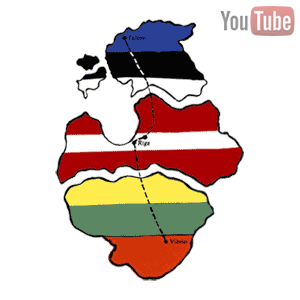
The Baltic Way was a peaceful political demonstration that occurred on August 23, 1989. Approximately two million people joined their hands to form a human chain spanning over 600 kilometres (370 mi) across the three Baltic states – Estonian SSR, Latvian SSR, and Lithuanian SSR, republics of the Soviet Union. It marked the 50th anniversary of the Molotov–Ribbentrop Pact between the Soviet Union and Nazi Germany. The pact and its secret protocols divided Eastern Europe into spheres of influence and led to the occupation of the Baltic states in 1940.
The event was organised by Baltic pro-independence movements: Rahvarinne of Estonia, Popular Front of Latvia, and Sąjūdis of Lithuania. The protest was designed to draw global attention by demonstrating a popular desire for independence for each of the entities. It also illustrated solidarity among the three nations. Within six months from the protest, Lithuania became the first of the Republics of the Soviet Union to declare independence.
Posted in Politics, World |
Leave a Comment »





