January 3, 2011

Flexible glass is a legendary lost invention from the reign of Roman Emperor Tiberius Caesar (between 14 CE-37 CE). As recounted by Archbishop Isadore of Seville, the craftsman who invented the technique brought before Caesar a drinking bowl made of flexible glass, and Caesar threw it to the floor, whereupon the material dented, rather than shattering.
The inventor was able to simply repair the dent with a small hammer. After the inventor swore to the Emperor that he alone knew the technique of manufacture, Caesar had the man beheaded, fearing such material could undermine the value of gold and silver.
Posted in Humor, Technology |
Leave a Comment »
January 3, 2011

The Young Shuffle is a style of running named for Australian potato farmer and athlete, Cliff Young (1922 — 2003). Young won the 544 mile Melbourne Ultramarathon at age 61, running in overalls and gumboots. He grew up on a 2000 acre farm in Beech Forest in south-western Victoria with approximately 2,000 sheep that he roundup on foot. He arrived at the 1983 Melbourne to Sydney ultramarathon as an unknown. He ran at a slow loping pace and trailed the leaders for most of the course, but by denying himself sleep and running while the others slept he slowly gained on them and eventually won by a large margin.
Before running the race he told the press that he had previously run for two to three days straight rounding up sheep. He claimed afterwards that during the race he imagined that he was running after sheep and trying to outrun a storm. The run took him five days, 15 hours and four minutes, trimming almost two days off the record for any previous run between Sydney and Melbourne. All of the six competitors who finished the race broke the previous record, but Young beat them by running while they were sleeping, and by using an ungainly looking, but very energy efficient running style that his since been dubbed the Young Shuffle.
Posted in Games, Humor |
Leave a Comment »
January 3, 2011


Academi (previously known as Xe Services and Blackwater Worldwide)—is a private military company founded in 1997 by former Navy SEALs Erik Prince and Al Clark. Academi is currently the largest of the U.S. State Department’s three private security contractors, and provided diplomatic security services in Iraq to the United States federal government on a contractual basis. Academi also has a research and development wing that was responsible for developing the Grizzly APC (an armored urban combat vehicle) along with other military technology. The company’s headquarters is located in Arlington County, Virginia.
In explaining Blackwater’s purpose in 1997, Prince stated that ‘We are trying to do for the national security apparatus what FedEx did for the Postal Service.’ Blackwater USA received its first government contract after the bombing of the USS Cole off of the coast of Yemen in October 2000. Blackwater trained over 100,000 sailors. Documents obtained from the Iraq War documents leak of 2010 argue that Blackwater employees committed serious abuses in Iraq, including killing civilians.
Continue reading →
Posted in Money, Politics, War |
Leave a Comment »
January 3, 2011

Personal rapid transit (PRT), also called personal automated transport (PAT) or podcar, is a public transportation mode featuring small automated vehicles operating on a network of specially-built guide ways. PRT is a type of automated guideway transit (AGT), which also includes systems with larger vehicles, all the way to small subway systems.
Continue reading →
Posted in Money, Technology |
Leave a Comment »
January 3, 2011

Masdar (Arabic for ‘source’) is a project in Abu Dhabi, in the United Arab Emirates. Its core is a planned city, designed by the British architectural firm Foster + Partners. Masdar City will rely entirely on solar energy and other renewable energy sources, with a sustainable, zero-carbon, zero-waste ecology, and is designated as a car-free zone.
It is being built by the Abu Dhabi Future Energy Company, a subsidiary of Mubadala Development Company, with the majority of seed capital provided by the government of Abu Dhabi. Construction is underway 11 mi east-south-east of the city of Abu Dhabi, beside Abu Dhabi International Airport. Skeptics are concerned that the city will be only symbolic for Abu Dhabi, and that it may become just a luxury development for the wealthy, a city sized gated community.
Continue reading →
Posted in Money, Technology, World |
Leave a Comment »
January 2, 2011

A panorama is any wide-angle view or representation of a physical space, whether in painting, drawing, photography, film/video, or a three-dimensional model. The word was originally coined by the Irish painter Robert Barker to describe his panoramic paintings of Edinburgh. Shown on a cylindrical surface and viewed from the inside, they were exhibited in London in 1792. The motion-picture term ‘panning’ is derived from panorama. Panoramic photography eventually came to displace painting as the most common method for creating wide views.
Not long after the introduction of the Daguerreotype in 1839, photographers began assembling multiple images of a view into a single wide image. In the late 19th century, panoramic cameras using curved film holders employed clockwork drives to scan a line image in an arc to create an image over almost 180 degrees. Digital photography of the late twentieth century greatly simplified this assembly process, which is now known as image stitching. Such stitched images may even be fashioned into forms of virtual reality movies, using technologies such as QuickTime VR, Flash, or Java.
Posted in Art, Technology |
Leave a Comment »
January 2, 2011
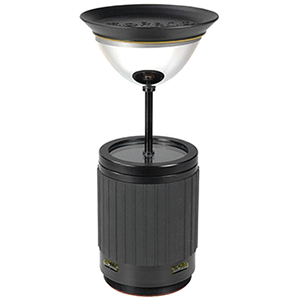
In photography, an omnidirectional camera is a camera with a 360-degree field of view in the horizontal plane, or with a visual field that covers (approximately) the entire sphere. Omnidirectional cameras are important in areas where large visual field coverage is needed, such as in panoramic photography and robotics.
Posted in Art, Technology |
Leave a Comment »
January 2, 2011

Fantastic Planet is a 1973 animated science fiction film directed by René Laloux, production designed by Roland Topor, written by both of them and animated at Jiří Trnka Studio. The film was an international production between France and Czechoslovakia and was distributed in the United States by Roger Corman. The story is based on the novel ‘Oms en série,’ by the French writer Stefan Wul. The film is chiefly noted for Topor’s surreal imagery.
The film depicts a future in which human beings, known as ‘Oms’ (a play on the French word ‘hommes,’ meaning ‘men’), have been brought by the giant Draags to the Draag home world, where they are kept as pets (with collars). Most Oms are domesticated as pets, but others run wild, and are periodically exterminated. The Draags’ treatment of the Oms is ironically contrasted with their high level of technological and spiritual development. The Draag practice of meditation, whereby they commune psychically with each other and with different species, is shown in transformations of their shape and color.
Posted in Art, World |
Leave a Comment »
January 2, 2011
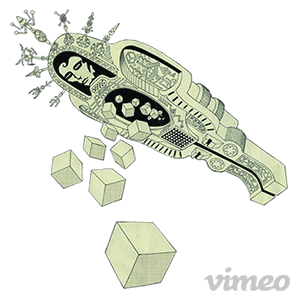
Birdy Nam Nam is a French DJ crew, originally formed to compete in the DMC World DJ Championship. Their self-titled debut album was released in 2006 on Uncivilized World Records and was created entirely on turntables.
In 2009 they released ‘Manual for Successful Rioting,’ an album that found the four programming and playing synths along with their turntables. The group’s name is taken from the 1968 Peter Sellers film ‘The Party,’ directed by Blake Edwards.
Posted in Art |
Leave a Comment »
January 2, 2011


x86 refers to a family of instruction sets based on the 8086 CPU, which was launched by Intel in 1978. The architecture has been implemented in processors from Intel, Cyrix, AMD, VIA, and many others, and is still dominant in the microprocessor market. An instruction set is a list of all the instructions that a processor can execute (e.g. add, subtract, move, load, store, etc.). Many additions and extensions have been added to the x86 instruction set over the years, almost consistently with full backward compatibility.
There have been several attempts, also within Intel itself, to break the market dominance of the inelegant x86 architecture that descended directly from the first simple 8-bit microprocessors. But, continuous refinement of x86 microarchitectures, circuitry, and semiconductor manufacturing have made x86 hard to replace. The scalability of x86 chips such as the eight-core Intel Xeon and 12-core AMD Opteron is underlining x86 as an example of how continuous refinement of established industry standards can resist the competition from completely new architectures.
Posted in Money, Technology |
Leave a Comment »
January 1, 2011

The Magpul FMG-9 is a prototype for a folding machine gun, designed by Magpul Industries in 2008. It is made out of a light-weight polymer material rather than metal, making it easy to carry and conceal. It is also small enough even to fit in the back pocket of most pants.
It was developed for use by personal protection details such as the United States Secret Service. It is still a prototype and may or may not be made in large numbers for law enforcement agencies. The prototype uses Glock pistol firing mechanisms, specifically the 9mm Glock 17 pistol and the Glock 18 machine pistol.
Posted in Money, Technology, War |
Leave a Comment »
January 1, 2011

TED (Technology Entertainment and Design) is a global set of conferences curated by the American private non-profit Sapling Foundation, formed to disseminate ‘ideas worth spreading.’ over 700 talks are available free online. TED was founded in 1984, and the conference was held annually from 1990 in Monterey, California. The speakers are given a maximum of 18 minutes to present their ideas in the most innovative and engaging ways they can
Past presenters include Bill Clinton, Jane Goodall, Malcolm Gladwell, Al Gore, Richard Dawkins, Bill Gates, and Larry Page and Sergey Brin. TED’s current curator is the British former computer journalist and magazine publisher Chris Anderson. TED’s early emphasis was largely technology and design, consistent with a Silicon Valley center of gravity. The events are now held in Long Beach and Palm Springs in the U.S. as well as in Europe and Asia, offering live streaming of the talks. They address an increasingly wide range of topics within the research and practice of science and culture.
Posted in Politics, Technology, World |
Leave a Comment »




