December 17, 2010
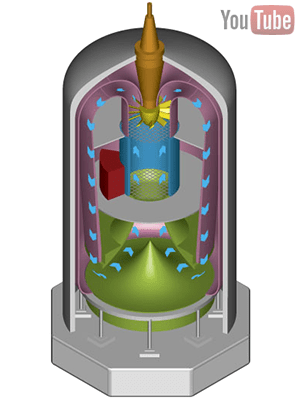
Bodyflight is the art of ‘flying your body’ in a controlled manner. This include turns, rolls, lateral movement, fall rate control, and other acrobatics in the air. The skill of bodyflight makes it possible for skydivers to fly closer to each other while they are falling, to allow them to link together in formation skydiving, then fly apart to a safe distance before opening parachutes. Many skills of bodyflight can be learned in a vertical wind tunnel, to enable skydivers to become better at controlling their bodies in the sky.
The first human to fly in a vertical wind tunnel was Jack Tiffany in 1964 at Wright Patterson Air Force Base. The first recreational vertical wind tunnel was developed by a Canadian company named AERODIUM in Quebec, patented as the ‘Levitationarium’ in 1979.
Continue reading →
Posted in Games, Technology |
1 Comment »
December 17, 2010
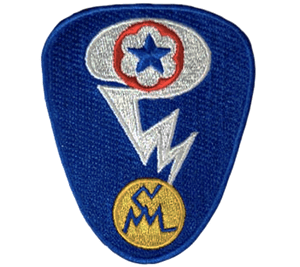

The Manhattan Project was the codename for a project conducted during World War II to develop the first atomic bomb, before the Germans or the Japanese. The project was led by the United States, and included participation from the United Kingdom and Canada. From 1942 to 1946 the project was under the command of Major General Leslie R. Groves, Jr. of the U.S. Army Corps of Engineers. Robert Oppenheimer was the scientific director.
Continue reading →
Posted in Science, Technology, War |
Leave a Comment »
December 17, 2010
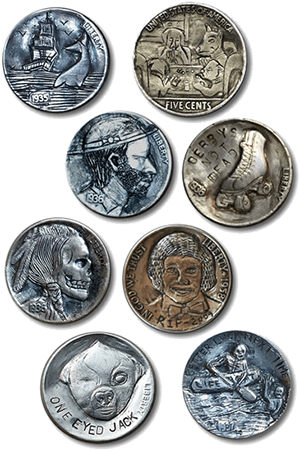
The hobo nickel is a sculptural art form involving the creative modification of small-denomination coins, essentially resulting in miniature bas reliefs. The nickel, because of its size, thickness, and relative softness, was a favored coin for this purpose. Due to its low cost and portability, this medium was particularly popular among hobos, hence the name. Common hobo nickels sell for $5 or $10, and rarer or more desirable coins sell for hundreds of dollars.
Continue reading →
Posted in Art, Humor, Money |
Leave a Comment »
December 17, 2010

Love Tokens are custom engraved coins given as a gift. They were especially popular in the 1750s in the United States. They are made by machine-smoothing a coin (usually silver) on one or both sides, then engraving it with initials, monograms, names, scenes, etc., often with an ornate border. They can be mounted on pins or incorporated into bracelets and necklaces. The love token fad faded out in the early 20th century; love tokens engraved on buffalo nickels are quite rare and prized by collectors of ‘hobo nickels’ (altered coins).
Posted in Art, Love, Money |
Leave a Comment »
December 16, 2010

An amplified cactus is a cactus plant used as a musical instrument. It harnesses the acoustic properties of a cactus (preferably a Denmoza or Geohintonia), by applying contact microphones and amplifying their projection and tone. The effect is somewhat ethereal: Vivien Schweitzer of The New York Times reports ‘Jason Treuting played an amplified cactus, running his hand over the plant’s unfriendly spikes to produce an alluring sound like a babbling brook.’
The amplified cactus is a medium rarely written for, even in the contemporary music genre. John Cage, perhaps one of the most recognizable names in the contemporary music genre, composed Child of Tree (1975) and Branches (1976) for what he described as ‘amplified plant materials.’ Cage was a large proponent of chance music and felt that the organic nature of music without man-made instruments was very strong and influential. Another of the most famous pieces for amplified cactus is called Degrees of Separation ‘Grandchild of Tree’ by Paul Rudy which received mention at the Bourges International Competition for Electroacoustic Music in 2000.
Posted in Art, Technology |
Leave a Comment »
December 16, 2010

A deck prism (sometimes called a deadlight) is a prism inserted into the deck of a ship to provide light down below. For centuries, sailing ships used deck prisms to provide a safe source of natural sunlight to illuminate areas below decks Before electricity, light below a vessel’s deck was provided by candles, oil and kerosene lamps – all dangerous aboard a wooden ship. The deck prism was a clever solution: laid flush into the deck, the glass prism refracted and dispersed natural light into the space below from a small deck opening without weakening the planks or becoming a fire hazard.
In normal usage, the prism hangs below the ceiling and disperses the light sideways; the top is flat and installed flush with the deck, becoming part of the deck. A plain flat glass would just form a single bright spot below– not very useful general illumination– hence the prismatic shape. On colliers (coal ships), prisms were also used to keep check on the cargo hold; light from a fire would be collected by the prism and be made visible on the deck even in daylight.
Posted in Technology |
1 Comment »
December 16, 2010

The current drug policy of Portugal was put in place in 2000, to be legally effective from July 2001. The EU had in effect forced the Portuguese government to make radical measures to reduce Portugal’s record high incidence of HIV/AIDS. In 1999 Portugal had the highest rate of HIV amongst injecting drug users in the European Union.
Continue reading →
Posted in Drugs, Health, Politics |
Leave a Comment »
December 16, 2010
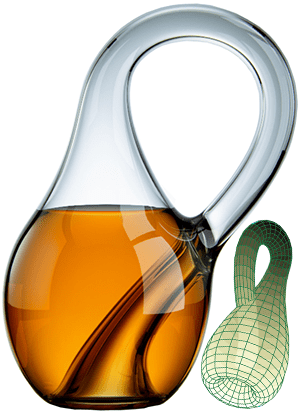
In mathematics, the Klein bottle is a geometrical object, named after the German mathematician Felix Klein. He described it in 1882, and named it Klein’sche Fläche (Klein surface). Like the Möbius strip, it only has one surface. Mathematicians call this a non-orientable surface. Klein bottles only exist in four-dimensional space, but a model of a Klein bottle can be made in 3D.
This model is different from the original because at some point the shape touches itself. In 3D, part of the shape is ‘inside’ the rest. Because the surface is non-orientable, there is no ‘inside’ or ‘outside.’ This means that if a liquid were filled ‘in the bottle,’ it would run down its surface. This may not be true for the 3D models of the bottle.
Posted in Art, Science, Technology |
Leave a Comment »
December 16, 2010

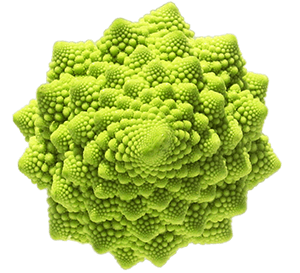
Many mathematicians derive aesthetic pleasure from their work, and from mathematics in general. They express this pleasure by describing mathematics as beautiful. Sometimes mathematicians describe mathematics as an art form or, at a minimum, as a creative activity. Hungarian mathematician Paul Erdős expressed his views on the ineffability of mathematics when he said, ‘Why are numbers beautiful? It’s like asking why is Beethoven’s Ninth Symphony beautiful. If you don’t see why, someone can’t tell you. I know numbers are beautiful. If they aren’t beautiful, nothing is.’
Comparisons are often made with music and poetry. British mathematician Bertrand Russell expressed his sense of mathematical beauty in these words: ‘Mathematics, rightly viewed, possesses not only truth, but supreme beauty — a beauty cold and austere, like that of sculpture, without appeal to any part of our weaker nature, without the gorgeous trappings of painting or music, yet sublimely pure, and capable of a stern perfection such as only the greatest art can show. The true spirit of delight, the exaltation, the sense of being more than Man, which is the touchstone of the highest excellence, is to be found in mathematics as surely as poetry.’
Posted in Art, Science |
Leave a Comment »
December 16, 2010

The Möbius strip [mo-bee-uhs] is a surface with only one side and only one edge. It can be made using a strip of paper by gluing the two ends together with a half-twist. The twisting is possible in two directions; so there are two different (mirror-image) Möbius strips.
The Möbius strip was discovered independently by the German mathematicians August Ferdinand Möbius and Johann Benedict Listing in 1858. The Mobius strip is known for its unusual properties. A bug crawling along the center line of the loop would go around twice before coming back to its starting point. Cutting along the center line of the loop creates one longer band, not two.
Posted in Art, Science |
Leave a Comment »
December 16, 2010

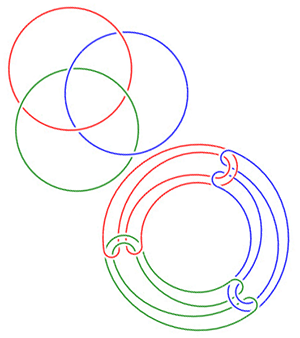
Topology [tuh-pol-uh-jee] is the study of how spaces are organized, how the objects are structured in terms of position. It also studies how spaces are connected. Topology has sometimes been called rubber-sheet geometry, because in topology there is no difference between a circle and a square (a circle made out of a rubber band can be stretched into a square) but there is a difference between a circle and a figure eight (you cannot stretch a figure eight into a circle without tearing).
The spaces studied in topology are called topological spaces. They vary from familiar manifolds to some very exotic constructions.
Continue reading →
Posted in Science |
Leave a Comment »
December 16, 2010

A human milk bank is a service which collects, screens, processes, and dispenses by prescription human milk donated by nursing mothers who are not biologically related to the recipient infant. There are currently eleven milk banks in North America. They are usually housed in hospitals, although sometimes they are free standing.
Continue reading →
Posted in Drugs, Food, Health |
Leave a Comment »