December 15, 2010

Light tubes or light pipes are used for transporting or distributing natural or artificial light. In their application to daylighting, they are also often called sun pipes, sun scopes, solar light pipes, or daylight pipes. The first commercial reflector systems were patented and marketed in the 1850s by British photographer Paul Emile Chappuis, utilising various forms of angled mirror designs.
Posted in Technology |
1 Comment »
December 15, 2010

Slow Cow is a ‘relaxation beverage’ launched in Quebec in December 2008, dubbed an ‘anti-energy’ drink by its creators.
Slow Cow’s principal ingredient is L-Theanine, an amino acid found in tea plants, which is said to produce a ‘feeling of relaxation and well-being.’ Other ingredients include extracts of chamomile, passiflora, valerian, tilia cordata, and hops.
Posted in Drugs, Food, Health |
Leave a Comment »
December 15, 2010


The United States Cyber Command (USCYBERCOM), located on Ft. Meade in Maryland, was officially activated in May of 2010. The command is led by National Security Agency Director General Keith B. Alexander. Elements of the command are responsible for the evolving mission of Computer Network Attack (CNA) – destroying networks and penetrating enemy computers to steal or manipulate data, and taking down command-and-control systems, for example. Some of these capabilities are known as Special Technical Operations (STO).
It has been suggested within the military that the cultures of the Army, Navy and Air Force are fundamentally incompatible with that of cyber warfare, and requires a fourth branch, a cyber-warfare branch. COL John Surdu (chief of staff of the United States Army Research, Development and Engineering Command) stated that the three major services are ‘properly positioned to fight kinetic wars, and they value skills such as marksmanship, physical strength, the ability to leap out of airplanes and lead combat units under enemy fire. These skills are irrelevant in cyber warfare.’
Posted in Politics, Technology, War |
Leave a Comment »
December 15, 2010
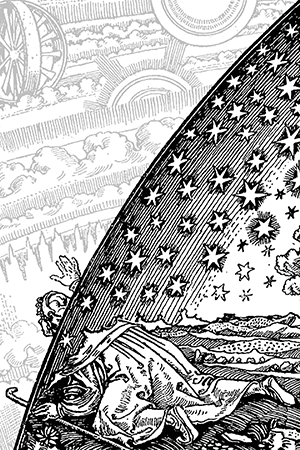
The Flammarion [fla-ma-ryawn] woodcut is an anonymous wood engraving (once believed to be a woodcut), so named because its first documented appearance is in Camille Flammarion’s 1888 book L’atmosphère: météorologie populaire (‘The Atmosphere: Popular Meteorology’).
The engraving depicts a man, dressed as a mediaeval pilgrim and carrying a pilgrim’s staff, who peers through the sky as if it were a curtain to look at the hidden workings of the universe. One of the elements of the cosmic machinery bears a strong resemblance to traditional pictorial representations of the ‘wheel in the middle of a wheel’ (Merkabah).
Posted in Art, Philosophy |
Leave a Comment »
December 15, 2010

Wood engraving is a technique in printmaking where the ‘matrix’ worked by the artist is a block of wood. It is a variety of woodcut and so a relief printing technique, where ink is applied to the face of the block and printed by using relatively low pressure. A normal engraving, like an etching, has a metal plate as a matrix and is printed by the intaglio method.
Wood engraving traditionally utilizes the end grain of wood as a medium for engraving, while in the older technique of woodcut the softer side grain is used. The technique of wood engraving developed at the end of the 18th century and the beginning of the 19th century, with the works of Thomas Bewick.
Posted in Art, Technology |
Leave a Comment »
December 15, 2010

Woodcut—formally known as xylography—is a relief printing artistic technique in printmaking in which an image is carved into the surface of a block of wood. the non-printing parts are removed, typically with gouges. The areas to show ‘white’ are cut away with a knife or chisel, leaving the characters or image to show in ‘black’ at the original surface level.
The block is cut along the grain of the wood (unlike wood engraving where the block is cut in the end-grain). Beechwood is commonly used in Europe. Cherry wood is favored in Japan. The surface is covered with ink by rolling over the surface with an ink-covered roller (brayer), leaving ink upon the flat surface but not in the non-printing areas. Multiple colors can be printed by keying the paper to a frame around the woodblocks (where a different block is used for each color).
Posted in Art, Technology |
Leave a Comment »
December 15, 2010
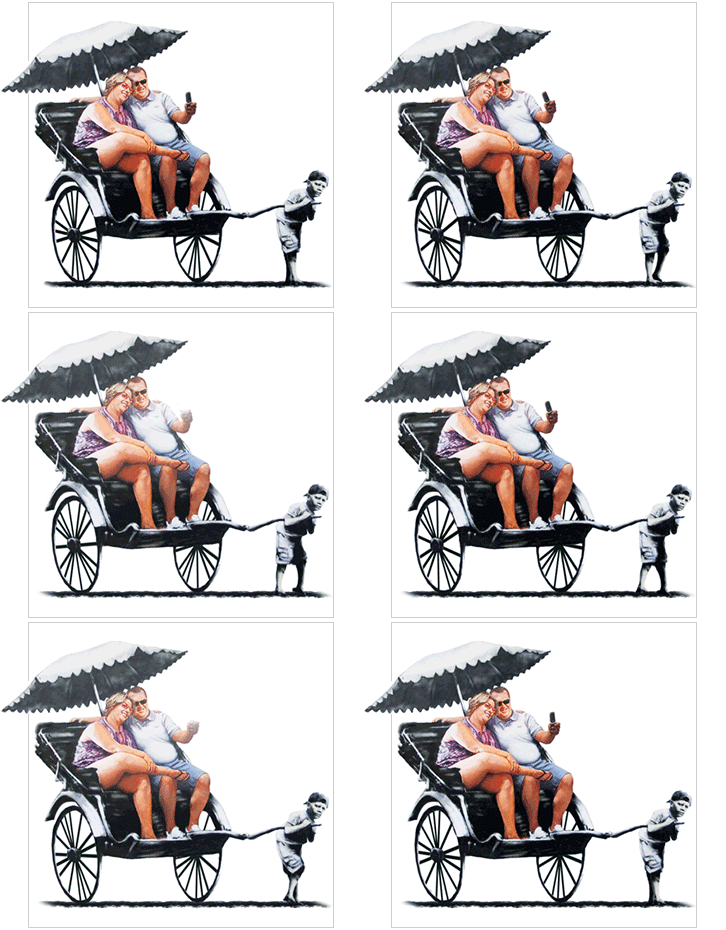
The Gini coefficient is a measure of statistical dispersion developed by the Italian statistician Corrado Gini in 1912. It has found application in the study of inequalities in disciplines as diverse as economics, health science, ecology, chemistry and engineering. It is commonly used as a measure of inequality of income or wealth. Worldwide, on a scale of 0 (total equality) to 1 (total inequality) Gini coefficients for income range from approximately 0.23 (Sweden) to 0.70 (Namibia) although not every country has been assessed.
Posted in Politics, Science, World |
Leave a Comment »
December 14, 2010

Kangaroo care is a technique shown to increase survivability rates in newborns wherein the infant is held, skin-to-skin, with an adult. Kangaroo care for pre-term infants may be restricted to a few hours per day, but if they are medically stable that time may be extended. Some parents may keep their babies in-arms for many hours per day. Kangaroo care, named for the similarity to how certain marsupials carry their young, was initially developed to care for preterm infants in areas where incubators are either unavailable or unreliable.
Posted in Health, Science |
Leave a Comment »
December 14, 2010
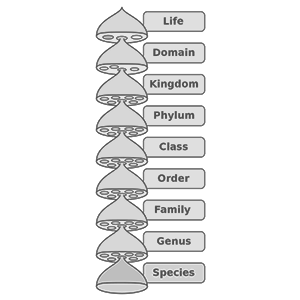
Taxonomy [tak-son-uh-mee] is the practice and science of classification. The word finds its roots in the Greek ‘taxis’ (meaning ‘order’ or ‘arrangement’) and ‘nomos’ (meaning ‘law’ or ‘science’).
Taxonomies are typically organized by generalization-specialization relationships, or less formally, parent-child relationships: the subtype has the same properties, behaviors, and constraints as the supertype plus one or more. For example: car is a subtype of vehicle, so any car is also a vehicle, but not every vehicle is a car.
Posted in Education, Language, Science |
Leave a Comment »
December 14, 2010

Vestas Wind Systems is a Danish manufacturer, seller, installer, and servicer of wind turbines. It is the largest in the world, but due to very rapid growth of its competitors – GE (US), Sinovel (China), Enercom (Germany), and Gamesa (Spain) – its market share decreased from 28% in 2007 to 12.5% in 2009. Vestas has installed over 41,000 wind turbines in 63 countries on five continents. The company employs more than 22,000 people globally, and has built production facilities in more than 12 countries.
Vestas spent €92 million ($128 million), or 1.4% of revenue, on research and development in 2009. It has filed 787 wind turbine patents (165 in 2009) according to United Kingdom Intellectual Property Office (UK-IPO), while General Electric has 666 and Siemens Wind Power has 242. In October 2009, Vestas and QinetiQ claimed a successful test of a stealth wind turbine blade mitigating radar reflection problems for aviation.
Posted in Money, Technology, World |
Leave a Comment »
December 14, 2010

The term life hack refers to productivity tricks that programmers devise and employ to cut through information overload and organize their data. The original definition of the term referred to utilities that filtered and processed data streams like email and RSS feeds. Examples of these types of life hacks might include utilities to synchronize files, track tasks, remind yourself of events or filter email. As the meme spread, the definition of the term expanded. Today, anything that solves an everyday problem in a clever or non-obvious way might be called a life hack. The term became popularized in the blogosphere and is primarily used by geeks who suffer from information overload or those with a playful curiosity in the ways they can accelerate their workflow.
The terms hack, hacking, and hacker have a long history of ambiguity in the computing and geek communities, particularly within the free and open source software crowds. However, in the context used here a ‘hack’ is a clever trick or stratagem. British technology journalist Danny O’Brien coined the term after polling a group of productive geeks on the details of their work processes. O’Brien discovered a pattern among these super-productive programmers: that they devised and used ’embarrassing’ scripts and shortcuts to get their work done.
Posted in Language, Technology |
Leave a Comment »
December 14, 2010

Getting Things Done (GTD) is an organizational method created by David Allen, described in a book of the same name. The Getting Things Done method rests on the principle that a person needs to move tasks out of the mind by recording them externally. That way, the mind is freed from the job of remembering everything that needs to be done, and can concentrate on actually performing those tasks.
Continue reading →
Posted in Money, Science |
Leave a Comment »





