December 13, 2010

Bubble car is a subjective term used for some small, economical automobiles, usually produced in the 1950s and 1960s. The Messerschmitt KR175 and KR200, and the FMR Tg500, had aircraft-style bubble canopies, giving rise to the term bubble car to refer to all these post-war microcars. Bubble cars became popular in Europe at that time as a demand for cheap personal motorized transport emerged and fuel prices were high due in part to the 1956 Suez Crisis. Most of them were three-wheelers, which in many places qualified them for inexpensive taxes and licensing as motorcycles. Most bubble cars were manufactured in Germany, including by the former German military aircraft manufacturers, Messerschmitt and Heinkel.
BMW manufactured the Italian Iso Rivolta Isetta under licence, using an engine from one of their own motorcycles. France also produced large numbers of similar tiny vehicles called voiturettes, but unlike the German makes, these were rarely sold abroad. There were a small number of British three wheeled microcars, including the larger Regal and Robin from the Reliant Motor Company in Staffordshire and the smaller P50 and Trident from the Peel Engineering Company on the Isle of Man. Bubble cars were superseded by a new wave of ‘proper small cars’ like the 1959 Austin Mini, which gave far more functionality for their owners for only slightly higher costs.
Posted in Money, Technology |
Leave a Comment »
December 13, 2010

Spirulina [spahy-ruh-lahy-nuh] is a microscopic blue-green algae in the shape of a spiral coil, living both in sea and freshwater. It is the common name for human and animal food produced primarily from two species: Arthrospira platensis, and Arthrospira maxima. Though referred to as ‘algae’ because they are aquatic organisms capable of photosynthesis, cyanobacteria are not related to any of the various eukaryotic algae. Spirulina is rich in complete proteins, essential fatty acids, b vitamins, minerals, and phytochemicals like beta-carotene. Spirulina contains an unusually high amount of protein, between 55% and 77% by dry weight. It is a complete protein, containing all essential amino acids, though with reduced amounts of methionine, cysteine, and lysine when compared to the proteins of meat, eggs, and milk.
It is, however, superior to typical plant protein, such as that from legumes. Spirulina also contains the amino acid phenylalanine, which should be avoided by people who have the metabolic disorder phenylketonuria. Arthrospira is cultivated around the world, and is used as a human dietary supplement, as well as a whole food, and is available in tablet, flake, and powder form. It is also used as a feed supplement in the aquaculture, aquarium, and poultry industries. Spirulina was a food source for Mesoamericans; the Aztecs called it ‘stone’s excrement.’ Its cultivation dates back to the 9th century in Chad, where dried cakes of spirulina, called dihéare, are used as bullion cubes.
Posted in Food, Health, Science |
Leave a Comment »
December 10, 2010
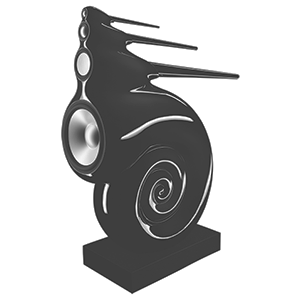
The Nautilus is a Bowers & Wilkins concept loudspeaker first released in 1993. It uses tapering tubes filled with absorbent wadding to reduce resonances to an insignificant minimum. Nautilus Tapering Tubes are fitted to nearly all Bowers & Wilkins speakers, even when they’re not visible to the eye. Tapering the tube enables you to make it shorter for the same level of absorption; it acts like a horn in reverse – reducing the sound level instead of increasing it.
The limit of this type of loading is reached when the wavelength gets small enough to be comparable with the diameter of the tube. To maintain the effectiveness of tube loading, you must restrict the bandwidth of each driver. This is one reason why the Nautilus loudspeaker is divided into a 4-way system. A more complex type of loading is required to cover a wider bandwidth and the sphere/tube enclosure was developed for the Nautilus 800 Series.
Posted in Art, Technology |
Leave a Comment »
December 10, 2010

Ferruccio [fer-root-chaw] Busoni [byoo-soh-nee] (1866 – 1924) was an Italian composer. His philosophy that ‘Music was born free; and to win freedom is its destiny,’ greatly influenced his students Percy Grainger and Edgard Varèse, both of whom played significant roles in the 20th century opening of music to all sound. In 1907 he published Sketch of a New Esthetic of Music, which discussed the use of electrical and other new sound sources in future music.
He deplored that his own keyboard instrument had conditioned our ears to accept only an infinitesimal part of the infinite gradations of sounds in nature. He wrote of the future of microtonal scales in music, made possible by Cahill’s Dynamophone: ‘Only a long and careful series of experiments, and a continued training of the ear, can render this unfamiliar material approachable and plastic for the coming generation, and for Art.’
Posted in Art, Technology |
Leave a Comment »
December 10, 2010

American fried rice (khao phat Amerikan) is a Thai fried rice dish with ‘American’ side ingredients like fried chicken, ham, hot dogs, raisins, ketchup, and croutons. It was invented during the Vietnam War era to serve to United States Marine Corps and United States Air Force personnel stationed in Thailand. The Malaysian equivalent of American fried rice, called Nasi Goreng USA, is made with many of the same ingredients; however, no pork products are used, and customers are given the choice of ketchup or chili sauce.
Posted in Food, World |
Leave a Comment »
December 10, 2010


A compression artifact is a noticeable distortion of media – an image, audio, or video – due to the application of an overly aggressive or inappropriate lossy data compression algorithm. These lossy data compression schemes discard some data to simplify the media sufficiently to store it in the desired space. If there is not enough data in the compressed version to reproduce the original with acceptable fidelity, artifacts will result. Alternatively, the compression algorithm may incorrectly determine certain distortions to be of little subjective importance, but they may in fact be objectionable to the viewer.
Compression artifacts occur in many common media such as DVDs, common computer file formats such as JPEG, MP3, or MPEG files, and Sony’s ATRAC compression algorithm. Uncompressed media (such as on Laserdiscs, Audio CDs, and WAV files) or losslessly compressed media (FLAC, PNG, etc.) do not suffer from compression artifacts. The minimization of artifacts is a key goal in implementation of lossy compression schemes. However, artifacts are occasionally intentionally produced for artistic purposes, a style known as glitch art.
Posted in Art, Technology |
Leave a Comment »
December 10, 2010

‘Red tape‘ is a derisive term for excessive regulation or rigid conformity to formal rules that is considered redundant or bureaucratic and hinders or prevents action or decision-making. It is usually applied to governments, corporations and other large organizations. Red tape generally includes the filling out of seemingly unnecessary paperwork, obtaining of unnecessary licenses, having multiple people or committees approve a decision and various low-level rules that make conducting one’s affairs slower, more difficult, or both.
The origins of the term are somewhat obscure, but it is first noted in historical records in the 16th century, when Henry VIII besieged Pope Clement VII with around eighty or so petitions for the annulment of his marriage to Catherine of Aragon. The documents were rolled, sealed and bound with the obligatory red tape, as was the custom. To this day, most U.K. barristers’ briefs are tied in a pink-colored ribbon known as ‘pink tape’ or ‘legal tape.’ All American Civil War veterans’ records were bound in red tape, and the difficulty in accessing them led to the modern American use of the term. Karl Marx wrote about the phenomenon of changing from one person in control of a complete task, to having multiple people each with specialties in specific tasks. He saw this occurring as society shifts from a Seigneurial system to a capitalist system.
Posted in Language, Politics |
Leave a Comment »
December 10, 2010


‘Kafkaesque‘ [kahf-kuh-esk] is an eponym used to describe concepts, situations, and ideas which are reminiscent of the literary work of the Austro-Hungarian writer Franz Kafka, particularly his novels ‘The Trial’ and ‘The Castle,’ and the novella ‘The Metamorphosis.’ The term has also been described as ‘marked by a senseless, disorienting, often menacing complexity: Kafkaesque bureaucracies’ and ‘marked by surreal distortion; and often a sense of impending danger: Kafkaesque fantasies of the impassive interrogation, the false trial, the confiscated passport, etc.’
It can also describe an intentional distortion of reality by powerful but anonymous bureaucrats: ‘Lack of evidence is treated as a pesky inconvenience, to be circumvented by such Kafkaesque means as depositing unproven allegations into sealed files…’ Another definition would be an existentialist state of ever-elusive freedom, existing under unmitigable control. The adjective refers to anything suggestive of Kafka, especially his nightmarish style of narration, in which characters lack a clear course of action, the ability to see beyond immediate events, and the possibility of escape. The term’s meaning has transcended the literary realm to apply to real-life occurrences and situations that are incomprehensibly complex, bizarre, or illogical.
Posted in Art, Language |
Leave a Comment »
December 10, 2010

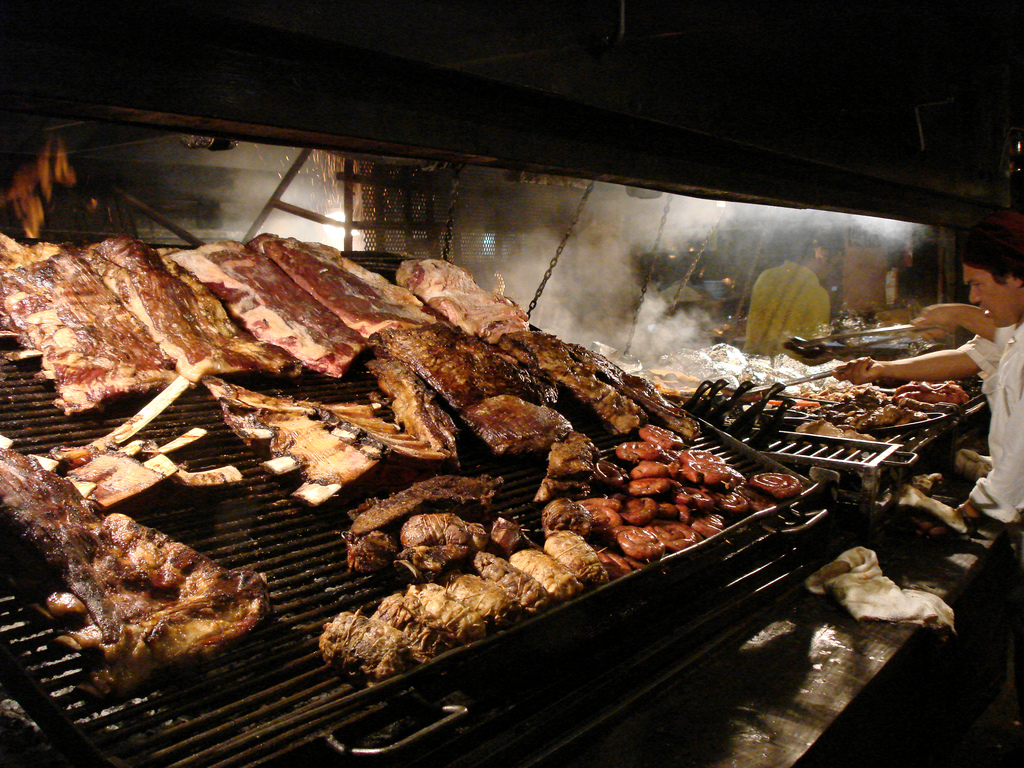
Asado [ah-sahdo] is a technique for cooking meat on a grill (parrilla) or open fire. It is considered the traditional dish of Argentina, Uruguay, Paraguay, and Chile. In southern Brazil it’s called ‘churrasco.’ An asado typically has a sequence: First are the chorizos, morcillas (black pudding), chinchulines (chitterlings), mollejas (sweetbread) and other organs, often accompanied by provoleta, a grilled cheese dish. Organs are sometimes these are served on a coal-heated brasero. Then costillas or asado de tira (ribs) are served. Finally, vacío (flank steak), matambre and possibly chicken and chivito (baby goat). Dishes such as the Uruguayan Pamplona, pork and Patagonian lamb are becoming more frequent, particularly in restaurants.
An asado also includes bread, a simple mixed salad of, for instance, lettuce, tomato and onions, or it could be accompanied with verdurajo (grilled vegetables), a mixture made of potatoes, corn, onion and eggplant cooked on the parrilla and seasoned with olive oil and salt. The meat for an asado is not marinated, the only preparation being the application of salt before and/or during the cooking period. Chimichurri, a sauce of chopped parsley, dried oregano, garlic, salt, pepper, onion, and paprika with olive oil, and salsa criolla, a sauce of tomato and onion in vinegar, are common accompaniments to an asado, where they are traditionally used on the offal, but not the steaks.
Posted in Food, World |
Leave a Comment »
December 10, 2010

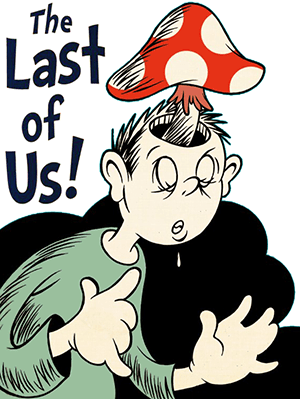
Cordyceps [kord-uh-seps] is a genus of mushrooms that grows on caterpillars and other insects; it has a number of Eastern and Western medical applications. It is used for a wide range of conditions including fatigue, sexual dysfunction, coughing, and as an adaptogen or immune stimulant.
An interesting feature of the Cordyceps species is the ability to affect the behavior of their insect host. Cordyceps unilateralis causes ants to climb a plant and attach there before they die. This ensures the parasite’s environment is of the optimal temperature and humidity, and maximal distribution of the spores from the fruiting body that sprouts out of the dead insect is achieved.
Continue reading →
Posted in Drugs, Money, Science |
Leave a Comment »
December 10, 2010

Transmetropolitan is a cyberpunk comic book series written by Warren Ellis with art by Darick Robertson and published by DC Comics. It chronicles the battles of Spider Jerusalem, infamous renegade gonzo journalist of the future, an homage to gonzo journalism founder Hunter S. Thompson. Jerusalem dedicates himself to fighting the corruption and abuse of power of two successive United States presidents; he strives to keep his world from turning more dystopian than it already is while dealing with the struggles of fame and power.
Posted in Art, Humor |
Leave a Comment »
December 10, 2010

Gonzo journalism is a style of journalism that is written subjectively, often including the reporter as part of the story via a first-person narrative. The word Gonzo was first used in 1970 to describe an article by Hunter S. Thompson, who later popularized the style. The term has since been applied to other subjective artistic endeavors.
Gonzo journalism tends to favor style over accuracy and often uses personal experiences and emotions to provide context for the topic or event being covered. It disregards the ‘polished’ edited product favored by newspaper media and strives for a more gritty approach. Use of quotations, sarcasm, humor, exaggeration, and profanity is common.
Continue reading →
Posted in Humor, Language, Politics |
Leave a Comment »