November 15, 2010

Lee’s Sandwiches is an American fast food restaurant chain specializing in Vietnamese cuisine. While originally famous for selling French baguette bánh mì (Vietnamese sandwiches), the chain has expanded its offering to many other goods, including packaged spring rolls, desserts, and other food to go items.
The first Lee’s opened in San Jose, California in 1980. There are now over three dozen locations in California, Arizona, Texas, and Oklahoma, as well as a new restaurant in Ho Chi Minh City, Vietnam. The company has plans to expand in the Pacific states of Nevada, Oregon, and Washington.
Posted in Food, Money, World |
Leave a Comment »
November 15, 2010
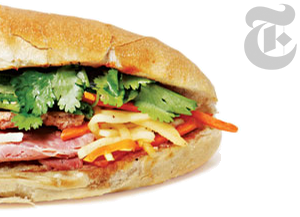
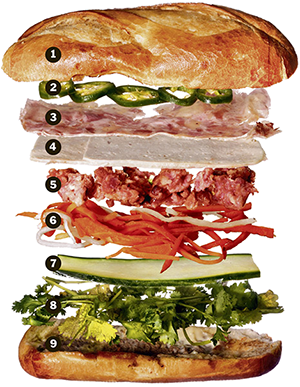
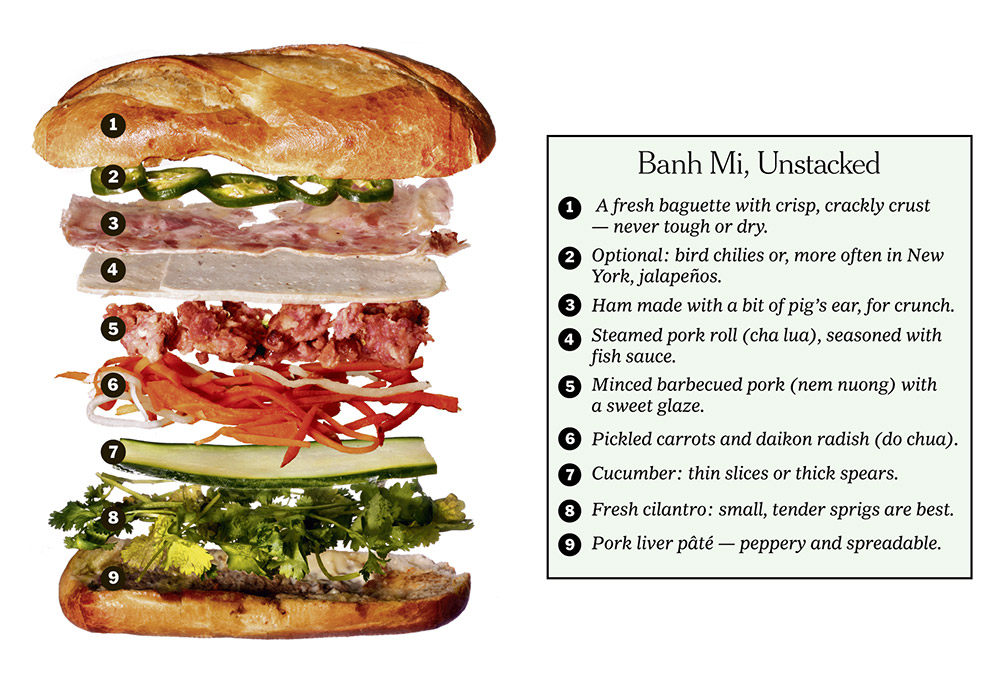
Bánh mì [ban-me] is a Vietnamese baguette made with both wheat and rice flour. The term also refers to what is sometimes called a ‘Vietnamese sandwich’ or a ‘Saigon sub,” which is made up of thinly sliced pickled carrots and daikon, cucumbers, cilantro, chili peppers, pâté, mayonnaise and various meat fillings or tofu. Popular fillings include roasted pork, steamed pork belly, Vietnamese sausage, chicken, head cheese and ham.
Posted in Food, World |
Leave a Comment »
November 15, 2010

The Voynich manuscript is a handwritten book thought to have been written between 1404 and 1438, composed of 240 vellum (mammal skin) pages, most with illustrations. Despite centuries of research, the author, script, and language remain unknown. Some think the manuscript is an elaborate hoax, others believe it was meant to serve as a pharmacopoeia or to address topics in medieval or early modern medicine.
Generally presumed to be some kind of ciphertext (an encrypted document), the Voynich manuscript has been studied by many professional and amateur cryptographers, including American and British codebreakers from both World War I and World War II. Yet it has defied all decipherment attempts, becoming a historical cryptology cause célèbre. The book is named after the Polish-Lithuanian-American book dealer Wilfrid M. Voynich, who acquired it in 1912. Currently the Voynich manuscript is owned by the Beinecke Rare Book and Manuscript Library of Yale University.
Posted in Art, Language |
Leave a Comment »
November 15, 2010
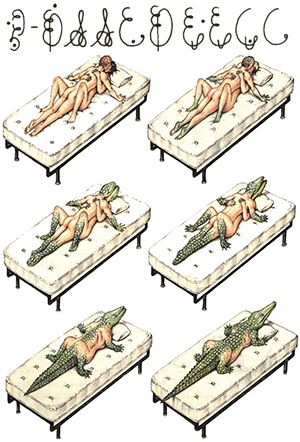

The Codex Seraphinianus is a book written and illustrated by the Italian artist, architect and industrial designer Luigi Serafini during thirty months, from 1976 to 1978. The book is a visual encyclopedia of an unknown world, written in one of its languages, a thus-far undeciphered alphabetic writing. The Codex is divided into eleven chapters, partitioned into two sections. The first section appears to describe the natural world, dealing with flora, fauna, and physics. The second deals with the humanities, the various aspects of human life: clothing, history, cuisine, architecture and so on. The illustrations are often surreal parodies of things in our world: bleeding fruit; a plant that grows into roughly the shape of a chair and is subsequently made into one; a lovemaking couple that metamorphoses into an alligator; etc.
The language of the codex has defied complete analysis by linguists for decades. The number system used for numbering the pages, however, has been discovered to be a variation of base 21. In a talk at the Oxford University Society of Bibliophiles held in 2009, Serafini stated that the script of the Codex is asemic, that his own experience in writing it was closely similar to automatic writing, and that what he wanted his alphabet to convey to the ‘reader’ is the sensation that children feel in front of books they cannot yet understand, although they see that their writing does make sense for grown-ups.
Posted in Art, Humor, Language |
2 Comments »
November 15, 2010

A bug-out bag is a portable kit that contains the items one would require to survive for seventy two hours when evacuating from a disaster. It is also known as a 72-hour kit, a grab bag, or a battle box. The focus is on evacuation, rather than long-term survival, distinguishing it from a survival kit, boating or aviation emergency kit, or a fixed-site disaster supplies kit. Bug-out bags are popular in the survivalist community. The term is related to, and possibly derived from, the ‘bail-out bag’ emergency kit many military aviators carry.
Typical contents include: 1 Gallon H2O per person, per day; Non-perishable food, Water purification supplies, Cooking supplies (camp stove, sterno, utensils), First aid kit, Fire starting tool (matches, ferrocerium rod, lighter), Disaster plan (location of emergency centers, rallying points, possible evacuation routes), Emergency reference literature,Maps, Clothing (rain poncho, hat, gloves), Bedding (bedroll, blankets), Medicine, Medical records, Radio, Lighting (flashlight, glow sticks), Firearm, Cash, Identification cards, Knife, Duct Tape, Rope, Plastic tarps, and Wire.
Posted in Health, Language |
1 Comment »
November 11, 2010

The Lamborghini Countach was a mid-engined sports car produced by Italian automaker Lamborghini from 1974 to 1990. A total of 2,042 cars were built during the Countach’s sixteen year lifetime: Its design both pioneered and popularized the wedge-shaped, sharply angled look popular in many high performance sports cars. The ‘cabin-forward’ design concept, which pushes the passenger compartment forward in order to accommodate a larger engine, was also popularized by the Countach.
The word ‘countach’ is an exclamation of astonishment in the local Piedmontese language — generally used by men on seeing an extremely beautiful woman. The Countach name stuck when Nuccio Bertone first saw ‘Project 112’ in his studio. The prototype was introduced to the world at the 1971 Geneva Motor Show. Most previous and subsequent Lamborghini car names were associated with bulls and bullfighting.
Posted in Language, Technology, World |
Leave a Comment »
November 11, 2010
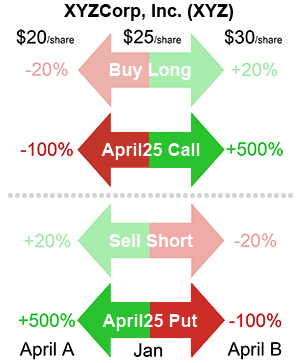
In finance, an option is a contract between two parties to buy (call) or sell (put) an asset (typically a stock or bond) at a strike price by a specified expiration date after which the option is worthless and the contact is void. The price of an option derives from the value of an underlying asset plus a premium based on the time remaining until the expiration of the option. Other types of options exist, and options can in principle be created for any type of valuable asset. You would buy the stock (go long) or a call option if you anticipated the price of the underlying security was going to rise before the option reached expiration.
You would buy a put option if thought the price was going to fall, or you can short the stock, selling shares borrowed from a third party with the intention of buying identical assets back at a later date to return to the lender. Options are quoted in per share prices, but only sold in 100 share lots. For example, a call option might be quoted at $2, but you would pay $200 because options are always sold in 100-share lots. Options are identified by the month they expire, and the strike price. For example, an ‘XYZ April25 Call’ would be a call option on XYZ stock with a strike price of 25 that expires in April. All options expire on the third Friday of the month unless that Friday is a holiday, then the options expire on Thursday.
Posted in Money |
Leave a Comment »
November 11, 2010

The Eames [eemz] Lounge Chair, officially titled Eames Lounge (670) and Ottoman (671), were released in 1956 after years of development by designers Charles and Ray Eames for the Herman Miller furniture company. It was the first chair the Eames designed for a high-end market. They are made of molded plywood and leather, and examples of these furnishings are part of the permanent collection of New York’s Museum of Modern Art. They are prized for comfort, aesthetics, and for the pioneering use of new materials and manufacturing methods.
There is a decent used market for these chairs. Some collectors are willing to pay high prices for earlier chairs made with Brazilian Rosewood veneer, which is no longer available due to a worldwide embargo since 1992. Prices for original rosewood chairs have recently reached as much as $7,000 in auction. A new Eames Lounge Chair and ottoman starts at $3,200 for a Herman Miller model. In 2006, to commemorate the 50th anniversary of the chair, Herman Miller released models using a sustainable Palisander Rosewood veneer.
Posted in Art, Money, Technology |
Leave a Comment »
November 11, 2010
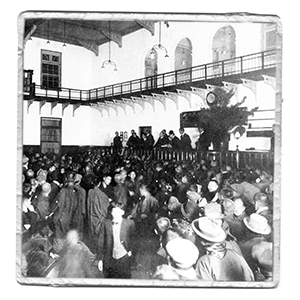
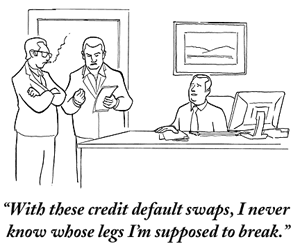
In finance, a derivative is a financial instrument (or, more simply, an agreement between two parties) that has a value, based on the expected future price movements of the asset to which it is linked—called the underlying— such as a share or a currency. There are many kinds of derivatives, with the most common being swaps, futures, and options.
Derivatives are a form of alternative investment, an investment product other than the traditional investments of stocks, bonds, cash or property. A derivative is not a stand-alone asset, since it has no value of its own. However, more common types of derivatives have been traded on markets before their expiration date as if they were assets. Among the oldest of these are rice futures, which have been traded on the Dojima Rice Exchange since the eighteenth century.
Posted in Language, Money |
Leave a Comment »
November 11, 2010
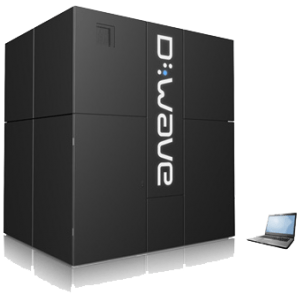
A quantum computer is a device for computation that makes direct use of quantum mechanical phenomena, such as superposition and entanglement, to perform operations on data. Quantum computers are different from traditional computers based on transistors. The basic principle behind quantum computation is that quantum properties can be used to represent data and perform operations on these data. If large-scale quantum computers can be built, they will be able to solve certain problems much faster than any current classical computers (for example Shor’s algorithm). The Bloch sphere is a representation of a qubit, the fundamental building block of quantum computers.
A classical computer has a memory made up of bits, where each bit represents either a one or a zero. A quantum computer maintains a sequence of qubits. A single qubit can represent a one, a zero, or, crucially, a quantum superposition where it is all possible states simultaneously. Although quantum computing is still in its infancy, experiments have been carried out in which quantum computational operations were executed on a very small number of qubits. Both practical and theoretical research continues, and many national government and military funding agencies support quantum computing research to develop quantum computers for both civilian and national security purposes, such as cryptanalysis.
Posted in Technology |
Leave a Comment »
November 11, 2010

The Whig Party was a political party of the United States during the era of Jacksonian democracy (1833 – 1856). The party was formed in opposition to the policies of President Andrew Jackson and his Democratic Party to promote the strength of the presidency and executive branch at the expense of Congress. The Whigs advocated the supremacy of Congress over the presidency, and favored a program of modernization and economic protectionism. In its two decades of existence, the Whig Party saw two of its candidates, William Henry Harrison and Zachary Taylor, elected president.
Continue reading →
Posted in Language, Politics |
Leave a Comment »
November 11, 2010
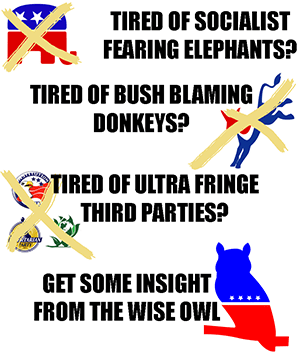
The Modern Whig Party is a United States political party whose stated intention is to be a ‘party for the rest of us.’ The Modern Whig Party describes itself as a mainstream, middle-of-the-road grassroots movement that caters to those voters who believe in various Republican issues but also believe in various other Democratic issues. Founded in 2008 by Iraq and Afghanistan veterans, the party has over 30,000 members nationally, with a sizable proportion affiliated with the American military. The general platform of the Modern Whig Party relates to fiscal responsibility, strong national defense, and social progress.
For its logo, the Modern Whig Party uses an owl, the symbol of the original Whig Party. As with the logos for the Democrats and the Republicans, a red, white, and blue color scheme is used, but with different meaning. Reportedly, the blue represents Democrats and the red, Republicans; the two colors are divided by a white band and four white stars. The party believes that the United States’ future lies in “meeting in the middle”, thus the placement of the stars in the middle of the owl.
Posted in Politics |
Leave a Comment »




 The Daily Omnivore