October 9, 2010

Abelardo is a green, full-bodied Muppet parrot who appears on Plaza Sésamo, the Mexican co-production of Sesame Street. He joined the cast in 1981 and soon became the show’s most recognizable figure. Abelardo also guest starred on the American Sesame Street on May 5, 1997 as part of the Cinco de Mayo celebration. On the Mexican show, he occasionally keeps contact with his cousin Big Bird via letters and video-chatting.
His character was originally a a tall orange-and-yellow scaled dragon which had a soft, gentle voice and a very particular way of talking, making pauses after every sentence. His favorite treat were pumpkin seeds or ‘semillas de calabaza’ which in Mexico are a very popular snack, also known as ‘Pepitas.’ In later seasons Abelardo the Dragon was replaced by Serapio Montoya, a large parrot-like character with a strong resemblance to Big Bird, of whom he is a cousin. However, children and others continued to refer to Serapio as ‘Abelardo’ and therefore his name was later changed to Abelardo Montoya. The reason the dragon character was dismissed when the series was re-launched in 1982, remains unexplained.
Posted in Education, World |
Leave a Comment »
October 1, 2010

The Olduvai Gorge in northern Tanzania is commonly referred to as ‘The Cradle of Mankind.’ The old name for the Gorge was Olduvai Gorge, which was a mispronunciation of Oldupai. The Gorge was re-named in 2005 to correct this mistake. Oldupai is the Maasai word for the wild plant which grows in the gorge that is used as an antiseptic and natural bandage. Excavation work there was pioneered by Louis and Mary Leakey beginning in 1931 and continued into the twenty-first century by Professor Fidelis Masao of the Open University of Tanzania supported by Earthwatch; there have also been teams from Rutgers University.
The earliest archaeological deposit, known as Bed I, has produced evidence of campsites and living floors along with stone tools made of local basalt and quartz. Since this is the site where these kinds of tools were first discovered, these tools are called Oldowan. It is now thought that the Oldowan toolmaking tradition started about 2.6 million years ago. Above this, in Bed II, pebble tools begin to be replaced by more sophisticated handaxes of the Acheulean industry and made by H. ergaster. This layer has not yet been successfully dated, but likely falls between 1.75 and 1.2 million years.
Posted in Technology |
Leave a Comment »
October 1, 2010


Unit 731 was a covert biological and chemical warfare research and development unit of the Imperial Japanese Army that undertook lethal human experimentation during the Second Sino-Japanese War (1937–1945) and World War II. It was responsible for some of the most notorious war crimes carried out by Japanese personnel. Unit 731 was the code name of an Imperial Japanese Army unit officially known as the Epidemic Prevention and Water Purification Department of the Kwantung Army. It was initially set up under the Kempeitai military police of the Empire of Japan to develop weapons of mass destruction for potential use against Chinese, and possibly Soviet forces.
Continue reading →
Posted in Death, Politics, War |
Leave a Comment »
October 1, 2010


The Scratchophone is a portable scratch instrument, featuring a turntable, a special tonearm, scratch mixer, and a pair of speakers, a battery, and a harness. They are hand-made in Quebec, Canada and feature a direct drive Numark turntable, a 2-channel Vestax mixer, and a Stanton cartdidge needle. It sells for $2,179.99.
Posted in Art, Money, Technology |
Leave a Comment »
September 30, 2010

Uniqlo is a Japanese casual wear designer, manufacturer and retailer. Uniqlo is Japan’s leading clothing retail chain in terms of both sales and profits. The company also operates in China, Hong Kong, South Korea, the United Kingdom, France, the United States, Singapore, Taiwan, and Russia. Originally a division of Fast Retailing Co., Ltd., on November 1, 2005, Uniqlo Co., Ltd. was born of corporate restructuring, and now exists as a 100% consolidated subsidiary of Fast Retailing, which is listed on the first section of the Tokyo Stock Exchange.
Posted in Money, World |
Leave a Comment »
September 30, 2010
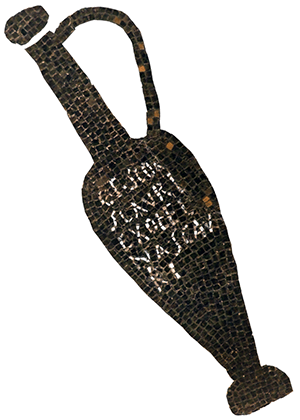
Garum [gah-rum], similar to liquamen, was a type of fermented fish sauce condiment that was an essential flavour in Ancient Roman cooking. Although it enjoyed its greatest popularity in the Roman world, it originally came from the Greeks, gaining its name from the Greek words garos or gáron (γάρον), a fish whose intestines were originally used in the condiment’s production. For the Romans it was both a staple to the common diet and a luxury for the wealthy. After the liquid garum was ladled off of the top of the mixture, the remains of the fish, called allec, was used by the poorest classes to flavour their staple porridge.
The sauce was generally made through the crushing and fermentation in brine of the innards of various fishes such as mackerel, tuna, eel, and others. While the finished product was apparently mild and subtle in flavor, the actual production of garum created such unpleasant smells as to become relegated to the outskirts of citie. Garum was prepared from the intestines of small fishes, macerated in salt and cured in the sun for one to three months, where the mixture fermented and liquified in the dry warmth, the salt inhibiting the common agents of decay. The end product was very nutritious, retaining a high amount of protein and amino acids, along with a good deal of minerals and B vitamins. Garum is still produced at factories in San Roque, Spain.
Posted in Food, World |
Leave a Comment »
September 30, 2010

Internet2 is a not-for-profit networking consortium, which operates a next-generation Internet Protocol and optical network. As the Internet gained in public recognition and popularity, universities were among the first institutions to outgrow their bandwidth limitations. The National Science Foundation and MCI developed the very-high-performance Backbone Network Service (vBNS) in 1995 to support high-bandwidth applications like data mining, medical imaging and particle physics. The Internet2 project was established in 1996, and in partnership with Qwest, built the first Internet2 Network, called Abilene in 1998.
In 2003 it was a prime investor in the National LambdaRail project, the first transcontinental 10-Gigabit Ethernet network. In 2007, Internet2 officially retired Abilene and now refers to its new, higher capacity network as the Internet2 Network. The network itself is a dynamic, robust and cost-effective hybrid optical and packet network. It furnishes a 100Gb/s network backbone to more than 210 U.S. educational institutions, 70 corporations and 45 non-profit and government agencies.
Posted in Education, Technology |
Leave a Comment »
September 30, 2010

Unit 8200 is an Israeli Defence Force (IDF) Intelligence Corps unit, responsible for collecting signal intelligence and code decryption. It is the largest unit in the IDF, with several thousand soldiers. It is comparable in its function to the United States’ National Security Agency, except that it is not a separate civilian body.
In March 2004, The Commission to investigate the intelligence network following the War in Iraq recommended turning the unit into a civilian National SIGINT Agency, as is largely the case in other Western countries, but this proposal has yet to be implemented. Urim SIGINT Base is the most important signal intelligence-gathering installation operated by Israel’s military and is part of Unit 8200. The Urim base is located in the Negev desert approximately 30km from Beersheba.
Posted in Politics, War |
Leave a Comment »
September 30, 2010
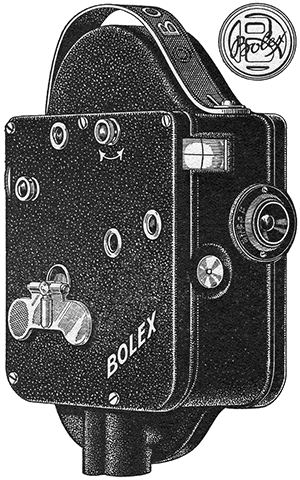

Bolex is a Swiss company that manufactures motion picture cameras and lenses. The most notable products of which are in the 16 mm and Super 16 mm formats. The Bolex was initially founded by Ukranian engineer and inventor Jacques Bogopolsky in the 1940s. Bolex is derived from his name. He had previously designed cameras for Alpa. Bolex cameras were particularly important for early television news, nature films, documentaries and the avant garde, and are still favoured by many animators today.
Some later models are electrically powered, the majority of those manufactured since the 1930s use a spring-wound clockwork. The 16 mm spring-wound Bolex is a popular introductory camera in film schools. Today, the Bolex factory in Switzerland continues to produce new 16mm and Super 16 film cameras and also can convert Bolex H16 reflex models to super 16mm.
Posted in Art, Technology, World |
1 Comment »
September 29, 2010

The Pineberry is a strawberry cultivar owned by breeder Hans de Jongh and commercialized by VitalBerry BV in Made, The Netherlands. The fruit flesh can range from soft white to orange and is very fragrant with a slight pineapple flavor. Pineberries begin life as green berries, then become slightly white. By the time their deeply set seeds turn deep red, the white fruit is deemed ripe.
Posted in Food, World |
Leave a Comment »
September 28, 2010


Paruresis [pahr-yew-ree-sis] is a type of phobia in which the sufferer is unable to urinate in the (real or imaginary) presence of others, such as in a public restroom. It most commonly affects males, though there are female sufferers too. The analogous condition that affects bowel movement is called parcopresis.
Many people have brief, isolated episodes of urinary difficulty in situations where other people are in close proximity. Paruresis is also known by many colloquial terms, including bashful bladder, bashful kidneys, mental cloggery, stage fright, pee fright, urophobia, pee-shyness, the slow dribbles, creeping pee-pee, public piss syndrome, shy bladder syndrome, air-blockage, and psychogenic urinary retention.
Continue reading →
Posted in Health |
Leave a Comment »
September 27, 2010
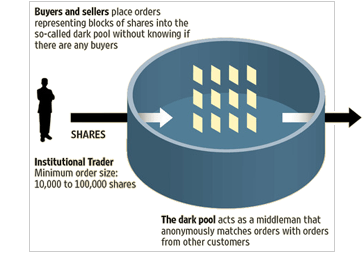

Dark pools of liquidity are financial trading venues or crossing networks similar to exchanges but that provide liquidity that is not displayed on order books. This is useful for traders who wish to move large numbers of shares without revealing themselves to the open market. Dark liquidity pools offer institutional investors many of the efficiencies associated with trading on the exchanges’ public limit order books but without showing their actions to others. Dark liquidity pools avoid this risk because neither the price nor the identity of the trading company is displayed.
Dark pools are recorded to the national consolidated tape. However, they are recorded as over-the-counter transactions. Therefore detailed information about the volumes and types of transactions is left to the crossing network to report to clients if they desire and are contractually obligated. Dark pools allow funds to line up and move large blocks of equities without tipping their hands as to what they are up to. Modern trading platforms and the lack of human interaction have reduced the time scale on market movements. This increased responsiveness of the price of an equity to market pressures has made it more difficult to move large blocks of stock without affecting the price.
Posted in Money |
Leave a Comment »