September 27, 2010

Stuxnet is a Windows computer worm discovered in July 2010 that targets industrial software and equipment. While it is not the first time that hackers have targeted industrial systems, it is the first discovered malware that spies on and subverts industrial systems. The worm initially spreads indiscriminately, but includes a highly specialized malware payload that is designed to target only Siemens Supervisory Control And Data Acquisition systems that are configured to control and monitor specific industrial processes.
The probable target of Stuxnet is widely suspected to be uranium enrichment infrastructure in Iran, which confirmed that its nuclear program had indeed been damaged. The infestation by this worm may therefore have damaged Iran’s nuclear facilities in Natanz and eventually delayed the start up of Iran’s Bushehr Nuclear Power Plant. Security experts have concluded that the sophisticated attack could only have been conducted with nation-state support and it has been speculated that Israel may have been involved.
Posted in Technology, War |
Leave a Comment »
September 26, 2010

The Ahnenerbe was a Nazi German think tank that promoted itself as a ‘study society for Intellectual Ancient History.’ Founded on July 1, 1935, by Heinrich Himmler, Herman Wirth, and Richard Walther Darré, the Ahnenerbe’s goal was to research the anthropological and cultural history of the Aryan race, and later to experiment and launch voyages with the intent of proving that prehistoric and mythological Nordic populations had once ruled the world.
The Ahnenerbe had several different research institutions. Most of these were archeological and anthropological but others included a meteorology department, devoted to ‘Welteislehre’ (World Ice Theory), a pseudoscientific cosmological theory proposed by Hans Hörbiger, an Austrian engineer and inventor. According to his theory, ice was the basic substance of all cosmic processes, and ice moons, ice planets, and the ‘global ether’ (also made of ice) had determined the entire development of the universe. There was also a section devoted to musicology, whose aim was to determine ‘the essence’ of German music. The section made sound recordings, transcribed manuscripts and songbooks, and photographed and filmed instrument use and folk dances. The lur, a Bronze Age musical instrument, became central to this research, which concluded that Germanic consonance was in direct conflict to Jewish atonalism.
Posted in Science, War |
Leave a Comment »
September 25, 2010

The Flat Earth Society is an organization that seeks to further the belief that the Earth is flat rather than the scientifically accepted view that it is a sphere or a geoid. The modern organization was founded by Englishman Samuel Shenton in 1956. The belief that the Earth was flat was typical of ancient cosmologies until about the 4th century BC, when the Ancient Greek philosophers proposed the idea that the Earth was a sphere, or at least rounded in shape. Aristotle was one of the first thinkers to propose a spherical Earth in 330 BC. By the early Middle Ages, it was widespread knowledge throughout Europe that the Earth was a sphere.
Modern hypotheses supporting a flat Earth originated with English inventor Samuel Rowbotham (1816–1884). Based on his interpretation of certain biblical passages, Rowbotham published a 16-page pamphlet, which he later expanded into a 430-page book, ‘Earth Not a Globe,’ expounding his views. According to Rowbotham’s system, which he called ‘Zetetic Astronomy,’ the earth is a flat disc centered at the North Pole and bounded along its southern edge by a wall of ice (Antarctica), with the sun and moon 3000 miles (4800 km) and the ‘cosmos’ 3100 miles (5000 km) above earth. As of September 2009, two web-based discussion forums exist devoted to the Flat Earth Society is also represented on Twitter and Facebook.
Posted in Humor, Science, World |
Leave a Comment »
September 24, 2010

Helium-3 (He-3) is a light, non-radioactive isotope of helium with two protons and one neutron. It is rare on Earth, and is sought for use in nuclear fusion research. The abundance of helium-3 is thought to be greater on the Moon (embedded in the upper layer of regolith by the solar wind over billions of years) and the solar system’s gas giants (left over from the original solar nebula), though still low in quantity.
Its existence was first proposed in 1934 by the Australian nuclear physicist Mark Oliphant. Helium-3 is proposed as a second-generation fusion fuel for fusion power uses. Tritium, with a 12-year half-life, decays into helium-3, which can be recovered. Irradiation of lithium in a nuclear reactor — either a fusion or fission reactor — can also produce tritium, and thus (after decay) helium-3.
Posted in Science |
Leave a Comment »
September 24, 2010

Minecraft is a ‘sandbox game’ where players mine and build in a randomly generated 3D world. Hostile monsters roam the environment at night, forcing players to build fortifications. Mining uncovers ores in the ground, which can be crafted into useful items such as chests, minecarts and tracks, and buckets. There are also plants and animals, which can be farmed and hunted for other resources. The game features a free classic mode where players have unlimited resources, and is available as an alpha release for €9.95. As of September 23rd 2010, it has surpassed 760,000 registered users and 208,000 purchases.
It is currently in development by Markus Persson, aka ‘Notch.’ The gameplay is inspired by Dwarf Fortress, RollerCoaster Tycoon, Dungeon Keeper, and especially Infiniminer. Players must devise methods of building functional and navigable structures that can withstand the nightly assault from various monsters. The player’s short reach and short jumping ability forces players to plan structures carefully, lest they trap themselves or fall to their death during construction. More advanced players can create complex traps and mechanisms using the game physics as well as primitive electrical circuits and logic gates.
Posted in Games, Money |
Leave a Comment »
September 24, 2010

In its original sense, a shaggy dog story is an extremely long-winded tale featuring extensive narration of typically irrelevant incidents, usually resulting in a pointless or absurd punchline. These stories are a special case of yarns, coming from the long tradition of campfire yarns. Shaggy dog stories play upon the audience’s preconceptions of the art of joke telling. The audience listens to the story with certain expectations, which are either simply not met or met in some entirely unexpected manner.
A boy owned a dog that was uncommonly shaggy. Many people remarked upon its considerable shagginess. When the boy learned that there are contests for shaggy dogs, he entered his dog. The dog won first prize for shagginess in both the local and the regional competitions. The boy entered the dog in ever-larger contests, until finally he entered it in the world championship for shaggy dogs. When the judges had inspected all of the competing dogs, they remarked about the boy’s dog: ‘He’s not so shaggy.’
Posted in Art, Humor |
Leave a Comment »
September 24, 2010


The Reagan Doctrine was a strategy orchestrated and implemented by the United States under the Reagan Administration to oppose the global influence of the Soviet Union during the final years of the Cold War. While the doctrine lasted less than a decade, it was the centerpiece of United States foreign policy from the early 1980s until the end of the Cold War in 1991. Under the Reagan Doctrine, the U.S. provided overt and covert aid to anti-communist guerrillas and resistance movements in an effort to ‘rollback’ Soviet-backed communist governments in Africa, Asia and Latin America. Most notably, the mujahideen in Afghanistan and the contras in Nicaragua.
The doctrine was designed to serve the dual purposes of diminishing Soviet influence in these regions, while also potentially opening the door for capitalism (and sometimes liberal democracy) in nations that were largely being governed by Soviet-supported socialist governments. However, since the September 11 attacks, some critics have argued that, by facilitating the transfer of large amounts of weapons to various areas of the world and by training military leaders in these regions, the Reagan Doctrine actually contributed to ‘blowback’ by strengthening some political and military movements that ultimately developed hostility toward the United States, such as al-Qaeda in Afghanistan.
Posted in Politics, War |
Leave a Comment »
September 24, 2010


Raggare (a Swedish word roughly corresponding to the English term ‘pick-up artist.’) refers to a subculture found mostly in Sweden and parts of Norway, Finland, Denmark, Germany and Austria. Raggare are closely related to the greaser subculture of the U.S. and are known for their love of hot rod cars and 1950s American pop culture. Pontiac Bonnevilles of the 1960s are particularly popular among raggare.
Considered by some a menace to society, but more often seen as an amusing group of outsiders, raggare culture lives on in Sweden, but in many ways it is still viewed in a negative light. Because of its mostly rural roots, retro-aesthetics, and unusual (for Swedes) pro-American stance, raggare are often (in urban areas and in pop-culture) seen as uneducated, with poor taste and a low-brow attitude towards sex.
Posted in Language, World |
Leave a Comment »
September 23, 2010
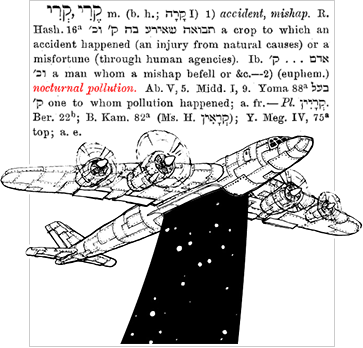
Keri is a Hebrew term which literally means ‘happenstance,’ ‘frivolity’ or ‘contrariness’ and has come to mean ‘seminal emission.’ The term is generally used in Jewish law to refer specifically to the regulations and rituals concerning the emission of semen. The biblical regulations of the Priestly Code specify that a man who had experienced an emission of semen would become ritually impure, until the evening came and the man had washed himself in water.
The Talmud adds prohibitions designed to avoid keri in cases that don’t involve sexual intercourse. It was forbidden for a man to investigate himself to determine whether an emission of semen had occurred. The Talmud goes on to address the concern that preventing any contact with the penis would make urination more awkward for males, with some Talmudic rabbis arguing that men should urinate from a high place or above dirt so that they don’t have to touch the penis to avoid making a mess. Deliberate erections were considered by some of the Talmudic writers to be an excommunicable offense, and Talmudic sources even prohibit men from witnessing sexually arousing scenes.
Posted in Philosophy, Sex |
Leave a Comment »
September 23, 2010

The Journal of Recreational Mathematics is an American journal dedicated to recreational mathematics, started in 1968. It is published quarterly by the Baywood Publishing Company. The journal contains original articles, book reviews, alphametics (verbal arithmetic), problems, conjectures, and solutions.
Posted in Education, Language, Science |
Leave a Comment »
September 23, 2010


Hafiz [hah-fiz], literally meaning ‘guardian’, is an honorific used by Muslims in modern days for someone who has completely memorized the Qur’an. The Islamic prophet Muhammad lived in the 7th century CE, in Arabia in a time when many people were not literate. The Arabs preserved their histories, genealogies, and poetry by memory alone. When Muhammad proclaimed the verses later collected as the Qur’an, his followers naturally preserved the words by memorizing them.
Early accounts say that the literate Muslims also wrote down such verses as they heard them. However, the Arabic writing of the time was a scripta defectiva, an incomplete script, that did not include vowel markings or other diacritics needed to distinguish between words. There are numerous traditions of recitation. Most hafiz know only one version, but true experts can recite in several traditions.
Posted in Language, Philosophy, World |
Leave a Comment »
September 23, 2010


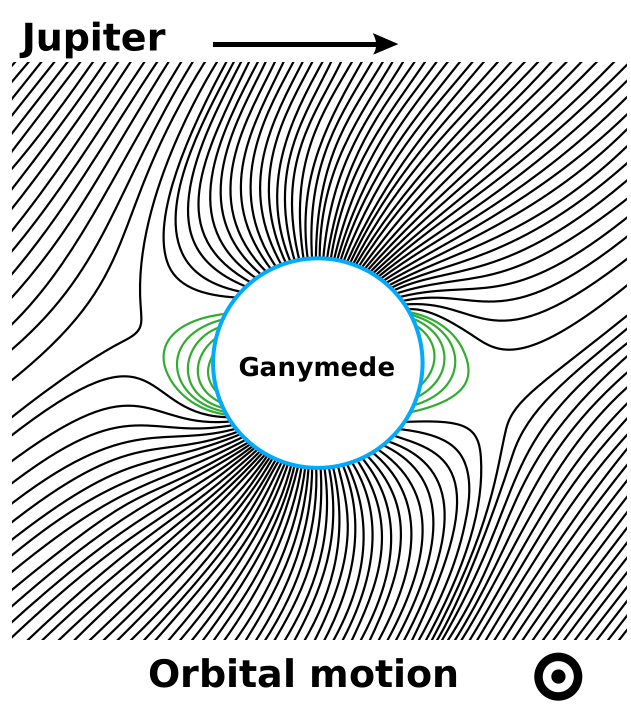
Ganymede [gan-uh-meed] is a moon of Jupiter and the largest satellite in the Solar System. It has a diameter of 5,268 km (8% larger than Mercury), orbits Jupiter in roughly seven days, and is composed of approximately equal amounts of silicate rock and water ice. A saltwater ocean is believed to exist nearly 200 km below Ganymede’s surface, sandwiched between layers of ice. Ganymede is the only satellite in the Solar System known to possess a magnetosphere, likely created through convection within its liquid iron core. The meager magnetosphere is buried within Jupiter’s much larger magnetic field and connected to it through open field lines. The satellite has a thin oxygen atmosphere that includes O, O2, and possibly O3 (ozone).
Ganymede’s discovery is credited to Galileo Galilei, who was the first to observe it on January 7, 1610. The satellite’s name was soon suggested by astronomer Simon Marius, for the mythological Ganymede, cupbearer of the Greek gods and Zeus’s beloved. A joint NASA/ ESA mission to Jupiter’s icy moons (including Ganymede), the Europa Jupiter System Mission (EJSM), is proposed for a launch in 2020.
Posted in Science |
Leave a Comment »