July 17, 2010

The evil eye is a look that is superstitiously believed by many cultures to be able to cause injury or bad luck on the person at whom it is directed for reasons of envy or dislike. The idea appears several times in the Old Testament. It was a widely extended belief between many Mediterranean tribes and cultures: Classical Greece probably learned this belief from ancient Egypt, and later passed it to ancient Rome. The hamsa is a palm-shaped amulet popular throughout the Middle East and North Africa as a defense against the evil eye. It is believed to originate in ancient practices associated with the Phoenicians of Carthage.
Posted in Art, Philosophy, World |
Leave a Comment »
July 17, 2010


The Eye of Providence, or the all-seeing eye of God, is a symbol showing an eye often surrounded by rays of light or a glory and usually enclosed by a triangle. It is sometimes interpreted as representing the eye of God watching over humankind. Imagery of an all-seeing eye can be traced back to Egyptian mythology and the Eye of Horus. It also appears in Buddhism, where Buddha is also regularly referred to as the ‘Eye of the World,’ and is represented as a trinity in the shape of a triangle known as the Tiratna, or Triple Gem. In Medieval and Renaissance European iconography, the Eye (often with the addition of an enclosing triangle) was an explicit image of the Christian Trinity.
Posted in Art, Philosophy |
Leave a Comment »
July 17, 2010

The rod of Asclepius [uh-sklee-pee-uhs] is an ancient symbol associated with astrology, the Greek god Asclepius, and with medicine and healing. It consists of a serpent entwined around a staff. The name of the symbol derives from its early and widespread association with Asclepius, the son of Apollo, who was a practitioner of medicine in ancient Greek mythology. Hippocrates himself was a worshipper of Asclepius.
Posted in Health, Language |
Leave a Comment »
July 17, 2010

The caduceus [kuh-doo-see-uhs] is a herald’s staff, a symbolic object representing Hermes (or the Roman Mercury), and by extension trades, occupations or undertakings associated with the god. It is today typically depicted as a short staff entwined by two serpents in the form of a double helix, and is sometimes surmounted by wings. The caduceus is sometimes used as a symbol of medicine and/or medical practice, especially in North America, due to widespread confusion with the traditional medical symbol, the rod of Asclepius, which has only a single snake and no wings.
Posted in Health, Language |
Leave a Comment »
July 15, 2010

Basket stars are a group of brittle stars, which are related to sea stars (also known as starfish). They generally live in deep sea habitats. Their life span in the wild is up to 35 years. They weigh around 11 lbs, or 5 kg. Like other echinoderms, basket stars lack blood and achieve gas exchange via their water vascular system.
Posted in Science |
Leave a Comment »
July 15, 2010
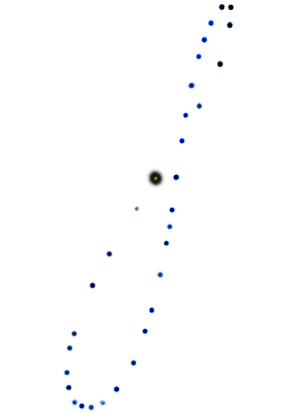

An analemma [an-l-em-uh] is a plot or photograph of the position of a star in the sky at a certain time of day (such as noon) at one locale measured throughout the year that has the shape of a figure 8. With great planning and effort, the series can include a total eclipse of the Sun as one of the images, which has been dubbed a tutulemma.
Posted in Science |
Leave a Comment »
July 15, 2010

Amerikamura (American Village) is a retail and entertainment area in Osaka, Japan. It contains a small-scale reproduction of the Statue of Liberty that peers down on the streets, and features Western themed restaurants and shops.
Posted in World |
Leave a Comment »
July 14, 2010


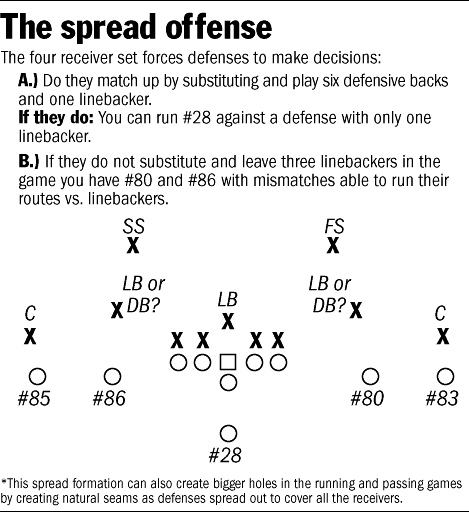
The spread offense is an offensive scheme in American and Canadian football that is used at every level of the game including professional, college, and high school. The spread offense begins with a no-huddle approach with the quarterback in the shotgun formation (5 – 7 yards behind the line of scrimmage) much of the time. 3-5 receivers are spread along the line of scrimmage, creating multiple vertical seams for both the running and passing game to exploit, as the defense is forced to spread itself thin across the field to cover everyone.
The father of the spread offense is Rusty Russell, coach of Fort Worth, Texas’ Masonic Home and School for orphaned boys. Russell began coaching Masonic Home in 1927, and due to the fact that his teams were often over matched physically by other schools, they were called the ‘Mighty Mites.’ While there, he deployed the earliest form of a spread offense to great success.
Continue reading →
Posted in Games |
Leave a Comment »
July 14, 2010
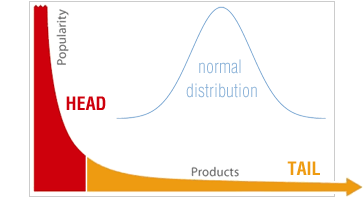

A long tail refers to the statistical property where a larger share of the population rests within the tail of a probability distribution than observed under a normal distribution. This has gained popularity in recent times as a retailing concept describing the niche strategy of selling a large number of unique items in relatively small quantities – usually in addition to selling fewer popular items in large quantities. The concept was popularized by Chris Anderson in an October 2004 Wired magazine article, in which he mentioned Amazon.com and Netflix as examples of businesses applying this strategy.
However, a 2008 study by Anita Elberse, professor of business administration at Harvard Business School, calls the Long Tail theory into question, citing sales data which shows that the Web magnifies the importance of blockbuster hits. Also in 2008, a sales analysis of an unnamed UK digital music service by economist Will Page and high-tech entrepreneur Andrew Bud found that sales exhibited a normal distribution; they reported that 80 percent of the music tracks available sold no copies at all over a one-year period.
Posted in Money |
Leave a Comment »
July 13, 2010


This list contains recording artists who reached the Top 40 of the U.S. pop chart with just one single in the 1980s.
Posted in Art |
Leave a Comment »
July 12, 2010

In gemology, chatoyancy [shuh-toi-an-see], or chatoyance, is an optical reflectance effect seen in certain gemstones. Coined from the French ‘œil de chat,’ meaning ‘cat’s eye,’ chatoyancy arises either from the fibrous structure of a material, as in tiger eye quartz, or from fibrous inclusions or cavities within the stone, as in cat’s eye chrysoberyl.
Posted in Science |
1 Comment »
July 12, 2010

Prosopagnosia [prahs-oh-pag-noh-shuh] (sometimes known as face blindness) is a disorder of face perception where the ability to recognize faces is impaired, while the ability to recognize other objects may be relatively intact. Few successful therapies have so far been developed for affected people, although individuals often learn to use ‘piecemeal’ or ‘feature by feature’ recognition strategies. This may involve secondary clues such as clothing, hair color, body shape, and voice.
Posted in Health, Science |
Leave a Comment »