December 23, 2024
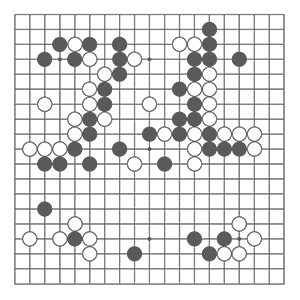
AlphaGo versus Lee Sedol, also known as the DeepMind Challenge Match, was a five-game Go match between top Go player Lee Sedol and AlphaGo, a computer Go program developed by DeepMind, played in Seoul, South Korea between 9 and 15 March 2016. AlphaGo won all but the fourth game; all games were won by resignation. The match has been compared with the historic chess match between Deep Blue and Garry Kasparov in 1997. Kasparov’s loss to Deep Blue is considered the moment a computer became better than humans at chess.
AlphaGo’s victory was a major milestone in artificial intelligence research. Most experts thought a Go program as powerful as AlphaGo was at least five years away; some experts thought that it would take at least another decade before computers would beat Go champions. Most observers at the beginning of the 2016 matches expected Lee to beat AlphaGo. With games such as checkers, chess, and now Go won by computer players, victories at popular board games can no longer serve as significant milestones for artificial intelligence in the way that they used to. Deep Blue’s Murray Campbell called AlphaGo’s victory ‘the end of an era… board games are more or less done and it’s time to move on.’ Continue reading →
Posted in Drugs, Games, Technology |
1 Comment »
December 16, 2024
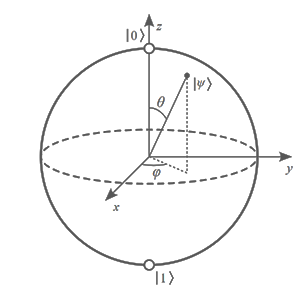
In quantum computing, quantum supremacy or quantum advantage is the goal of demonstrating that a programmable quantum computer can solve a problem that no classical computer can solve in any feasible amount of time, irrespective of the usefulness of the problem. The term was coined by Caltech theoretical physicist John Preskill in 2011, but the concept dates to Russian mathematician Yuri Manin’s 1980 and theoretical physicist Richard Feynman’s 1981 proposals of quantum computing.
Conceptually, quantum supremacy involves both the engineering task of building a powerful quantum computer and the computational-complexity-theoretic task of finding a problem that can be solved by that quantum computer and has a superpolynomial speedup over the best known or possible classical algorithm for that task. Continue reading →
Posted in Language, Science, Technology |
Leave a Comment »
December 9, 2024
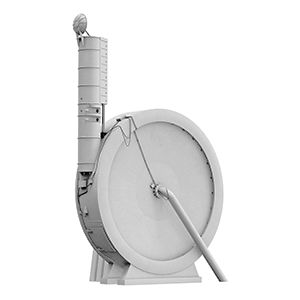
SpinLaunch is a spaceflight technology development company working on mass accelerator technology to move payloads to space.[3] As of September 2022, the company has raised US$150 million in funding, with investors including Kleiner Perkins, Google Ventures, Airbus Ventures, ATW Partners, Catapult Ventures, Lauder Partners, John Doerr, and the Byers Family.
SpinLaunch’s projected cost per kg of payload is approximately $1,250 – $2,500. This projection is significantly less expensive than SpaceX’s current price per kg of payload on the Falcon 9 of $6,000. SpaceX’s projected cost per kg on Starship, however, is less than $1,000 per kg. What real costs and prices for either SpinLaunch or Starship remains to be seen. Continue reading →
Posted in Money, Technology |
Leave a Comment »
December 2, 2024

Video nasty is a colloquial term popularized by the National Viewers’ and Listeners’ Association (NVALA) in the United Kingdom to refer to a number of films, typically low-budget horror or exploitation films, distributed on video cassette in the early 1980s that were criticized by the press, social commentators, and various religious organisations for their violent content.
These video releases were not brought before the British Board of Film Classification (BBFC) due to a loophole in film classification laws that allowed videos to bypass the review process. The resulting uncensored video releases led to public debate concerning the availability of these films to children due to the unregulated nature of the market. Continue reading →
Posted in Art, Politics, World |
Leave a Comment »
November 13, 2024
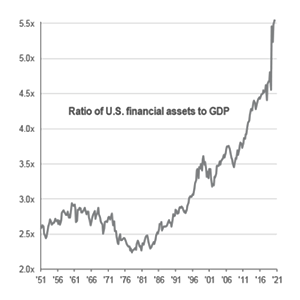
The Buffett Indicator, named after Warren Buffett, measures market valuation by dividing a country’s total stock market value by its GDP. A ratio of 100% suggests fair market. For example, if stocks are worth $50 trillion and GDP is $25 trillion, a 200% ratio would suggest the market is overvalued.
It was proposed as a metric by Buffett in 2001, who called it ‘probably the best single measure of where valuations stand at any given moment,’ and its modern form compares the capitalization of the US Wilshire 5000 index to US GDP. It is widely followed by the financial media as a valuation measure for the US market in both its absolute, and de-trended forms. The indicator set an all-time high during the so-called ‘everything bubble,’ crossing the 200% level in February 2021; a level that Buffett warned if crossed, was ‘playing with fire.’ Continue reading →
Posted in Money |
Leave a Comment »
October 22, 2024

The crayon-eating Marine is a humorous trope (or meme) associated with the United States Marine Corps, emerging online in the early 2010s. Playing off of a stereotype of Marines as unintelligent, the trope supposes that they frequently eat crayons and drink glue.
In an instance of self-deprecating humor, the crayon-eater trope was popularized by Marines through social media and in Maximilian Uriarte’s comic strip ‘Terminal Lance.’ The joke’s ubiquity has led to real-life humorous consumption of crayons and has been referenced by the Marine Corps itself in celebration of National Crayon Day. Multiple products have capitalized on the trend, including two lines of edible crayons created by former Marines and a coloring book by Uriarte. Continue reading →
Posted in Humor, War |
Leave a Comment »
October 11, 2024

Slop is low-quality media—including writing and images—made using generative artificial intelligence technology. Coined in the 2020s, the term has a derogatory connotation akin to ‘spam.’ It has been variously defined as ‘digital clutter,’ ‘filler content produced by AI tools that prioritize speed and quantity over substance and quality,’ and ‘shoddy or unwanted AI content in social media, art, books and, increasingly, in search results.’ Jonathan Gilmore, a professor of philosophy at the City University of New York, describes the ‘incredibly banal, realistic style’ of AI slop as being ‘very easy to process.’
After Hurricane Helene, an AI-generated image of a girl holding a puppy while sitting in a boat floating on flooded waters circulated among Republicans, who used as evidence of failures or the Biden administration to respond to the disaster. U.S. Senator Mike Lee posted the image of the girl on social media before later deleting it. The image apparently originated on the Trump-centered Internet forum Patriots.win.
Continue reading →
Posted in Language, Money, Technology |
Leave a Comment »
September 29, 2024

Tariff engineering refers to design and manufacturing decisions made primarily so that the manufactured good is classified at a lower rate for tariffs than it would have been absent those decisions. It is a loophole whereby an importer pays a lower tariff by changing the intended import such that the importer has a lesser tariff burden.
In contrast to tariff evasion, tariff engineering configures the design, material, or construction to legally achieve the desired classification rather than illegally misclassifying the product or good. For tariff engineering to be legal, the good being imported must be a ‘commercial reality,’ which means any tariff engineering must be a ‘genuine step in the manufacturing process’ or have a commercial use or identity as imported. Continue reading →
Posted in Money, Technology, World |
Leave a Comment »
August 14, 2024

A reverse search warrant is a type of search warrant used in the U.S., in which law enforcement obtains a court order for information from technology companies to identify a group of people who may be suspects in a crime. They differ from traditional search warrants, which typically apply to specific individuals. Geofence warrants, which seek data on mobile phone users who were in a specific location at a given time, and keyword warrants, which request information on users who searched specific phrases, are two types of reverse search warrants.
Reverse location warrants were first used in 2016, and have become increasingly widely used by law enforcement. Google reported that it had received 982 reverse location warrants in 2018, 8,396 in 2019, and 11,554 in 2020. A 2021 transparency report showed that 25% of data requests from law enforcement to Google were geofence data requests. Google is the most common recipient of reverse location warrants and the main provider of such data, although companies including Apple, Snapchat, Lyft, and Uber have also received such warrants. Continue reading →
Posted in Politics, Technology |
1 Comment »
July 16, 2024
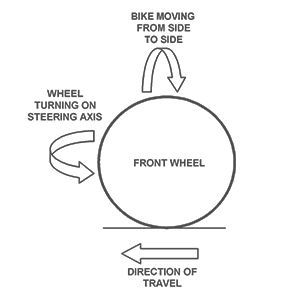
Speed wobble (also known as shimmy, tank-slapper, or speed wobble) is a rapid side-to-side shaking of a vehicle’s front wheel(s) that occurs at high speeds and can lead to loss of control. It presents as a quick (4–10 Hz) oscillation of primarily the steerable wheel(s) of a vehicle. It is caused by a combination of factors, including initial disturbances and insufficient damping, which can create a resonance effect. Initially, the rest of the vehicle remains mostly unaffected, until translated into a vehicle yaw oscillation of increasing amplitude producing loss of control.
Vehicles that can experience this oscillation include motorcycles and bicycles, skateboards, and, in theory, any vehicle with a single steering pivot point and a sufficient amount of freedom of the steered wheel, including that which exists on some light aircraft with tricycle gear where instability can occur at speeds of less than 80 km/h (50 mph); this does not include most automobiles. The initial instability occurs mostly at high speed and is similar to that experienced by shopping cart wheels and aircraft landing gear. Continue reading →
Posted in Death, Science, Technology |
Leave a Comment »
June 28, 2024

A potato cannon is a pipe-based cannon that uses air pressure (pneumatic) or combustion of a flammable gas (aerosol, propane, etc.) to fire projectiles, usually potatoes. A simple design consists of a pipe sealed on one end, with a reducer on the other end to lower the diameter of the pipe, which has the corresponding lower-diameter pipe attached to it, called the barrel. Generally, the operator loads the projectile into the barrel, then utilizes a fuel or air pressure (or sometimes both) to propel the projectile out of the cannon.
The range of the cannon depends on many variables, including the type of fuel used, the efficiency of the fuel/air ratio, the combustion chamber/barrel ratio, and the flight characteristics of the projectile. Common distances vary from 100–200 meters (330–660 feet), and there is a reported case of a cannon exceeding 500 meters (1,600 feet) of range. The potato cannon can trace its origin to the World War II-era Holman Projector, which was a shipboard anti-aircraft weapon. Continue reading →
Posted in Humor, Technology, War |
Leave a Comment »
June 25, 2024

Quis custodiet ipsos custodes? is a Latin phrase found in the ‘Satires,’ a work of the 1st–2nd century Roman poet Juvenal. It may be translated as ‘Who will guard the guards themselves?’ or ‘Who will watch the watchmen?”.
The original context deals with the problem of ensuring marital fidelity, though the phrase is now commonly used more generally to refer to the problem of controlling the actions of persons in positions of power, an issue discussed by Plato in the ‘Republic.’ It is not clear whether the phrase was written by Juvenal, or whether the passage in which it appears was interpolated into his works. Continue reading →
Posted in Philosophy, Politics |
Leave a Comment »


 The Daily Omnivore