April 14, 2015

Road rage is aggressive or angry behavior by a driver of an automobile or other road vehicle. Such behavior might include rude gestures, verbal insults, deliberately driving in an unsafe or threatening manner, or making threats. Road rage can lead to altercations, assaults, and collisions that result in injuries and even deaths. It can be thought of as an extreme case of aggressive driving. The term originated in 1987 at KTLA, a Los Angeles television station, during a rash of freeway shootings. These shooting sprees even spawned a response from the AAA Motor Club to its members on how to respond to drivers with road rage or aggressive maneuvers and gestures.
Road rage levels and laws vary from country to country. In Germany, mere insults and rude gestures in traffic can lead to fines and even prison sentences. Australia also has rather stringent laws against malicious motoring. In the US, a 2007 study concluded that the cities with the least courteous drivers (most road rage) are Miami, Phoenix, New York, Los Angeles, and Boston. The cities with the most courteous drivers (least road rage) are Minneapolis, Nashville, St. Louis, Seattle, and Atlanta. In spite of this, in 2009, New York, Dallas/Fort Worth, Detroit, Atlanta and Minneapolis/St. Paul were rated the top five ‘Road Rage Capitals’ of the United States.
Continue reading →
Posted in Health, Politics, World |
1 Comment »
April 13, 2015

Monoamine oxidase A (MAO-A), is an enzyme that in humans is encoded by the MAO-A gene, a version of which has been popularly referred to as the Warrior Gene. Several different versions of the gene are found in different individuals, although a functional gene is present in most humans (with the exception of a few individuals with Brunner syndrome, a rare genetic disorder). MAO aids in the breakdown of neurotransmitters such as serotonin and dopamine and are, therefore, capable of influencing the feelings, moods, and behaviors of individuals.
According to this, if there was a mutation to the gene that is involved in the process of promoting or inhibiting MAO enzymes, it could affect a person’s personality and could therefore make them more prone to aggression. A deficiency in the MAO-A gene has been linked to higher levels of aggression in males. In a 2009 criminal trial in the US, an argument based on a combination of ‘warrior gene’ and history of child abuse was successfully used to avoid a conviction of first-degree murder and the death penalty; however, the convicted murderer was sentenced to 32 years in prison.
Posted in Health, Politics, Science |
Leave a Comment »
April 10, 2015

In terms of fiction, a quibble [kwib-uhl] is a plot device, used to fulfill the exact verbal conditions of an agreement in order to avoid the intended meaning. Typically quibbles are used in legal bargains and, in fantasy, magically enforced ones. In one of the best known examples, William Shakespeare used a quibble in ‘The Merchant of Venice.’ Portia saves Antonio in a court of law by pointing out that the agreement called for a pound of flesh, but no blood, and therefore Shylock can collect only if he sheds no blood.
A ‘pact with the Devil’ commonly contains clauses that allow the devil to quibble over what he grants, and equally commonly, the maker of the pact finds a quibble to escape the bargain. In Norse mythology, Loki, having bet his head with Brokk and lost, forbids Brokk to take any part of his neck, saying he had not bet it; Brokk is able only to sew his lips shut. Continue reading →
Posted in Humor, Language, Politics |
1 Comment »
April 9, 2015
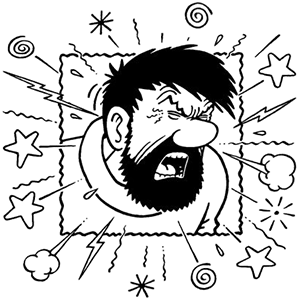
Coprolalia [kop-ruh-ley-lee-uh] is involuntary swearing or the involuntary utterance of obscene words or socially inappropriate and derogatory remarks. Coprolalia comes from the Greek ‘kopros’ meaning ‘feces’ and ‘lalia,’ ‘to talk.’ The term is often used as a clinomorphism (a simplification or amplification of the term for a medical condition), with ‘compulsive profanity’ inaccurately referred to as being Tourette syndrome (an inherited neurological disorder characterized by involuntary speech and movements). Related terms are ‘copropraxia,’ performing obscene or forbidden gestures, and ‘coprographia,’ making obscene writings or drawings.
Coprolalia encompasses words and phrases that are culturally taboo or generally unsuitable for acceptable social use, when used out of context. The term is not used to describe contextual swearing. It is usually expressed out of social or emotional context, and may be spoken in a louder tone or different cadence or pitch than normal conversation. It can be a single word, or complex phrases. A person with coprolalia may repeat the word mentally rather than saying it out loud; these subvocalizations can be very distressing. Continue reading →
Posted in Health, Language |
Leave a Comment »
April 8, 2015

The religious texts of the world’s faiths are replete with examples of individuals who are well known by the general public. Some of the pharaohs of ancient Egypt set in motion devices to ensure their own fame for centuries to come. Herostratus, a young Greek man arsoned the Temple of Artemis (one of the Seven Wonders of the Ancient World) in 356 BCE in order to immortalize his name. Although authorities at the time tried to expunge him from history and punished people with the death penalty for even merely mentioning his name, he succeeded in achieving lasting fame, as his name is well known to this day.
Celebrity culture, once restricted to royalty and biblical/mythical figures, has pervaded many sectors of society including business, publishing, and even academia (scilebrities). With every scientific advance names have become attached to discoveries. Each nation or cultural community (linguistic, ethnic, religious) has its own independent celebrity system (e.g. J-Pop), but this is becoming less the case due to globalization. Mass media has increased the exposure and power of celebrity. Continue reading →
Posted in Money, Politics, World |
1 Comment »
April 7, 2015
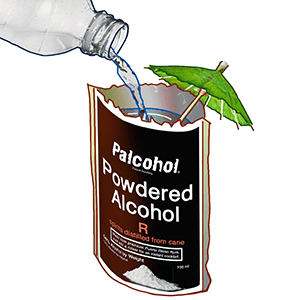
Alcohol powder is molecularly encapsulated ethanol. The powder produces an alcoholic beverage when mixed with water. According to food chemist Udo Pollmer of the European Institute of Food and Nutrition Sciences in Munich, alcohol can be absorbed in cyclodextrins, a synthetic carbohydrate derivative. The cyclodextrins can absorb an estimated 60 percent of their own weight in alcohol while remaining dry to the touch. A US patent was registered for the process as early as 1974.
Alcohol powder can be used to reconstitute alcoholic beverages or inhaled through a nebulizer (mister). In Germany a product called Subyou reportedly was distributed on the Internet. The product was available in four flavors and packed in 65 – 100 gram sachets. When mixed with 0.25 liters of water it gives a drink with 4.8% alcohol. It was assumed a German producer manufactured the product from imported raw alcohol powder from the US. Continue reading →
Posted in Drugs, Food, Politics |
1 Comment »
April 6, 2015


Goose bumps (‘cutis anserina,’ also called ‘goose pimples’ or ‘goose flesh’) are bumps that develop on human skin at the base of body hairs in response to cold. They can also occur involuntarily as the result of strong emotions such as fear, nostalgia, pleasure, euphoria, awe, admiration, or sexual arousal. The same effect is manifested in the root word ‘horror’ in English, which is derived from Latin ‘horrere,’ which means ‘to bristle,’ and ‘be horrified,’ because of the accompanying hair reaction.
The reflex of producing goose bumps is known as ‘arasing,’ ‘piloerection,’ or the ‘pilomotor reflex.’ It occurs in many mammals besides humans; a prominent example is porcupines, which raise their quills when threatened, or sea otters when they encounter sharks or other predators. Small muscles at the follicles raise the body’s hair to make the animal appear larger and more imposing when facing predators. The formation of goose bumps in humans under stress is considered by some to be a vestigial reflex. In furred animals, the cold response erects hairs to trap air, creating a layer of insulation.
Continue reading →
Posted in Health, Language, Science |
1 Comment »
April 2, 2015

Stone Soup is an old folk story in which hungry strangers trick the local people of a town to share their food: a good confidence trick that benefits the group from combining their individual resources. The story is usually told as a lesson in cooperation, especially amid scarcity. In varying traditions, the stone has been replaced with other common inedible objects, and therefore the fable is also known as button soup, wood soup, nail soup, and axe soup. In the story, some hungry travellers come to a village carrying nothing more than an empty cooking pot. Upon their arrival, the villagers are unwilling to share any of their food stores with them.
The travellers go to a stream and fill the pot with water, drop a large stone in it, and place it over a fire. One of the villagers becomes curious and asks what they are doing. The travellers answer that they are making ‘stone soup,’ which tastes wonderful, but could use a little bit of garnish to improve the flavor. The villager does not mind parting with a few carrots to help them out, so that gets added to the soup. Another villager walks by, inquiring about the pot, and the travellers again mention their stone soup which has not reached its full potential yet. The villager hands them a little bit of seasoning to help them out. More and more villagers walk by, each adding another ingredient. Finally, a delicious and nourishing pot of soup is enjoyed by all.
Continue reading →
Posted in Art, Food, Humor |
Leave a Comment »
April 1, 2015

Perceptual learning is the process of learning improved skills of perception from simple sensory discriminations (e.g., distinguishing two musical tones from one another) to complex categorizations of spatial and temporal patterns relevant to real-world expertise (e.g., reading, seeing relations among chess pieces, knowing whether or not an X-ray image shows a tumor). Perceptual learning forms important foundations of complex cognitive processes (i.e., language).
In visual Vernier acuity tasks, observers judge whether one line is displaced above or below a second line. Untrained observers are often already very good with this task, but after training, observers’ threshold has been shown to improve as much as six fold. Similar improvements have been found for visual motion discrimination and orientation sensitivity. Continue reading →
Posted in Education, Health, Science |
Leave a Comment »
March 30, 2015

David Miscavige (b. 1960) is the leader of the Church of Scientology. He was an assistant to church founder L. Ron Hubbard (a ‘Commodore’s messenger’) while a teenager, and rose to a leadership position by the early 1980s, becoming Chairman in 1987. He is lauded within Scientology for obtaining recognition as a tax-favored charity by the IRS, issuing restored and corrected editions of Hubbard’s works, and undertaking a program of new or remodeled churches and related facilities.
His official title is Chairman of the Board of Religious Technology Center (RTC), a corporation that controls the trademarks and copyrights of ‘Dianetics’ and Scientology. During his tenure, a number of allegations have been made against Miscavige, including claims of forced separation of family members, coercive fundraising practices, harassment of journalists and church critics, and humiliation of church staff members. He has also been accused of physically assaulting his staff. He has denied the majority of these claims, often criticizing the credibility of those who bring them. Continue reading →
Posted in Money, Philosophy, Politics |
Leave a Comment »
March 28, 2015

A Notel, also called Notetel, is a type of portable media player made in China which is popular in North Korea. The device has USB and SD ports, can play DVDs and EVDs (Enhanced Versatile Discs, which are physically identical to DVDs but use a different file format), and contains a radio and TV tuner. The name is a portmanteau of ‘notebook’ and ‘television.’ In China, Notels are no longer popular as of 2015, but sell well in the provinces that border on North Korea, where scarce internet and frequent power outages, as well as their ease of concealment make them very useful.
Notetels have been popular in North Korea since around 2005, significantly facilitating the extension of the ‘Korean Wave’ (‘Hallyu,’ the increase of the popularity of South Korean pop culture) into the communist country. After an earlier crackdown that caused black market prices to drop, the devices were legalized in December 2014 (however, they require a license and the government monitors their use). As of 2015 they are available in some government stores as well as on the black market (Jangmadang ) for around 300 Chinese Yuan (ca. US$ 50), and are present in about half of all households.
Posted in Politics, Technology, World |
Leave a Comment »
March 26, 2015

The Truman Show delusion, informally known as Truman Syndrome, is a type of persecutory/grandiose delusion in which patients believe their lives are staged plays or reality television shows. The term was coined in 2008 by brothers Joel and Ian Gold, a psychiatrist and a neurophilosopher, respectively, after the 1998 film ‘The Truman Show,’ about a man who discovers he is living in a constructed reality televised globally around the clock. Since he was in the womb, all the people in Burbank’s life have been paid actors.
The concept predates this particular film. It was based on a 1989 episode of the ‘Twilight Zone,’ ‘Special Service,’ which begins with the protagonist discovering a camera in his bathroom mirror. This man soon learns that his life is being broadcast 24/7 on TV. Author Philip K. Dick has also written short stories and, most notably, a novel, ‘Time Out of Joint’ (1959), in which the protagonist lives in a created world in which his ‘family’ and ‘friends’ are paid to maintain the delusions. Continue reading →
Posted in Art, Health, Technology |
Leave a Comment »


 The Daily Omnivore