February 24, 2015

The Comedy of the Commons is an economic concept, developed as an opposite model to the tragedy of the commons (where individuals acting in their own self interest cooperatively deplete a shared resource, to the detriment of the group). In the ‘comedy’ individuals contribute knowledge and content for the good of the community rather than extracting resources for their own personal gain. Examples of this are free and open source software and Wikipedia. This phenomenon is linked to ‘viral’ effects and increases in prominence as individuals contribute altruistically and for social gain. The term appears to have originated in any essay by Yale law professor Carol M. Rose in 1986.
This outcome is more likely when the cost of the contribution is much less than its value over time. Information has this property. For example, it costs very little for a Wikipedia contributor to enter knowledge from their experience into Wikipedia’s servers, and very little for Wikipedia to serve that information over and over again to readers, generating great value over time. Unlike the pasture of a physical commons, information isn’t degraded by use. Thus the value of Wikipedia increases over time, attracting more readers of whom some become contributors, forming a virtuous cycle.
Posted in Money, Technology |
Leave a Comment »
February 23, 2015
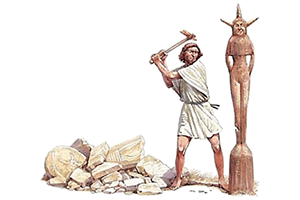

Aniconism [an-ahy-kuh-niz-uhm] is the practice of or belief in the avoiding or shunning of images of divine beings, prophets or other respected religious figures, or in different manifestations, any human beings or living creatures. The term ‘aniconic’ may be used to describe the absence of graphic representations in a particular belief system, regardless of whether an injunction against them exists.
An avoidance and repugnance of holy representations is called ‘iconophobia,’ its antonymic reaction being that of an ‘iconodule’ (one who is in favor of religious images or icons and their veneration). Aniconism can lead to iconoclasm, the destruction of sacred images as heretical. Aniconism can also lead to censorship, which takes place after a representation was already produced, but before, or shortly after, it is made public. Continue reading →
Posted in Art, Philosophy, Politics |
Leave a Comment »
February 22, 2015
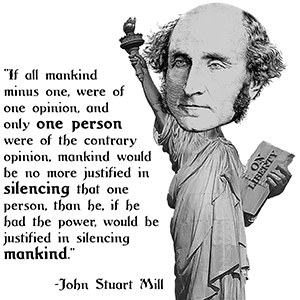
The ‘marketplace of ideas’ is a rationale for freedom of expression based on an analogy to the economic concept of a free market. The ‘marketplace of ideas’ belief holds that the truth will emerge from the competition of ideas in free, transparent public discourse. This concept is often applied to discussions of patent law as well as freedom of the press and the responsibilities of the media in a liberal democracy.
The general idea is that free speech should be tolerated because it will lead toward the truth. English poet John Milton suggested that restricting speech was not necessary because ‘in a free and open encounter,’ truth would prevail. President Thomas Jefferson argued that it is safe to tolerate ‘error of opinion … where reason is left free to combat it.’ Journalism professor Fredrick Siebert echoed the idea that free expression is self-correcting in ‘Four Theories of the Press’: ‘Let all with something to say be free to express themselves. The true and sound will survive. The false and unsound will be vanquished. Government should keep out of the battle and not weigh the odds in favor of one side or the other.’ Continue reading →
Posted in Language, Money, Politics |
Leave a Comment »
February 21, 2015

Wim Delvoye (b. 1965 ) is a Belgian neo-conceptual artist known for his inventive and often shocking projects. Much of his work is focused on the body, and he is perhaps best known for his digestive machine, Cloaca, which he unveiled at the Museum voor Hedendaagse Kunst, Antwerp, after eight years of consultation with experts in fields ranging from plumbing to gastroenterology. In a comment on the Belgians’ love of fine dining, Cloaca is a large installation that turns food into feces, allowing Delvoye to explore the digestive process. The food begins at a long, transparent mouth, travels through a number of enzyme filled, machine-like assembly stations, and ends in hard matter which is separated from liquid through a cylinder. Delvoye collects and sells the realistically smelling output, suspended in small jars of resin at his Ghent studio.
When asked about his inspiration, Delvoye stated that everything in modern life is pointless. The most useless object he could create was a machine that serves no purpose at all, besides the reduction of food to waste. Previously, Delvoye claimed that he would never sell a Cloaca machine to a museum as he could never trust that the curator would maintain the installation properly. However after two years of discussion with David Walsh, Delvoye agreed to construct a custom Cloaca built specifically for the Museum of Old and New Art in Hobart, Tasmania. The new installation is suspended from the museum ceiling in a room custom-built for it.
Posted in Art, Health, Humor |
Leave a Comment »
February 18, 2015

‘All Is Full of Love‘ is a 1997 song by Icelandic musician Björk and is from her fourth studio album, ‘Homogenic.’ The lyrics are inspired by the presence of love in the advent of spring and Norse mythology’s Ragnarök (the universe ending clash of the gods). The more popular version of the track, the original mix solely produced by Björk, was used in the music video but did not appear in the album. The album version is a remix by Glaswegian producer Howie B and has a minimalist approach and places emphasis on the singer’s vocals. The video version of “All Is Full of Love” is a midtempo trip hop ballad with soul influences. In opposition to the sonically minimalist mix included in the album.
The music video was directed by British video artist Chris Cunningham and depicts the assembling of a robot with Björk’s features and her passionately kissing another robot against an ethereal and sterile backdrop. The song’s video garnered acclaim from critics and is commonly regarded as one of the best music videos of all time and a milestone in computer animation. The subject of much analysis and scrutiny, it was on permanent display at the Museum of Modern Art in New York City and has been included in various art exhibitions.
Posted in Art, Love |
Leave a Comment »
February 17, 2015

Cyberspace is ‘the notional environment in which communication over computer networks occurs.’ The word became popular in the 1990s when the uses of the internet, networking, and digital communication were all growing dramatically. The parent term is ‘cybernetics,’ derived from an Ancient Greek word meaning ‘steersman,’ ‘governor,’ ‘pilot,’ or ‘rudder’ (coined by American mathematician Norbert Wiener for his pioneering work in electronic communication and control science).
According to programmer Chip Morningstar and game developer F. Randall Farmer, cyberspace is defined more by the social interactions involved rather than its technical implementation. In their view, the computational medium in cyberspace is an augmentation of the communication channel between real people; the core characteristic of cyberspace is that it offers an environment that consists of many participants with the ability to affect and influence each other. They derive this concept from the observation that people seek richness, complexity, and depth within a virtual world. Continue reading →
Posted in Language, Technology |
Leave a Comment »
February 15, 2015

I. Spiewak & Sons, Inc., commonly known simply as Spiewak, is a New York-based apparel manufacturer founded in 1904. Spiewak currently manufactures high-visibility safety apparel, EMS protective gear, and other uniforms for private businesses (including American Airlines and Avis) and government agencies (including the FBI, ATF, Secret Service, and Postal Service). During WWI, Spiewak produced wool coats and breeches for the US Army and Navy, including pea coats, which are still made by the company today. During WWII parkas, flight jackets, flight suits, and field jackets were produced for the US military. Spiewak also offers a line of consumer outerwear constructed with ‘workwear’ values.
Isaac Spiewak grew up in Warsaw, Poland and fled to Brooklyn, NY in 1903. He started a small family business, making sheepskin vests by hand and selling them on the docks of Williamsburg in 1904. By 1906, Isaac’s vests were in sufficient demand around New York for him to establish a small manufacturing space, calling it ‘House of the Golden Fleece.’ As his brothers entered into various facets of the outerwear business, the Spiewaks developed different, and sometimes competing, lines and companies to capitalize on prevailing trends and emerging market segments. Their family of brands including Bronco Manufacturing, Ram Manufacturing, United Sheeplined Clothing Company, Spiewak Brothers, Swiss Blouse, Excalibur, Frost King, Pan-Jac, Trappings, Prince Jason, and Flight Deck USA.
Posted in Money, War |
Leave a Comment »
February 14, 2015

Winter storm naming in the United States has been used by The Weather Channel (TWC) since 2011, when the cable network informally used the previously-coined name ‘Snowtober’ for a 2011 Halloween nor’easter. In November 2012, TWC began systematically naming winter storms, starting with the November 2012 nor’easter it named ‘Winter Storm Athena.’ TWC compiled a list of winter storm names for the 2012–13 winter season. It would only name those storms that are ‘disruptive’ to people, said Bryan Norcross, a TWC senior director. TWC’s decision was met with criticism from other weather forecasters, who called the practice self-serving and potentially confusing to the public.
The U.S. government-operated National Oceanic and Atmospheric Administration (NOAA) (a division of which–the National Hurricane Center–has named hurricanes for many years) and its main division–the National Weather Service (NWS)–did not acknowledge TWC’s winter storm names and asked its forecast offices to refrain from using them. The NWS spokesperson Susan Buchanan stated, ‘The National Weather Service does not name winter storms because a winter storm’s impact can vary from one location to another, and storms can weaken and redevelop, making it difficult to define where one ends and another begins.’
Posted in Language, Money, Science |
Leave a Comment »
February 13, 2015

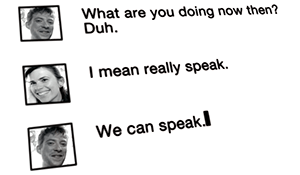
Black Mirror is a British television anthology series created by English broadcaster Charlie Brooker that features speculative fiction with dark and sometimes satirical themes that examine modern society, particularly with regard to the unanticipated consequences of new technologies. Regarding the program’s content and structure, Brooker noted, ‘each episode has a different cast, a different setting, even a different reality. But they’re all about the way we live now – and the way we might be living in 10 minutes’ time if we’re clumsy.’
He explained the series’ title to ‘The Guardian,’ noting: ‘If technology is a drug – and it does feel like a drug – then what, precisely, are the side-effects? This area – between delight and discomfort – is where ‘Black Mirror,’ my new drama series, is set. The ‘black mirror’ of the title is the one you’ll find on every wall, on every desk, in the palm of every hand: the cold, shiny screen of a TV, a monitor, a smartphone.’ The first series has been acclaimed as being innovative and shocking with twists-in-the-tale reminiscent of ‘The Twilight Zone.’ ‘The Daily Telegraph’ described the first episode as ‘a shocking but ballsy, blackly comic study of the modern media. A reporter from ‘The Beijing News’ thought the show was ‘an apocalypse of modern world,’ ‘desperate but profound.’
Posted in Art, Technology, World |
Leave a Comment »
February 12, 2015
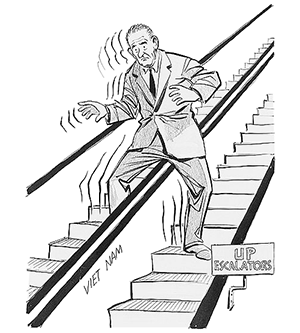
Escalation of commitment was first described by business professor Barry M. Staw in his 1976 paper, ‘Knee deep in the big muddy: A study of escalating commitment to a chosen course of action.’ More recently the term ‘sunk cost fallacy’ has been used to describe the phenomenon where people justify increased investment in a decision, based on the cumulative prior investment, despite new evidence suggesting that the cost, starting today, of continuing the decision outweighs the expected benefit. Such investment may include money, time, or even — in the case of military strategy— human lives (the term has been used to describe the US commitment to military conflicts including Vietnam and Iraq).
The phenomenon and the sentiment underlying it are reflected in such proverbial images as ‘Throwing good money after bad,’ ‘In for a dime, in for a dollar,’ or ‘In for a penny, in for a pound.’ A common example irrational escalation is a bidding war; the bidders can end up paying much more than the object is worth to justify the initial expenses associated with bidding (such as research), as well as part of a competitive instinct. The main drivers of the tendency to invest in losing propositions are: Social (peer pressure), Psychological (gambling), Project (past commitments), and Structural (cultural and environmental factors). After a heated bidding war, Canadian financier Robert Campeau ended up buying Bloomingdale’s for an estimated $600 million more than it was worth. The ‘Wall Street Journal’ noted that ‘we’re not dealing in price anymore but egos.’ Campeau was forced to declare bankruptcy soon afterwards.
Posted in Money, Science, War |
1 Comment »
February 11, 2015
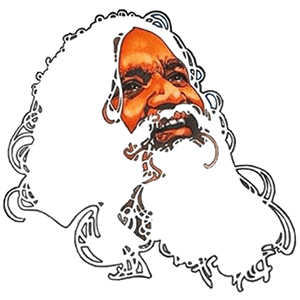
Transcendental [tran-sen-den-tl] Meditation (TM) refers to a specific form of mantra meditation (consciousness training aided by inner chanting) first introduced in India in the mid-1950s by Hindu spiritual teacher Maharishi Mahesh Yogi (1918–2008). The Maharishi taught thousands of people during a series of world tours from 1958 to 1965, expressing his teachings in spiritual and religious terms.
TM became more popular in the 1960s and 1970s, as he shifted to a more technical presentation and his meditation technique was practiced by celebrities (notably the Beatles). At this time, he began training TM teachers and created specialized organizations to present TM to specific segments of the population such as business people and students. By the late 2000s, TM had been taught to millions of people, and the worldwide TM organization had grown to include educational programs, health products, and related services. Continue reading →
Posted in Health, Philosophy |
2 Comments »
February 9, 2015
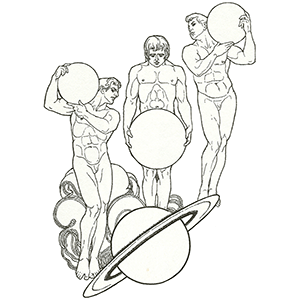
Reincarnation is one of the thirteen Principles of Faith of Judaism. It states: ‘I believe with a perfect faith that the Holy One… in the future will bring the dead back to life…’ It is also a core element in the tale of the ‘Ten Martyrs’ in the Yom Kippur liturgy, who were killed by Romans to atone for the souls of the ten brothers of Joseph. Jewish mystical texts (the ‘Kabbalah’), from their classic Medieval canon onwards, teach a belief in ‘Gilgul Neshamot’ (lit. ‘soul cycle’).
It is a common belief in contemporary Hasidic Judaism, which regards the Kabbalah as sacred and authoritative, though unstressed in favor of a more innate psychological mysticism. Kabbalah also teaches that ‘The soul of Moses is reincarnated in every generation.’ Other, Non-Hasidic, Orthodox Jewish groups while not placing a heavy emphasis on reincarnation, do acknowledge it as a valid teaching. Continue reading →
Posted in Death, Philosophy |
1 Comment »



 The Daily Omnivore