February 13, 2024

In urban planning, Brusselization is ‘the indiscriminate and careless introduction of modern high-rise buildings into gentrified neighborhoods’ and has become a byword for ‘haphazard urban development and redevelopment.’
The notion applies to anywhere whose development follows the pattern of the uncontrolled development of Brussels in the 1960s and 1970s, that resulted from a lack of zoning regulations and the city authorities’ laissez-faire approach to city planning. Continue reading →
Posted in Money, Politics, World |
Leave a Comment »
January 18, 2024
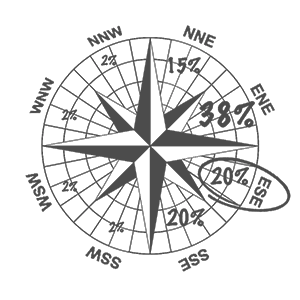
Crosswordese is the group of words frequently found in U.S. crossword puzzles but seldom found in everyday conversation. The words are usually short, three to five letters, with letter combinations which crossword constructors find useful in the creation of crossword puzzles, such as words that start and/or end with vowels, abbreviations consisting entirely of consonants, unusual combinations of letters, and words consisting almost entirely of frequently used letters. Such words are needed in almost every puzzle to some extent. Too much crosswordese in a crossword puzzle is frowned upon by cruciverbalists (people skillful in creating or solving crossword puzzles) and crossword enthusiasts.
The popularity of individual words and names of crosswordese, and the way they are clued, changes over time. For instance, ITO was occasionally clued in the 1980s and 1990s in reference to dancer Michio Itō and actor Robert Ito; then boomed in the late 1990s and 2000s with the rise of judge Lance Ito; and has since fallen somewhat, and when it appears today, the clue typically references figure skater Midori Ito or uses the partial phrase ‘I to’ (as in [‘How was ___ know?’]).
Posted in Games, Language |
1 Comment »
January 11, 2024
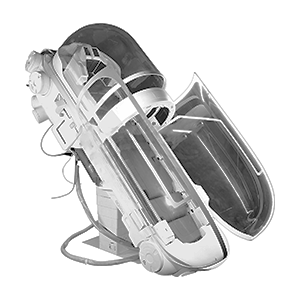
According to a false conspiracy theory, medbeds (an abbreviation of ‘medical bed’ or ‘meditation bed’) are secret beds that can miraculously heal humans and extend life. The plausibility of such devices is pseudoscience. Medbed conspiracy theories often involve claims that the devices are utilized by members of a ‘deep state’ and billionaires and that the former President of the United States, John F. Kennedy, is still alive, lying on a medbed.
Belief in these devices is popular among QAnon influencers such as Michael Protzman, Romana Didulo, and YamatoQ. Various companies sell devices or access to beds that supposedly heal ailments via imaginary technologies while also including fine print on their websites disclaiming that no diagnoses, treatment, or cures are provided.
Posted in Health, Politics, Technology |
Leave a Comment »
January 6, 2024

EleutherAI is a grass-roots non-profit artificial intelligence (AI) research group. The group, considered an open-source version of OpenAI, was formed in a Discord server in July 2020 to organize a replication of GPT-3. In early 2023, it formally incorporated as the EleutherAI Foundation, a non-profit research institute. EleutherAI began as a Discord server on July 7, 2020 under the tentative name ‘LibreAI’ before rebranding to ‘EleutherAI’ later that month, in reference to eleutheria, an ancient greek term for liberty.
On December 30, 2020, EleutherAI released The Pile, a curated dataset of diverse text for training large language models. Continue reading →
Posted in Money, Politics, Technology |
Leave a Comment »
January 5, 2024

Radio Raheem is a fictional character in the 1989 Spike Lee film ‘Do the Right Thing,’ played by Bill Nunn. Radio Raheem’s name is a reference to the boombox that he carries wherever he goes.
Raheem’s death leads to the film’s climax, in which tensions between the Brooklyn neighborhood’s local Black community and the Italian American owners of a local pizzeria peak. According to Lee, Raheem’s death scene was inspired by the Howard Beach racial incident of 1986.
Continue reading →
Posted in Art |
Leave a Comment »
December 26, 2023

Do-gooder derogation [dehr-uh-gey-shuhn] is a phenomenon where a person’s morally motivated behavior leads to them being perceived negatively by others. The term ‘do-gooder’ refers to a person who deviates from the majority in terms of behavior, because of their morality. A combination of moral and dominance personality traits in a person have been linked to an increased level of moral self-righteousness and dislike by perceivers, and research suggests that the most generous can be punished more than those less generous.
One possible reason for do-gooder derogation is ‘anticipated moral reproach.’ This describes a threat to one’s moral standing and to their sense of self-worth. Research suggests that since people are highly sensitive to any criticism or challenge to their morals, they are more likely to put down the source of this ‘threat.’ Continue reading →
Posted in Science |
Leave a Comment »
December 13, 2023
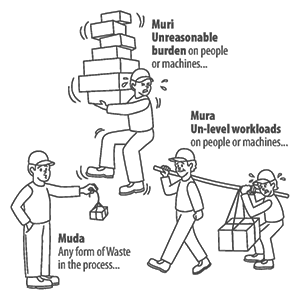
Muda [moo-duh] is a Japanese word meaning ‘futility,’ ‘uselessness,’ or ‘wastefulness,’ and is a key concept in lean process thinking such as in the Toyota Production System (TPS), denoting one of three types of deviation from optimal allocation of resources. The other types are known by the Japanese terms ‘mura’ (‘unevenness’) and ‘muri’ (‘overload’). Waste in this context refers to the wasting of time or resources rather than wasteful by-products.
From an end-customer’s point of view, value-added work is any activity that produces goods or provides a service for which a customer is willing to pay; muda is any constraint or impediment that causes waste to occur. Continue reading →
Posted in Money, Technology, World |
Leave a Comment »
November 30, 2023

Q* (pronounced ‘Q-star’) is an alleged internal project by OpenAI dedicated to the application of artificial intelligence in logical and mathematical reasoning. In November 2023, certain employees of OpenAI reportedly raised concerns with the company’s board, suggesting that Q* might signify the imminent emergence of artificial general intelligence. The reported work involves performing math on the level of grade-school students.
Math requires abstract reasoning and a firm grasp of logical principles. It’s not just about recognizing patterns or processing language, but about understanding and applying mathematical concepts and rules. Mathematics also demands precision and consistent application of rules, unlike many language tasks where approximations or multiple interpretations can be acceptable. An AI model that can reliably perform grade-school level math marks a significant advancement in the field, indicating progress towards more sophisticated and logically rigorous AI systems. Continue reading →
Posted in Technology |
Leave a Comment »
November 27, 2023
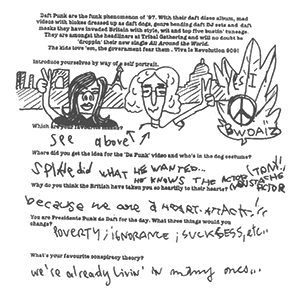
‘Jockey Slut’ was a British music magazine that ran from 1993 to 2004, starting as a bi-monthly fanzine focused on dance music and club culture before becoming a monthly publication in 1999 following acquisition by Swinstead Publishing. The magazine distinguished itself through music-centered coverage that balanced witty fanzine-style writing with irreverent humor, giving early coverage to influential acts like The Chemical Brothers, Daft Punk, and The Streets, while also featuring rock and indie music. Its readers tended to refer to the magazine as just ‘The Slut.’
After transitioning to a quarterly format with increased online presence in 2004, the magazine closed in May of that year, leaving behind a legacy of being one of the first publications to feature interviews with many now-legendary electronic music artists. Continue reading →
Posted in Art |
1 Comment »
November 26, 2023

Roko’s basilisk [bas-uh-lisk] is a thought experiment which states that an otherwise benevolent artificial superintelligence (AI) in the future would be incentivized to create a virtual reality simulation to torture anyone who knew of its potential existence but did not directly contribute to its advancement or development, in order to incentivize said advancement.
It originated in a 2010 post at discussion board LessWrong, a technical forum focused on analytical rational enquiry. The thought experiment’s name derives from the poster of the article (Roko) and the basilisk, a mythical creature capable of destroying enemies with its stare. Continue reading →
Posted in Philosophy, Technology |
Leave a Comment »
November 14, 2023
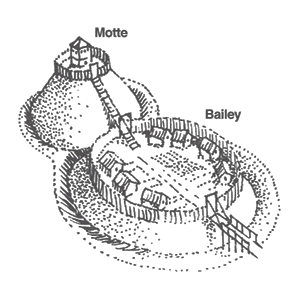
The motte-and-bailey fallacy (named after the motte-and-bailey castle) is a form of argument and an informal fallacy where an arguer conflates two positions that share similarities, one modest and easy to defend (the ‘motte’) and one much more controversial and harder to defend (the ‘bailey’).
The arguer advances the controversial position, but when challenged, insists that only the more modest position is being advanced. Upon retreating to the motte, the arguer can claim that the bailey has not been refuted (because the critic refused to attack the motte) or that the critic is unreasonable (by equating an attack on the bailey with an attack on the motte). Continue reading →
Posted in Language, Politics |
Leave a Comment »
October 30, 2023

A participation trophy is a trophy given to children (usually) who participate in any sport event or contest without requiring their success in competition. The term may be used more generally as an example of the celebration of mediocrity or of emotional coddling. In this rhetorical context, it is frequently associated with millennials, those of Generation Y.
The use of participation trophies has caused some controversy. Critics argue that they promote narcissism and entitlement among children to whom they are given, and are based on incorrect assumptions regarding supposed psychological benefits of self-esteem. Critics also note that some children also do not value them as much as they do ‘normal’ trophies that are given to winners. Defenders of participation trophies argue that they teach children that trying their best is good enough, even if they do not win. Continue reading →
Posted in Games, Health, Politics |
Leave a Comment »


 The Daily Omnivore