March 8, 2011
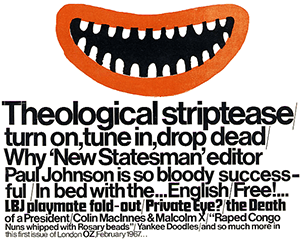
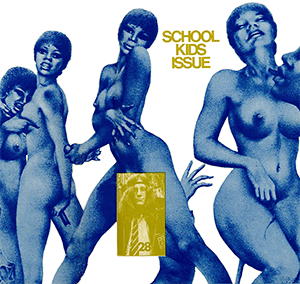
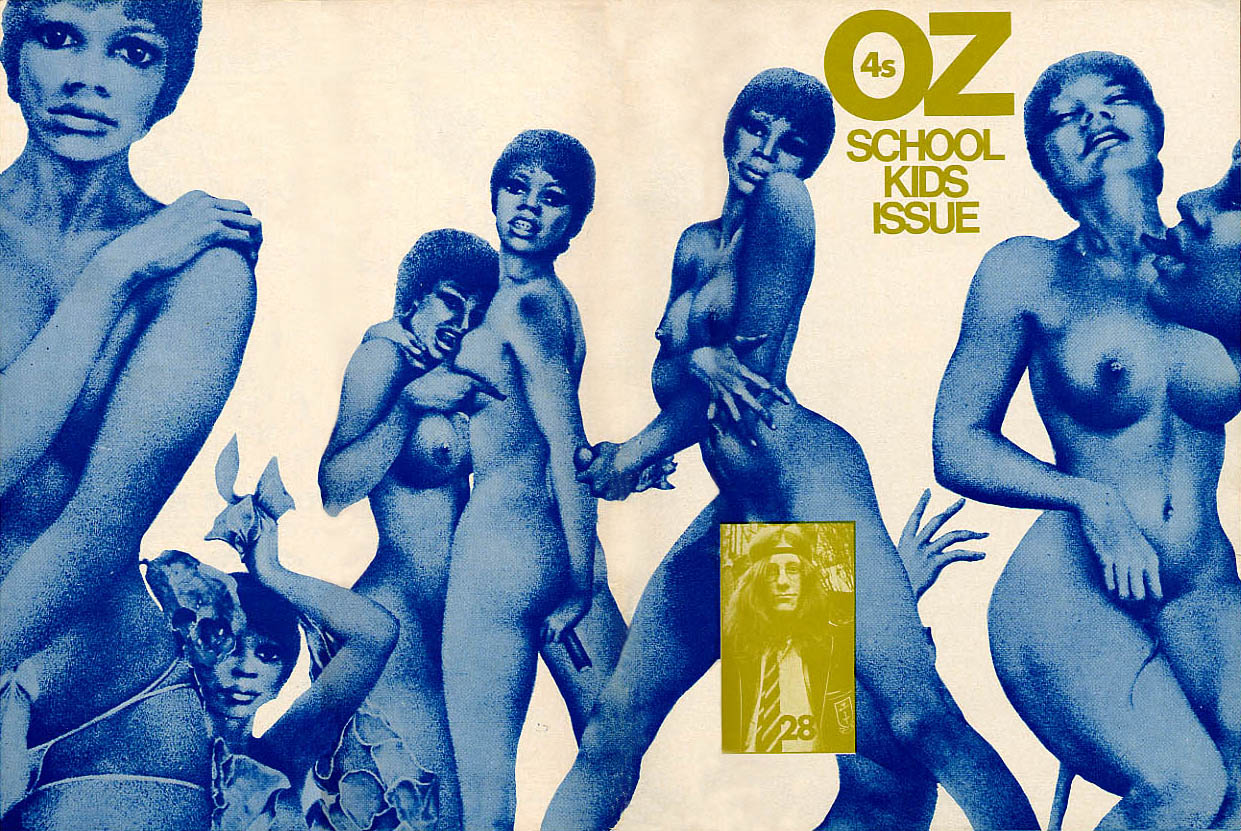
Oz was first published as a satirical humor magazine between 1963 and 1969 in Sydney, Australia and, in its second and better known incarnation, became a ‘psychedelic hippy’ magazine from 1967 to 1973 in London.
Strongly identified as part of the underground press, it was the subject of two celebrated obscenity trials, one in Australia in 1964 and the other in the UK in 1971. On both occasions the magazine’s editors were acquitted on appeal after initially being found guilty and sentenced to harsh jail terms. The central editor throughout the magazine’s life was Richard Neville.
Posted in Art, Drugs, Humor |
Leave a Comment »
March 1, 2011

The Nation is the oldest continuously published weekly magazine in the US. The periodical, devoted to politics and culture, is self-described as ‘the flagship of the left.’ Founded on July 6, 1865, It is published by The Nation Company, L.P., at 33 Irving Place, New York City. It has bureaus in Washington, D.C., London, and South Africa, with departments covering Architecture, Art, Corporations, Defense, Environment, Films, Legal Affairs, Music, Peace and Disarmament, Poetry, and the UN. The publisher and editor is Katrina vanden Heuvel.
According to its founding prospectus of 1865, ‘The Nation will not be the organ of any party, sect, or body. It will, on the contrary, make an earnest effort to bring to the discussion of political and social questions a really critical spirit, and to wage war upon the vices of violence, exaggeration and misrepresentation by which so much of the political writing of the day is marred.’ Notable contributors have included Albert Einstein, Martin Luther King Jr., Bertrand Russell, Hunter S. Thompson, Leon Trotsky, George Orwell, Franklin D. Roosevelt, John Steinbeck, Kurt Vonnegut, Robert Frost, Frank Lloyd Wright, Jean-Paul Sartre, and John Maynard Keynes.
Posted in Language, Money, Politics |
Leave a Comment »
March 1, 2011

The Weekly Standard is an American neoconservative opinion magazine published semi-weekly since 1995 by News Corporation. Currently edited by founder William Kristol and Fred Barnes, the Standard has been described as a ‘redoubt of neoconservatism’ and as ‘the neo-con bible.’
Many of the magazine’s articles are written by members of conservative think tanks located in Washington, D.C.: the American Enterprise Institute, the Ethics and Public Policy Center, the Foundation for Defense of Democracies, and the Hudson Institute. The magazine’s website blog, titled the ‘Daily Standard,’ is edited by John McCormack and Daniel Halper and produces daily articles and commentary.
Posted in Language, Money, Politics |
Leave a Comment »
February 3, 2011

Vice is a free magazine and media conglomerate founded in Montreal and currently based in New York City. It is available in 19 countries. It supports itself primarily through advertising. Founded by Suroosh Alvi, Shane Smith, and Gavin McInnes, it was launched as the ‘Voice of Montreal’ in 1994 with government funding to provide work and a community service. When the editors wanted to break free of their commitments with the original publisher, Alix Laurent, they bought him out and changed the name to ‘Vice’ in 1996.
Vice’s content has shifted from dealing mostly with independent arts and pop cultural matters to covering more serious news topics, although both are often treated with the same spirit of blithe and caustic irreverence. Vice has championed the ‘Immersionist’ school of journalism, which it regards as something of a DIY antithesis to the big-office methods practiced by traditional news outlets. There have been issues dedicated to concerns facing Iraqi people, Native Americans, Russian people, people with mental disorders, and people with mental disabilities.
Posted in Art, Language, Money |
Leave a Comment »
December 7, 2010

Kangura was a Kinyarwanda- and French-language magazine in Rwanda that served to stoke ethnic hatred in the run-up to the Rwandan Genocide. It was established in 1990, following the invasion of the rebel Rwandan Patriotic Front (RPF), and continued publishing up to the genocide. Sponsored by the dominant MRND party and edited by founder Hassan Ngeze, the magazine was a response to the RPF-sponsored Kanguka, adopting a similar informal style.
‘Kangura’ was a Kinyarwanda word meaning ‘wake others up,’ as opposed to ‘Kanguka,’ which meant ‘wake up.’ The magazine was the print equivalent to the later-established Radio Télévision Libre des Mille Collines (RTLM), publishing articles harshly critical of the RPF and of Tutsis generally. Its sensationalist news was passed by word-of-mouth through the largely illiterate population. Copies of Kangura were read in public meetings and, as the genocide approached, during Interahamwe militia rallies.
Posted in Language, Politics, War |
Leave a Comment »
December 7, 2010

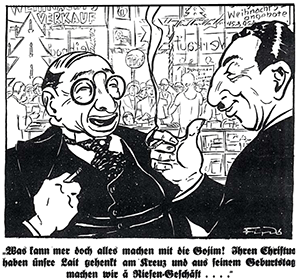
Der Stürmer (literally, ‘The Stormer;’ or more accurately, ‘The Attacker’) was a weekly Nazi newspaper published from 1923 to the end of World War II in 1945. It was a significant part of the Nazi propaganda machinery and was vehemently anti-Semitic. Unlike the ‘Völkischer Beobachter’ (‘The People’s Observer’), the official party paper which gave itself an outwardly serious appearance, the tabloid-style ‘Der Stürmer’ often ran obscene materials such as anti-Semitic caricatures and accusations of blood libel, pornography, anti-Catholic, anti-capitalist and anti-reactionary propaganda. The paper originated at Nuremberg; the first copy was published April 20, 1923. Its circulation grew over time, distributing to a large percentage of the German population as well as Argentina, Brazil, Canada and the United States.
‘Der Stürmer’ was best-known for its effective anti-semitic caricatures, which revealed Jews as ugly characters with exaggerated facial features and misshapen bodies. Many of these drawing were the work of Philipp Rupprecht, known as Fips, who was one of the best-known anti-Semitic cartoonists, his virulent attacks wedding ‘Jewish capitalists’ with ‘Jewish Communism.’ At the bottom of the title page there was always the motto ‘Die Juden sind unser Unglück!’ (‘The Jews are our misfortune!’), coined by German historian, Heinrich von Treitschke in the 1880s. The paper’s other motto was: ‘Deutsches Wochenblatt zum Kampfe um die Wahrheit’ (‘German Weekly Newspaper in the Fight for Truth’).
Posted in Language, Politics, War |
Leave a Comment »
September 23, 2010

The Journal of Recreational Mathematics is an American journal dedicated to recreational mathematics, started in 1968. It is published quarterly by the Baywood Publishing Company. The journal contains original articles, book reviews, alphametics (verbal arithmetic), problems, conjectures, and solutions.
Posted in Education, Language, Science |
Leave a Comment »
August 17, 2010
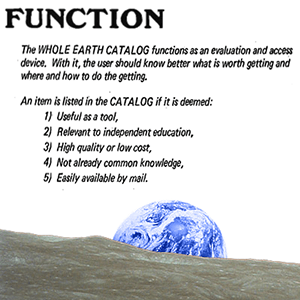
The Whole Earth Catalog was an American counterculture catalog published by Stewart Brand between 1968 and 1972, and occasionally thereafter, until 1998. Although the WECs listed all sorts of products for sale (clothing, books, tools, machines, seeds — anything for a self-sustainable ‘hippie’ lifestyle) the Whole Earth Catalogs themselves did not sell any of the products.
Instead the vendors and their prices were listed right alongside with the items. This led to a need for the Catalogs to be frequently updated. Apple Inc. founder and entrepreneur Steve Jobs has described the Catalog as the conceptual forerunner of the World Wide Web, stating that it was, ‘sort of like Google in paperback form, 35 years before Google came along.’
Posted in Money |
1 Comment »





 The Daily Omnivore