February 21, 2011

A slush or a slushie is a flavored frozen drink. Frozen carbonated beverages, typified by the Slurpee or ICEE, are made by freezing a carbonated drink. These machines are complicated and expensive, and notably require a carbon dioxide supply. They make a very fine and ‘dry’ slush. Frozen uncarbonated beverages are made by freezing a non-carbonated juice or liquid. These machines do not require a pressure chamber, and so are much cheaper and easier to maintain. They make a slightly wetter slush. They are notable in the wide variety of drinks they create, including coffee-flavored ices and alcoholic drinks like margaritas and daiquiris.
Conventional slush drinks, typified by the Slush Puppie, use a single slurry made by freezing a sweetened base, similar to apple juice. This slurry is mixed at serving time with a flavoring syrup. These drinks are notable in that the flavored syrup can be drawn out of the drink, leaving a relatively-unflavoured base ice behind. ‘Instant’ slush drinks (beverages that turn to slush upon opening) are formed via supercooling (e.g. Slush-It!, the Chill Chamber which allows businesses to store beverages at below freezing temperatures, and supercooled Sprite from Coca-Cola which required special vending machines).
Posted in Food, Language, Money |
Leave a Comment »
February 7, 2011

Meritage is a proprietary term used to denote Bordeaux-style wines without infringing on the French region’s legally protected designation of origin. Winemakers license the Meritage trademark from its owner, the California-based Meritage Alliance. Most Meritage wines come from California, but there are members in 18 other states and five other countries (Argentina, Australia, Canada, Israel, and Mexico).
Many people, including some wine experts, Frenchify the word ‘Meritage’ by pronouncing its last syllable with a ‘zh’ sound, as in ‘garage,’ but the Meritage Alliance specifically states that the word should be pronounced to rhyme with ‘heritage.’ The Meritage Association was formed in 1988 by a small group of Napa Valley, California vintners increasingly frustrated by regulations stipulating wines contain at least 75% of a specific grape to be labeled as that varietal.
read more »
Posted in Food, Language, Money |
Leave a Comment »
January 28, 2011

A Mickey Finn (or simply Mickey) is a slang term for a drink laced with a drug (especially chloral hydrate) given to someone without their knowledge in order to incapacitate them. Serving someone a Mickey Finn is most commonly referred to as ‘slipping a mickey.’ The practice is most likely named for the bartender of a Chicago establishment, the Lone Star Saloon and Palm Garden Restaurant.
In December 1903, several newspapers document that a Michael ‘Mickey’ Finn managed the Lone Star Saloon and was accused of using knockout drops to incapacitate and rob some of his customers. Moreover, the first known written example (according to the Oxford English Dictionary) of the use of the term Mickey Finn is in 1915, twelve years after his trial, lending credence to this theory of the origination of the phrase.
Posted in Drugs, Health, Language |
Leave a Comment »
January 20, 2011

Whisky production in Japan began around 1870, but the first commercial production was in 1924 upon the opening of the country’s first distillery, Yamazaki. Broadly speaking the style of Japanese whisky is more similar to that of Scotch whisky than Irish whiskey, and thus the spelling typically follows the Scottish convention (omitting the letter ‘e’).
There are several companies producing whisky in Japan. Perhaps the two most well known are Suntory and Nikka. Both produce blended as well as single malt whiskies.
Posted in Food, World |
Leave a Comment »
January 19, 2011

OK Soda was a soft drink created by Coca-Cola in 1993 that aggressively courted the Generation X demographic with unusual advertising tactics, including endorsements and even outright negative publicity. It did not sell well in select test markets and was officially declared out of production in 1995 before reaching nation-wide distribution.
The drink’s slogan was ‘Things are going to be OK.’ The project was cancelled by Coca-Cola just seven months after its kickoff, and the soft drink was never widely released to the public.
read more »
Posted in Food, Money, Politics |
1 Comment »
January 11, 2011

Coconut water is the clear liquid inside young coconuts. As the fruit matures, the coconut water gradually is replaced by the coconut meat and air. A very young coconut has very little meat, and the meat is very tender, almost a gel. Coconut water has long been a popular drink in the tropics, especially in Southeast Asia, the Pacific Islands, such as Hawaii, and the Caribbean, where it is available fresh, canned or bottled. It is naturally fat-free and low calorie.
read more »
Posted in Food, Health, World |
Leave a Comment »
January 1, 2011

Free Beer, formerly known as ‘Our Beer,’ is the first brand of Danish beer with a ‘free’ recipe – free as in ‘freedom,’ taken after the term ‘free software.’ The name ‘Free Bee’ is a play on Richard Stallman’s common explanation that free software is ‘free as in speech, not free as in beer.’ The recipe is published under a Creative Commons license, specifically the Attribution-ShareAlike license. The beer was created by students at the IT-University in Copenhagen together with Superflex, a Copenhagen-based artist collective, to illustrate how concepts of the free software movement might be applied outside the digital world.
Initially, much of the homebrewing community spoke out against the quality and comprehensiveness of the recipe. Making reference to the technical problems of when software instructions (‘source code’) cannot be made into a functioning program, several people commented that if the recipe were source code, it would not compile (a compiler is a program that takes ‘source code’ from a high-level language and changes it to a target language, mostly machine code, the lowest level language). Since then the recipe went through several iterations and has now reached version 4.0, which corrects most of the early mistakes. The quality of the beer also improved, and the amount of sugar in it decreased by 90%.
Posted in Drugs, Food, Philosophy |
Leave a Comment »
January 1, 2011
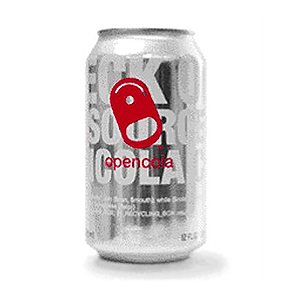
OpenCola is a brand of cola unique in that the instructions for making it are freely available and modifiable. Anybody can make the drink, and anyone can modify and improve on the recipe as long as they, too, license their recipe under the GNU General Public License. Since recipes are, by themselves, not copyrightable, the legal basis for this is untested.
The original version 1.0 was released on 27th January 2001. Current Version is 1.1.3. Although originally intended as a promotional tool to explain free and open source software, the drink took on a life of its own and 150,000 cans were sold. The Toronto-based company Opencola founded by Grad Conn, Cory Doctorow, and John Henson became better known for the drink than the software it was supposed to promote. Laird Brown, the company’s senior strategist, attributes its success to a widespread mistrust of big corporations and the ‘proprietary nature of almost everything.’
Posted in Food, Money, Politics |
Leave a Comment »
December 15, 2010

Slow Cow is a ‘relaxation beverage’ launched in Quebec in December 2008, dubbed an ‘anti-energy’ drink by its creators.
Slow Cow’s principal ingredient is L-Theanine, an amino acid found in tea plants, which is said to produce a ‘feeling of relaxation and well-being.’ Other ingredients include extracts of chamomile, passiflora, valerian, tilia cordata, and hops.
Posted in Drugs, Food, Health |
Leave a Comment »
December 7, 2010

Pruno, or prison wine, is an alcoholic liquid variously made from apples, oranges, fruit cocktail, ketchup, sugar, and possibly other ingredients, including bread. Pruno originated in (and remains largely confined to) prisons, where it can be produced cheaply, easily, and discreetly. The concoction can be made using only a plastic bag, hot running water, and a towel or sock to conceal the pulp during fermentation. The end result has been colorfully described as a ‘vomit-flavored wine-cooler.’ Depending on the time spent fermenting, the sugar content, and the quality of the ingredients and preparation, pruno’s alcohol content by volume can range from 2 – 14%.
Typically, the fermenting mass of fruit — called the motor in prison parlance (from ‘promoter’) – is retained from batch to batch to make the fermentation start faster. Increasing sugar results in more alcohol until the waste products of fermentation kill the motor. This also causes the taste of the end product to suffer. Ascorbic acid or Vitamin C powder is sometimes used to stop the fermentation, which, combined with the tartness of the added acid, counteracts the cloyingly sweet flavor. In an effort to eradicate pruno, some wardens have gone as far as banning all fresh fruit from prison cafeterias. In such cases, inmates often resort to using sauerkraut and orange juice.
Posted in Drugs, Food, Language |
2 Comments »
October 19, 2010
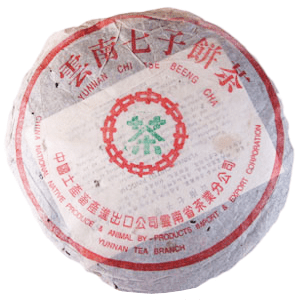
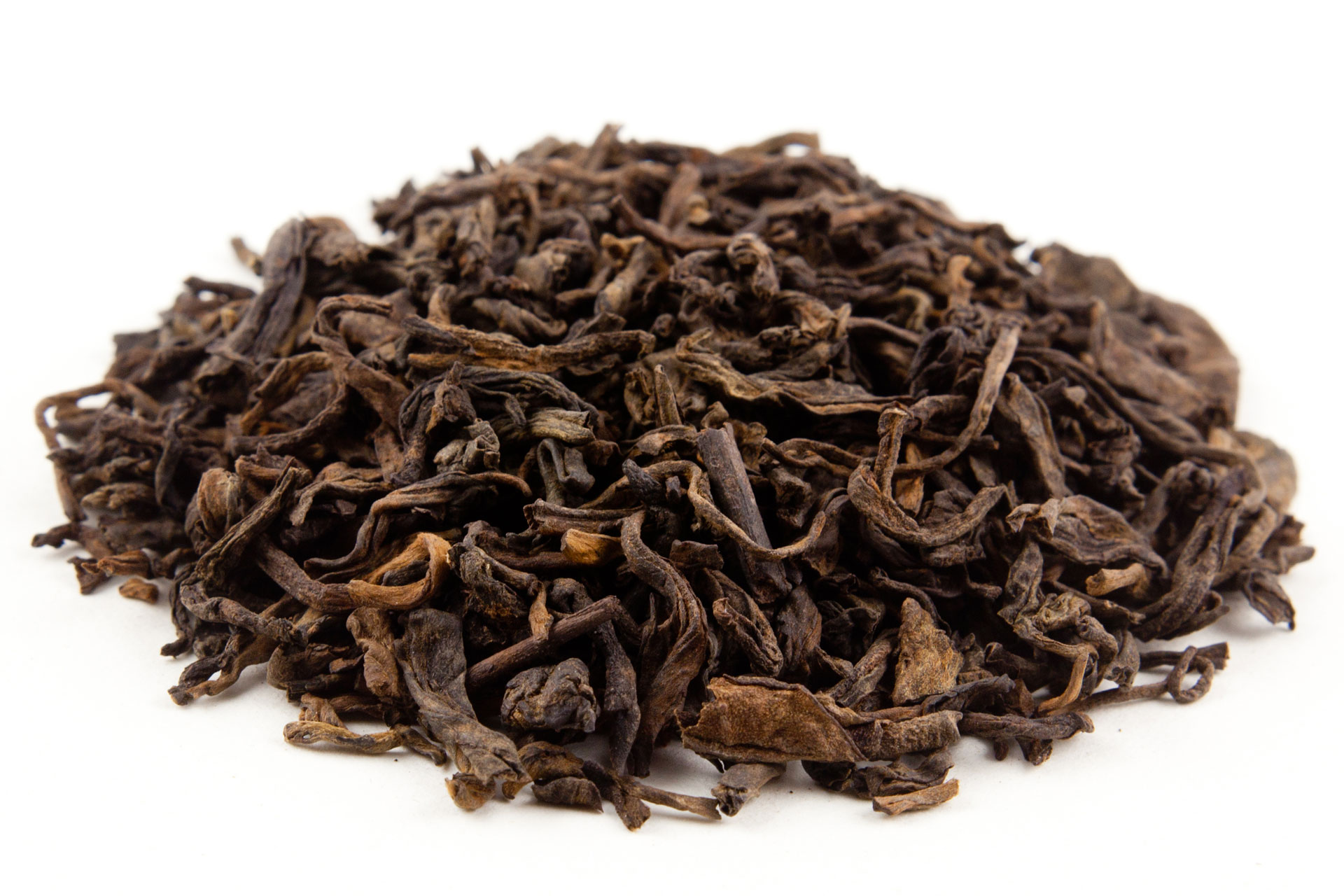
Pu-erh tea or Bolay tea is a type of tea made from a ‘large leaf’ variety of the tea plant Camellia sinensis and named after Pu’er county near Simao, Yunnan, China. Pu-erh tea can be purchased as either raw/green (sheng) or ripened/cooked (shu), depending on processing method or aging. Sheng pu-erh can be roughly classified on the tea oxidation scale as a green tea, and the shou or aged-green variants as post-fermented tea. The fact that pu-erh fits in more than one tea type poses some problems for classification. For this reason, the ‘green tea’ aspect of pu-erh is sometimes ignored, and the tea is regarded solely as a post-fermented product.
Unlike other teas that should ideally be consumed shortly after production, pu-erh can be drunk immediately or aged for many years; pu-erh teas are often now classified by year and region of production much like wine vintages. While there are many counterfeit pu-erhs on the market and real aged pu-erh is difficult to find and identify, it is still possible to find pu-erh that is 10 to 50 years old, as well as a few from the late Qing dynasty (1644–1912). Indeed, tea connoisseurs and speculators are willing to pay high prices for older pu-erh, upwards of thousands of dollars per cake.
Posted in Food, Health, World |
Leave a Comment »
October 18, 2010


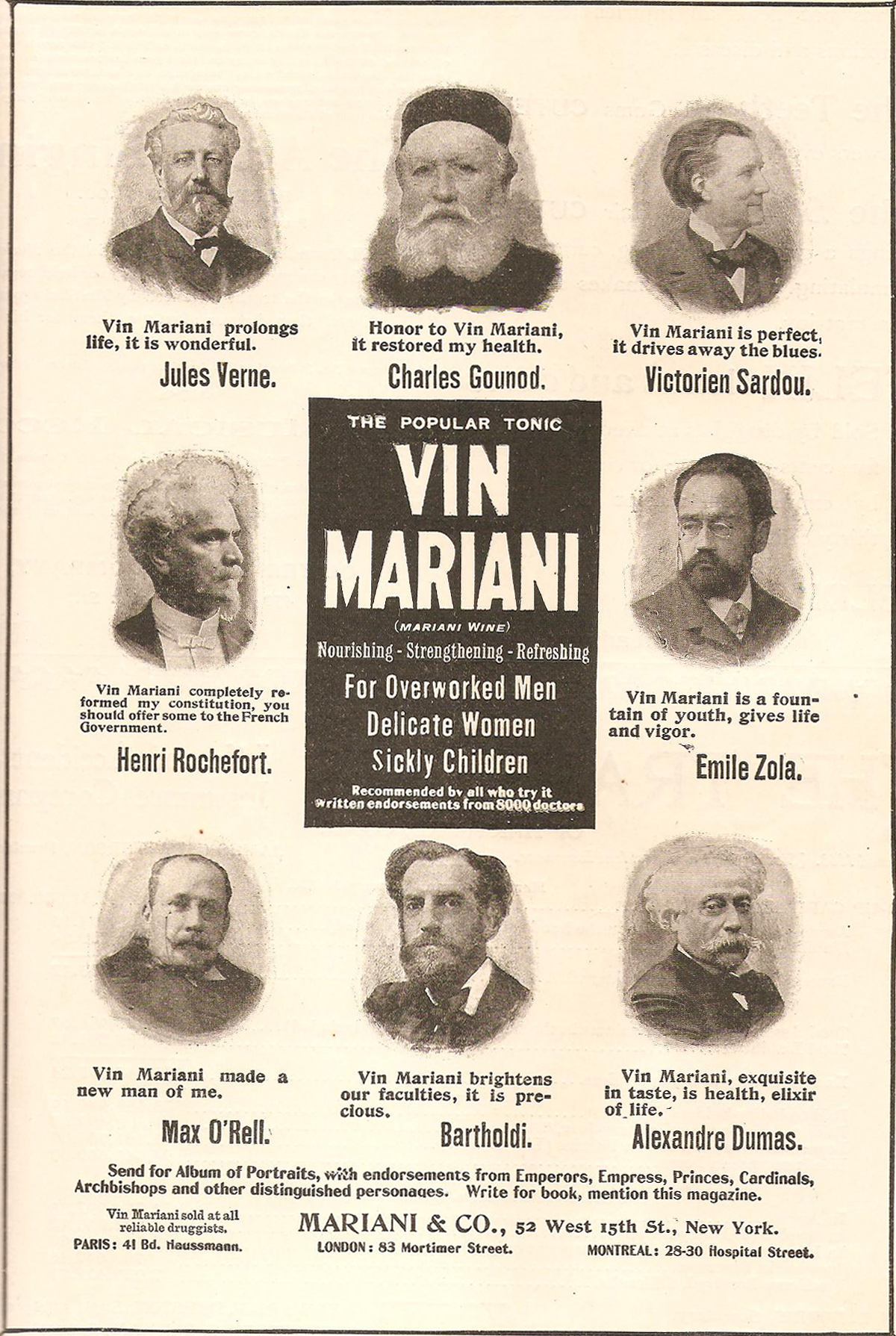
Vin Mariani (French: Mariani’s wine) was a tonic and patent medicine created circa 1863 by Angelo Mariani, a chemist who became intrigued with coca and its economic potential after reading Paolo Mantegazza’s paper on coca’s effects. Mariani started marketing a wine called Vin Tonique Mariani (à la Coca du Pérou) which was made from Bordeaux wine treated with coca leaves.
The ethanol in the wine acted as a solvent and extracted the cocaine from the coca leaves, altering the drink’s effect. It originally contained 6 mg of cocaine per fluid ounce of wine, but Vin Mariani which was to be exported contained 7.2 mg per ounce in order to compete with the higher cocaine content of similar drinks in the United States. Ads for Vin Mariani claimed that it would restore health, strength, energy, and vitality.
read more »
Posted in Drugs, Food, Money |
Leave a Comment »




 The Daily Omnivore