May 11, 2012

Jennifer Government is a 2003 novel written by Max Barry, set in a dystopian alternate reality in which most nations (now controlled by the United States) are dominated by for-profit corporate entities while the government’s political power is extremely limited. Some readers consider it similar in satiric intent to Orwell’s ‘1984,’ but of a world with too little political power as opposed to too much.
Consequently, some readers see the novel as a criticism of libertarianism. Many readers also see it as a criticism of globalization, although Barry claims he is not an anti-globalizationist.
read more »
Posted in Language, Money, Politics |
Leave a Comment »
May 9, 2012

‘The Better Angels of Our Nature: Why Violence Has Declined’ is a 2011 book by American cognitive scientist Steven Pinker arguing that violence in the world, especially the western part, has declined both in the long run and in the short. He also suggests explanations of why this has happened. The phrase ‘the better angels of our nature’ stems from the last words of Lincoln’s first inaugural address. Due to the highly interdisciplinary nature of the book Pinker uses the works of political scientist John Mueller and sociologist Norbert Elias, among others.
The extent of Elias’ influence on Pinker can be adduced from the title of Chapter 3: ‘The Civilizing Process,’ which is taken from the title of Elias’ seminal sociology text. Pinker also draws upon the work of international relations scholar Joshua Goldstein, and both have co-written a New York Times op-ed article titled ‘War Really Is Going Out of Style’ that summarizes many of their shared views. Both authors also appeared together at Harvard’s Institute of Politics to answer questions from academics and students concerning their similar thesis.’
Posted in Politics, War, World |
Leave a Comment »
May 9, 2012

American Gods is a 2001 novel by Neil Gaiman. The novel is a blend of Americana, fantasy, and various strands of ancient and modern mythology, all centering on a mysterious and taciturn protagonist, Shadow. Several of the themes touched upon in the book were previously glimpsed in Gaiman’s ‘The Sandman’ graphic novels. The central premise of the novel is that gods and mythological creatures exist because people believe in them. Immigrants to the United States brought with them dwarves, elves, leprechauns, and other spirits and gods.
However, the power of these mythological beings has diminished as people’s beliefs wane. New gods have arisen, reflecting America’s obsessions with media, celebrity, technology, and drugs, among others. In addition to the numerous figures from real-world myths, a few characters from ‘The Sandman’ and its spinoffs make brief cameos in the book. Other mythological characters featured in the novel are not divine, but are legendary or folk heroes, such as Johnny Appleseed. Shadow himself is implied to be Baldr (the Norse god of sun and light, son of Odin)
read more »
Posted in Art, Language, Philosophy |
1 Comment »
May 7, 2012

The Atrocity Exhibition is an experimental collection of ‘condensed novels’ by British writer J. G. Ballard. The book was originally published in the UK in 1970 by Jonathan Cape.
After a 1970 edition by Doubleday & Company had already been printed, Nelson Doubleday, Jr. personally cancelled the publication and had the copies destroyed, fearing legal action from some of the celebrities depicted in the book. Thus, the first U.S. edition was published in 1972 by Grove Press under the title ‘Love and Napalm: Export U.S.A.’
read more »
Posted in Language, Politics, Sex |
1 Comment »
May 3, 2012

Basic Color Terms: Their Universality and Evolution (1969) is a book by Brent Berlin and Paul Kay, who’s work proposed that the kinds of basic color terms a culture has, such as black, brown or red, are predictable by the number of color terms the culture has.
Berlin and Kay posit seven levels in which cultures fall, with Stage I languages having only the colors black (dark–cool) and white (light–warm). Languages in Stage VII have eight or more basic color terms. This includes English, which has eleven basic color terms.
read more »
Posted in Language, Science, World |
1 Comment »
May 3, 2012

Excession, first published in 1996, is Scottish writer Iain M. Banks’s fourth science fiction novel to feature the Culture (a fictional interstellar anarchist, socialist, and utopian society). It concerns the response of the Culture and other interstellar societies to an unprecedented alien artifact, the Excession of the title.
The book is largely about the response of the Culture’s Minds (AIs with enormous intellectual and physical capabilities and distinctive personalities) to the Excession itself and the way in which another society, whose systematic brutality horrifies the Culture, tries to use the Excession to increase its power.
read more »
Posted in Art, Language, Technology |
Leave a Comment »
April 23, 2012
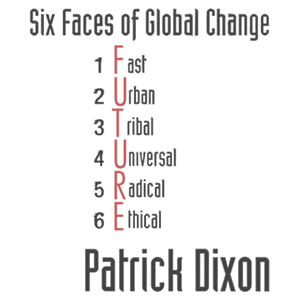
Futurewise is a book on global trends written by the futurist Patrick Dixon in 1998, with new editions in 2001, 2003, and 2007. ‘Futurewise’ contains over 500 expectations about what future life will be like, and divides future trends into six dimensions, which spell the word FUTURE: Fast (combinations of events bring new opportunities for agile leaders—and risks); Urban (demographics and lifestyle issues including megacities); Tribal (the most powerful force in the world today is tribalism—basis of culture, belonging, teams, brands); Universal (globalization at cost of local identity, risking international tensions, and the impact of the digital age); Radical (the rise of single issue activism and the death of left-right politics); and Ethical (the passions people have and personal values, including spirituality– the glue holding our future together)
A key thesis of ‘Futurewise’ is that the future is about emotion, and that emotional reactions to events are usually more important than the events themselves. Therefore a deep understanding is needed of how people are likely to feel in the future. The book also focuses on managing uncertainty. Risk management is a major challenge for all large corporations, including responding to wild cards – low probability but potentially high impact events.
Posted in Language, Politics, World |
Leave a Comment »
April 19, 2012

Rubyfruit Jungle is the first novel (1973) by Rita Mae Brown, remarkable, in its day, for its explicit lesbianism. The novel is a semi-autobiographical (some have suggested picaresque) account of Brown’s youth and emergence as a lesbian author. The term ‘ruby fruit jungle’ is slang for the female genitals. The novel focuses on Molly Bolt, the adopted daughter of a poor family, who possesses remarkable beauty and who is aware of her lesbianism from early childhood. The work is notable for being an early literary lesbian novel, as well as for Brown’s own activism in lesbian and feminist causes. Many lesbian readers have found in it a reflection of their own experiences and observations. While some now refer to it as ‘just another lesbian coming of age novel’ (Bildungsroman), its success is part of why the genre is now often considered a cliché.
In 1955, when Brown was 11 years old, her family moved to Fort Lauderdale where she attended high school and experimented sexually with boys and girls. When Brown was 16, her girlfriend’s father found her love letters, and Brown was dismissed from the student council. In the 1960s, Brown attended Broward Community College and the University of Florida, but she was expelled from UF for participating in a civil rights rally. She later moved to New York City, attended New York University, and received a degree in Classics and English. Later, she received another degree in Cinematography from the New York School of Visual Arts, and, in 1976, she received a doctorate in political science.
Posted in Language, Politics, Sex |
Leave a Comment »
April 11, 2012

‘Free Culture: How Big Media Uses Technology and the Law to Lock Down Culture and Control Creativity’ is a 2004 book by law professor Lawrence Lessig that was released on the Internet under the Creative Commons Attribution/Non-commercial license.
The book documents how copyright power has expanded substantially since 1974 in five critical dimensions: duration (from 32 to 95 years), scope (from publishers to virtually everyone), reach (to every view on a computer), control (including “derivative works” defined so broadly that virtually any new content could be sued by some copyright holder as a ‘derivative work’ of something), and concentration and integration of the media industry.
read more »
Posted in Money, Politics, Technology |
Leave a Comment »
April 9, 2012

‘On Writing: A Memoir of the Craft’ by Stephen King, published in 2000, is a memoir of the prolific author’s experiences as a writer, and also serves as a guide book for those who choose to enter the craft. The first section of the book is an Autobiography mainly about King’s early exposure to writing, and his childhood attempts at writing. King talks about his early attempts to get published, and his first novel ‘Carrie.’ He also talks about his fame as a writer, and what it took to get there. This includes his relationship with his wife, the death of his mother and his history of drug and alcohol abuse.
The second section is practical advice on writing, including tips on grammar and ideas about developing plot and character. King himself describes it as a guide for how ‘a competent writer can become a good one.’ This includes his beliefs that a writer should edit out unnecessary details and avoid the use of unnecessary adverbs. He also uses quotes from other books and authors to illustrate his points. The third section is also autobiographical, in which he discusses the 1999 automobile accident in which he was struck by a vehicle while walking down an isolated country road. He describes serious injuries, his painful recovery and his struggle to start writing again.
Posted in Art, Language, Money |
1 Comment »
March 24, 2012

The Running Man is a science fiction novel by Stephen King, first published under the pseudonym Richard Bachman in 1982 as a paperback original. It was collected in 1985 in the hardcover omnibus ‘The Bachman Books.’ The novel is set in a dystopian United States during the year 2025, in which the nation’s economy is in ruins and world violence is rising.
The story follows protagonist Ben Richards as he participates in the game show ‘The Running Man’ in which contestants, allowed to go anywhere in the world, are chased by ‘Hunters,’ employed to kill them. ‘The Running Man’ was loosely adapted into a film with the same name, which was released five years after the book in 1987. The film starred Arnold Schwarzenegger as Richards.
read more »
Posted in Art, Death, Language |
Leave a Comment »
March 24, 2012
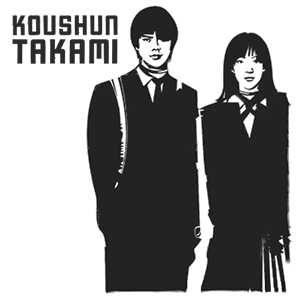
Battle Royale is a 1999 Japanese novel written by Koushun Takami about schoolchildren who are forced to fight each other to the death. The novel has been adapted into a 2000 film and a manga series. The story takes place in an alternate timeline—Japan is a member region of a totalitarian state known as the Republic of Greater East Asia. Under the guise of a ‘study trip,’ a group of students are gassed on a bus. They awaken in the Okishima Island School on an isolated, evacuated island (modeled after the island of Ogijima). They learn that they have been placed in an event called the Program.
Officially a military research project, it is a means of terrorizing the population, of creating such paranoia as to make organized insurgency impossible. The Program began in 1947. According to the rules fifty third-year high school classes are selected (prior to 1950, forty-seven classes were selected) annually to participate in the Program for research purposes. The students from a single class are isolated and are required to fight the other members from their class to the death. The Program ends when only one student remains, with that student being declared the winner.
Posted in Art, Death, Language |
Leave a Comment »


 The Daily Omnivore