June 26, 2012

Boombox is a colloquial expression for a portable music player with two or more loudspeakers. It is a device capable of receiving radio stations and playing recorded music (usually cassettes or CDs), usually at relatively high volume. Many models are also capable of recording (onto cassette) from radio and (sometimes) other sources. Designed for portability, most boomboxes can be powered by batteries, as well as by line current.
The first Boombox was developed by the inventor of the C-Cassette, Philips of the Netherlands. Their first ‘Radiorecorder’ was released in 1969. The Philips innovation was the first time that radio broadcasts could be recorded onto C-Cassette tapes without cables or microphones. Early sound quality of tape recordings was poor but as the C-Cassette technology evolved, with stereo recording, Chromium tapes and noise reduction, soon HiFi quality devices become possible. Several European electronics brands such as Grundig also introduced similar devices.
read more »
Posted in Art, Money, Technology |
Leave a Comment »
June 11, 2012
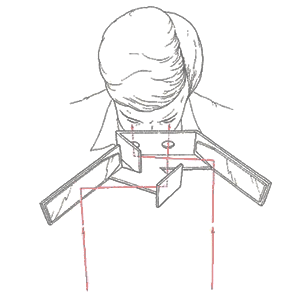
A pseudoscope [soo-duh-skohp] (‘false view’) is a binocular optical instrument that reverses depth perception. It is used to study human stereoscopic perception. Objects viewed through it appear inside out, for example: a box on a floor would appear as a box shaped hole in the floor. It typically uses sets of optical prisms, or periscopically arranged mirrors to swap the view of the left eye with that of the right eye.
In the 1800s Victorian scientist Charles Wheatstone coined the name and used the device to explore his theory of stereo vision. Switching the two pictures in a standard stereoscope changes all the elevated parts into depressions, and vice versa.
read more »
Posted in Health |
Leave a Comment »
June 3, 2012

A wobbulator is an electronic device primarily used for the alignment of receiver or transmitter intermediate frequency strips. It is usually used in conjunction with an oscilloscope, to enable a visual representation of a receivers passband to be seen, hence, simplifying alignment; it was used to tune early consumer AM radios. The term ‘wobbulator’ is a portmanteau of wobble and oscillator. A ‘wobbulator’ (without capitalization) is a generic term a frequency-modulated RF oscillator, also called a ‘sweep generator.’
A wobulator was used in some old microwave signal generators to create what amounted to frequency modulation. When capitalized ‘Wobbulator’ refers to the trade name of a specific brand of RF/IF alignment generator. The Wobbulator was made by a company known as TIC (Tel-Instrument Company). The Wobbulator generator, designated model 1200A, when connected to an oscilloscope and television receiver under test, would display a representation of the receiver’s RF/IF response curves with ‘markers’ defining critical frequency reference points as a response curve on the oscilloscope screen. Such an amplitude-versus-frequency graph is also often referred to as a Bode (pronounced ‘bodee’) plot.
Posted in Technology |
Leave a Comment »
May 27, 2012

A paperclip is an instrument used to hold sheets of paper together, usually made of steel wire bent to a looped shape. Most paper clips are variations of the Gem type introduced in the 1890s or earlier, characterized by the almost two full loops made by the wire. Common to paper clips proper is their utilization of torsion and elasticity in the wire, and friction between wire and paper.
When a moderate number of sheets are inserted between the two ‘tongues’ of the clip, the tongues will be forced apart and cause torsion in the bend of the wire to grip the sheets together. Too many sheets will cause the elastic limit of the material to be exceeded, resulting in permanent deformation. Paper clips usually have an oblong shape with straight sides, but may also be triangular or circular, or have more elaborate shapes. The most common material is steel, but molded plastic is also used. Some other kinds of paper clip use a two-piece clamping system. Recent innovations include multi-colored plastic-coated paper clips and spring-fastened binder clips.
read more »
Posted in Money, Technology, World |
Leave a Comment »
April 24, 2012

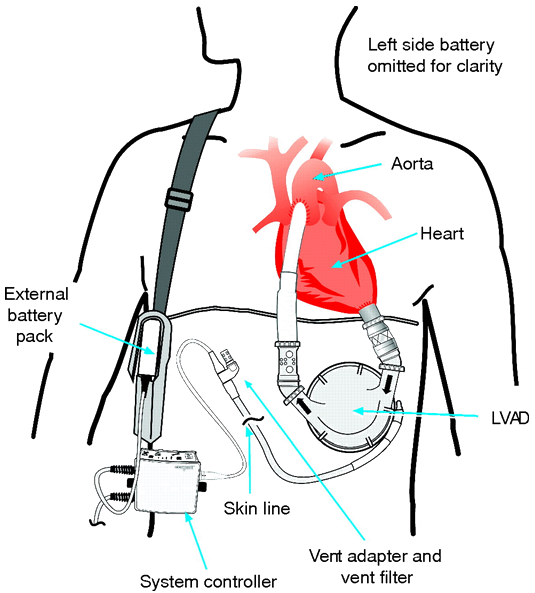
A Ventricular assist device [ven-trik-yuh-ler] (VAD) is a mechanical circulatory device that is used to partially or completely replace the function of a failing heart. Some VADs are intended for short term use, typically for patients recovering from heart attacks or heart surgery, while others are intended for long term use (months to years and in some cases for life), typically for patients suffering from congestive heart failure. VADs are designed to assist either the right (RVAD) or left (LVAD) ventricle, or both at once (BiVAD).
Which of these types is used depends primarily on the underlying heart disease and the pulmonary arterial resistance that determines the load on the right ventricle. LVADs are most commonly used, but when pulmonary arterial resistance is high, right ventricular assistance becomes necessary. Long term VADs are normally used to keep patients alive with a good quality of life while they wait for a heart transplantation (known as a ‘bridge to transplantation’). However, LVADs are sometimes used as ‘destination therapy’ (therapy when a heart transplant is not an option) and sometimes as a ‘bridge to recovery.’
read more »
Posted in Health, Technology |
Leave a Comment »
March 27, 2012

A vacuum bed is a device sometimes used in BDSM (bondage, domination, sadomasochism) play. A person is placed in a latex envelope spanned by a frame and a suction pump or floor vacuum removes most of the air in the envelope. The frame is often a simple rectangle of pierced PVC pipes, joined by PVC joints. There are several ways that the vacuum bed can be designed to facilitate breathing. The most common is a tube running from outside of the vacuum bed into the person’s mouth. A second option is a reinforced hole that is positioned so that the mouth protrudes. A third option is a reinforced gasket through which one forces the entire head. Incorporating a related fetish, some vacuum beds use a gas mask to facilitate respiration.
The vacuum bed is both a bondage and sensation device. The user is unable to move significantly (although some wiggling is possible), and is unable to speak or see, depending on the breathing hole used. In addition, though, the sensation of the vacuum bed itself, as well as any other play (stroking, percussion, vibrations) are quite pleasurable, and some are much more intense than what would be experienced without the vacuum bed. The vacuum bed must be used with the aid of another person, as the user cannot control the vacuum itself, nor escape the vacuum bed unaided.
Posted in Games, Money, Sex |
Leave a Comment »
March 20, 2012
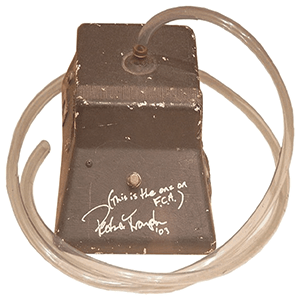
A talk box is an effects unit that allows a musician to modify the sound of a musical instrument. The musician controls the modification by lip syncing, or by changing the shape of the mouth. The effect can be used to shape the frequency content of the sound and to apply speech sounds (in the same way as singing) onto a musical instrument, typically a guitar (its non-guitar use is often confused with the vocoder) and keyboards.
A talk box is usually an effects pedal that sits on the floor and contains a speaker attached with an airtight connection to a plastic tube; however, it can come in other forms, such as the ‘Ghetto Talkbox’ (a crude homemade version). The speaker is generally in the form of a compression driver, the sound-generating part of a horn loudspeaker with the horn replaced by the tube connection.
read more »
Posted in Art, Technology |
Leave a Comment »
March 13, 2012

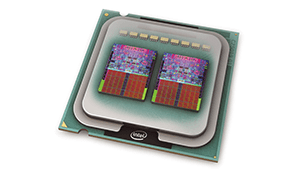
A multi-core CPU is a single computing component with two or more independent actual processors (called ‘cores’), which are the units that read and execute program instructions. Multiple cores can run multiple instructions at the same time, increasing overall speed for programs amenable to parallel computing.
Processors were originally developed with only one core. After a certain point, multi-processor techniques are no longer efficient, largely because of issues with congestion in supplying instructions and data to the many processors. The threshold is roughly in the range of several tens of cores; above this threshold network on chip technology is advantageous. Tilera processors feature a switch in each core to route data through an on-chip mesh network to lessen the data congestion, enabling their core count to scale up to 100 cores.
read more »
Posted in Money, Technology |
Leave a Comment »
March 12, 2012
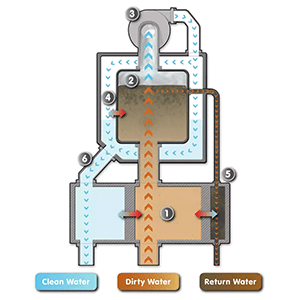
Slingshot is a water purification device created by Dean Kamen. Powered by a stirling engine running on a combustible fuel source, it claims to be able to produce clean water from almost any source. The device takes contaminated water and runs it through a vapor compression distiller that produces clean water, producing 250 gallons daily, enough for 100 people. The test devices have been used with ‘anything that looks wet,’ including polluted river water, saline ocean water, and raw sewage. In a demonstration at a technology conference in 2004, Kamen ran his own urine through the machine and drank the clean water that came out.
A pair of Slingshot devices ran successfully for a month in a village in Honduras during the summer of 2006. While the initial devices cost hundreds of thousands of dollars, Kamen hopes that increased economies of scale will allow production machines to be made available for $2,000 each. The Slingshot process operates by means of vapor compression distillation, requires no filters, and can operate using cow dung as fuel. In addition to producing drinkable water, the Slingshot also generates enough electricity to light 70 energy-efficient light bulbs.Kamen hopes to seed thousands of the units with local village entrepreneurs, in much the same way independent cell phone businesses have thrived and gradually changed the face of many impoverished areas around the globe.
Posted in Food, Technology, World |
Leave a Comment »
March 12, 2012

The mosquito laser is a device invented by astrophysicist Lowell Wood to kill large numbers of mosquitoes to reduce the chance of people being infected with malaria. Although originally introduced in the early 1980s, the idea was not substantially researched until decades later.
In 2007, the Bill & Melinda Gates Foundation requested Intellectual Ventures LLC to find a way to fight and eventually end malaria. Intellectual Ventures resurrected the idea of using lasers to kill mosquitoes and now has a working prototype. The idea has been criticized because most areas where malaria runs rampant do not have reliable electrical power.
read more »
Posted in Health, Technology |
Leave a Comment »
February 6, 2012
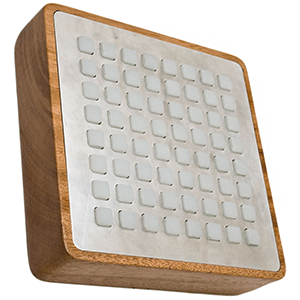
Monome is a family of interface devices for computers made by a Pennsylvania company of the same name. Despite being produced irregularly in small quantities since its introduction in 2006, the Monome button-grid controller has had a significant impact on electronic music. Together with the physically similar Yamaha Tenori-On, which was released a year later in 2007, the monome inspired interest in minimalist, grid-based music controllers. That interest spawned hobbyist projects like the Arduinome and commercial products like the Akai APC40 and the Novation Launchpad. The Monome has a minimalist design. It is simply a box with no letters or labels. There are random buttons that are back-lit. The box that holds the monome is entirely made up of timber, usually walnut. Notable users include deadmau5, Flying Lotus, Daedelus, and Nine Inch Nails contributor Alessandro Cortini.
Monome devices do not produce any sound on their own; they must be connected to a computer. A core design principle of the Monome is that it is not intended for any one specific application — the function of each button and the decision as to which lights are lit are completely up to the software communicating with the device over the Open Sound Control protocol. Several models have been produced, with typical sizes ranging from 64 to 256 buttons — plus a very limited run of 512-button devices. Monome applications span a wide variety of capabilities. Several applications provide sample sequencing capabilities. One such application is MLR, an application that allows for live sequencing and re-cutting of samples. There are also many applications that allow for synthesis either via their own internal synthesizers or by sending MIDI/OSC messages to external synthesizers.
Posted in Art, Money, Technology |
Leave a Comment »
January 15, 2012
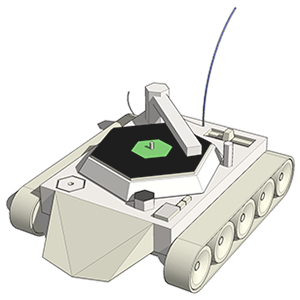
Sonic and ultrasonic weapons (USW) are weapons of various types that use sound to injure, incapacitate, or kill an opponent. Some sonic weapons are currently in limited use or in research and development by military and police forces. Others exist only in the realm of science fiction.
Some of these weapons have been described as sonic bullets, sonic grenades, sonic mines, or sonic cannons. Some make a focused beam of sound or ultrasound; some make an area field of sound. Although many real sonic and ultrasonic weapons are described as ‘non-lethal,’ they can still kill under certain conditions.
read more »
Posted in Technology, War |
1 Comment »



 The Daily Omnivore