April 7, 2011
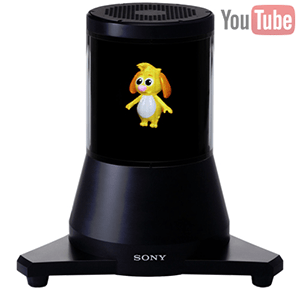
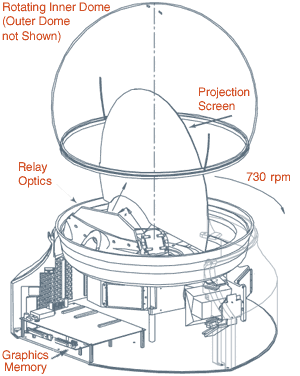
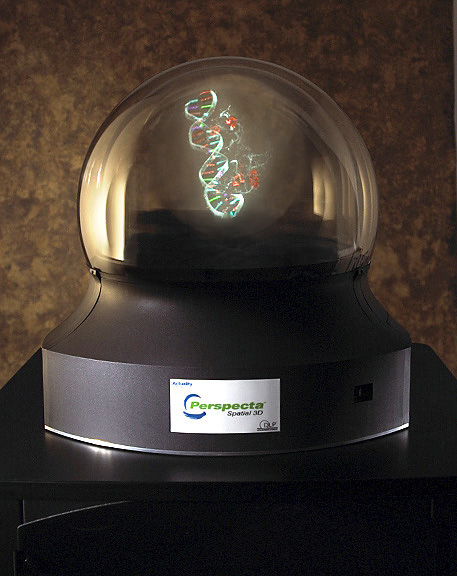
A volumetric [vol-yuh-me-trik] display is a device that forms a visual representation of an object in three physical dimensions, as opposed to the planar image of traditional screens that simulate depth through a number of different visual effects. One definition offered by pioneers in the field is that volumetric displays create 3-D imagery via the emission, scattering, or relaying of illumination from well-defined regions in (x,y,z) space. Though there is no consensus among researchers in the field, it may be reasonable to admit holographic and highly multiview displays to the volumetric display family if they do a reasonable job of projecting a three-dimensional light field within a volume.
Although first postulated in 1912, and a staple of science fiction, volumetric displays are still under development, and have yet to reach the general population. With a variety of systems proposed and in use in small quantities — mostly in academia and various research labs — volumetric displays remain accessible only to academics, corporations, and the military.
Posted in Money, Technology |
Leave a Comment »
April 4, 2011
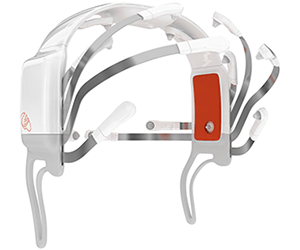
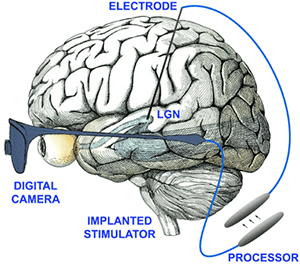
A brain–computer interface (BCI) is a direct communication pathway between the brain and an external device. BCIs are often aimed at assisting, augmenting or repairing human cognitive or sensory-motor functions. Research on BCIs began in the 1970s at UCLA under a grant from the National Science Foundation, followed by a contract from DARPA.
The field has since focused primarily on neuroprosthetics applications that aim at restoring damaged hearing, sight and movement. Thanks to the remarkable cortical plasticity of the brain, signals from implanted prostheses can, after adaptation, be handled by the brain like natural sensor or effector channels.
Posted in Health, Money, Technology |
Leave a Comment »
April 1, 2011


A mirrorless interchangeable lens camera is an emerging class of digital system cameras, intermediate between compact digital cameras and digital single-lens reflex cameras (DSLRs).
They are characterized by large sensors (the same size as entry-level DSLRs), no mirror, and interchangeable lenses, as the name suggests, and provide DSLR-quality pictures in a significantly smaller camera.
Posted in Money, Technology |
Leave a Comment »
March 31, 2011

A dog whistle is a type of whistle used in the training of dogs and cats. It was invented by British polymath, Francis Galton. The frequency range of a dog whistle is largely out of the range of human hearing. Typically, a dog whistle is within the range of 16 to 22 kHz with only the frequencies below 20 kHz audible to the human ear.
Some dog whistles have adjustable sliders for active control of the frequency produced. Depending on the way the whistle is used, a trainer may simply gather a dog’s attention or inflict pain for the purpose of behavior modification. The name dog whistle is often used for both lung-powered whistles as well as electronic devices that emit ultrasonic sound via piezoelectric emitters. The electronic variety are sometimes coupled with bark detection circuits in an effort to curb barking behavior.
Posted in Technology |
Leave a Comment »
March 28, 2011

A Spinthariscope [spin-thar-uh-skohp] is a device for observing individual nuclear disintegrations caused by the interaction of ionizing radiation with a phosphor (radioluminescence). It was invented by William Crookes in 1903. It consisted of a small screen coated with zinc sulfide affixed to the end of a tube, with a tiny amount of radium salt suspended a short distance from the screen and a lens on the other end of the tube for viewing the screen. Crookes named his device after the Greek word ‘spintharis’, meaning ‘a spark.’
It is said that for a short time after its invention, spinthariscopes were very popular among the social upper classes who gave them as gifts and used them in demonstrations to appear up to date with the most modern scientific advances of the day. Spinthariscopes were quickly replaced with more accurate and quantitative devices for measuring radiation in scientific experiments, but enjoyed a modest revival in the mid 20th century as children’s educational toys. They can still be bought today as instructional novelties, but they now use Americium or Thorium.
Posted in Games, Science |
Leave a Comment »
March 28, 2011
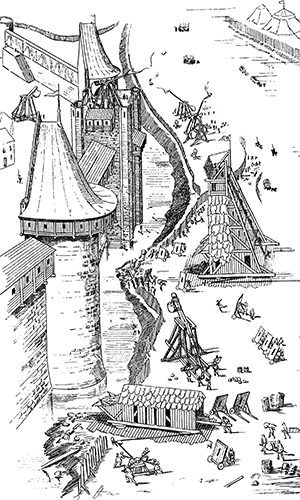
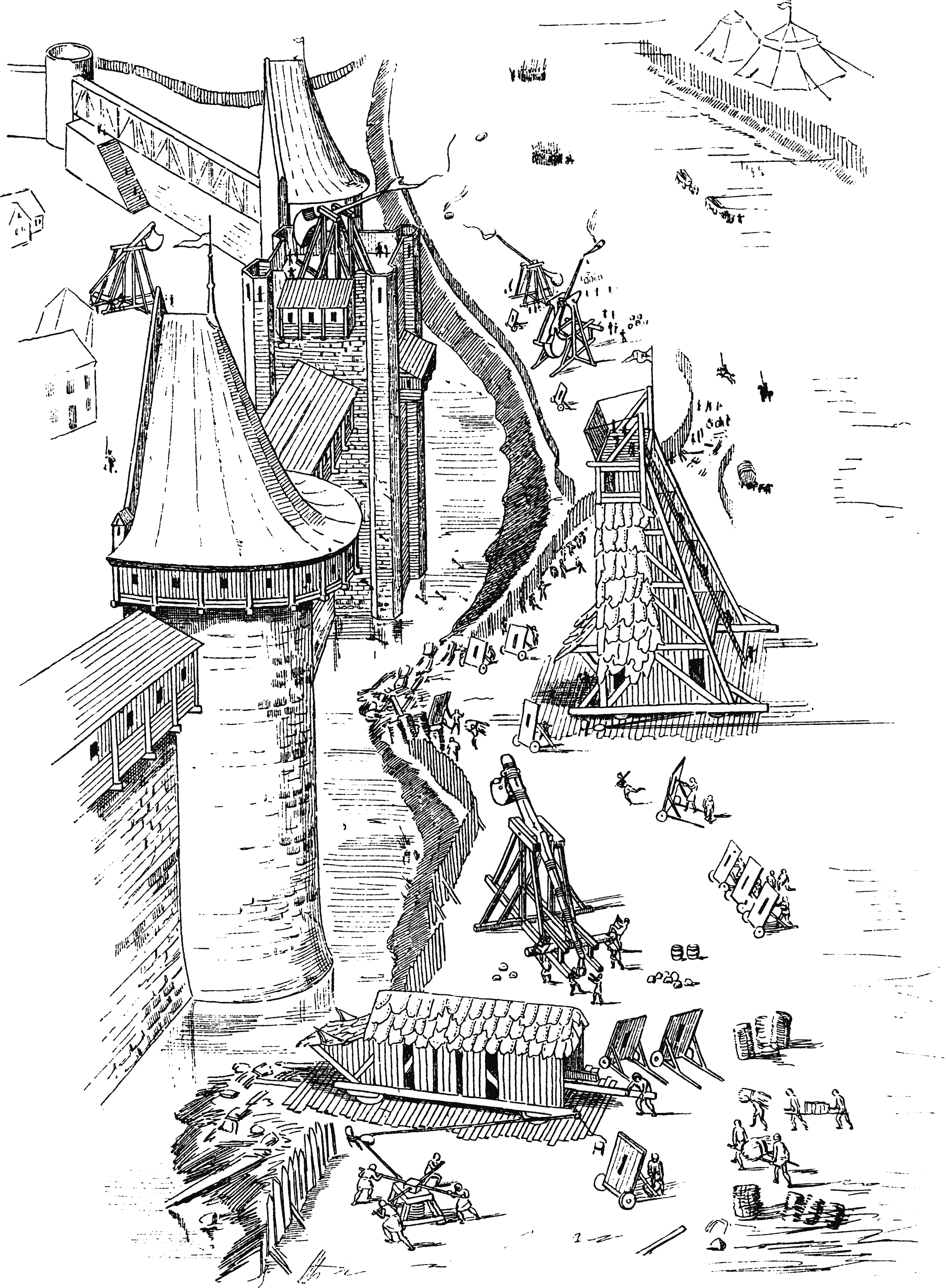
A siege engine is a device that is designed to break or circumvent city walls and other fortifications in siege warfare. Some are operated close to the fortifications, while others attack from a distance. From antiquity, siege engines were constructed largely of wood and tended to use mechanical advantage to fling stones and similar missiles. With the development of gunpowder and improved metallurgical techniques, siege engines became artillery. Collectively, siege engines or artillery combined with the necessary troops and transport vehicles to conduct a siege are referred to as a ‘siege-train.’
The earliest engine was the battering ram, developed by the Assyrians, followed by the catapult in ancient Greece. The Spartans used battering rams in the Siege of Plataea in 429 BCE, but it seems that the Greeks limited their use of siege engines to assault ladders, though Peloponnesian forces used something resembling flamethrowers. The Carthaginians used siege towers and battering rams against the Greek colonies of Sicily.
read more »
Posted in Technology, War |
Leave a Comment »
March 23, 2011
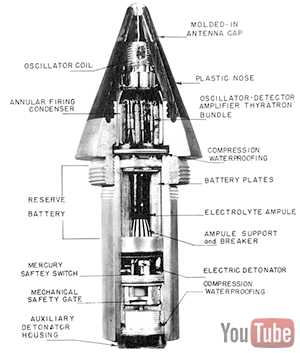
A proximity fuze is designed to detonate an explosive device automatically when the distance to target becomes smaller than a predetermined value or when the target passes through a given plane. A shell with a standard ‘contact fuze’ explodes upon impact, and a ‘time fuze’ after a specified number of seconds. A ‘proximity fuze,’ however uses a radio detection system, and explodes when within a certain distance from a target.
One of the first practical proximity fuzes was codenamed the ‘VT fuze,’ an acronym of ‘Variable Time fuze,’ as deliberate camouflage for its operating principle. The VT fuze concept in the context of artillery shells originated in the UK with British researchers (particularly Sir Samuel Curran) and was developed under the direction of physicist Merle A. Tuve at The Johns Hopkins University Applied Physics Lab. It is considered one of the most important technological innovations of World War II.
Posted in Technology, War |
Leave a Comment »
February 22, 2011
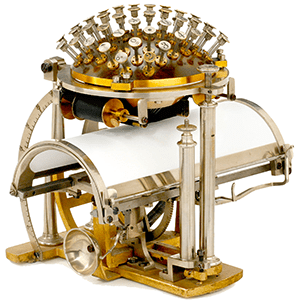
The Hansen Writing Ball was invented in 1865 by the reverend and principal of the Royal Institute for the deaf-mutes in Copenhagen. The writing ball was first patented and entered production in 1870, and was the first commercially produced typewriter. In Danish it was called the skrivekugle. The Hansen ball was a combination of unusual design and ergonomic innovations, but like most of the early 19th century typewriters, it did not allow the paper to be seen as it passed through the device.
Posted in Language, Technology |
1 Comment »
February 12, 2011

A neti pot is a device used for irrigating the nasal passages. Typically it has a spout attached near the bottom, sometimes with a handle on the opposite side. Neti pots flush out the nasal cavities by using gravity to draw the flow of saline. Some modern variants available from pharmacies are made of flexible plastic and can be compressed to exert additional pressure. In recent years alternative strategies have been developed, including bulb syringes in which the flow is created by squeezing a bulb and more advanced ‘pulsatile devices’ which mechanically pump the saline.
The use of a neti pot requires mixing up a saline solution that will be poured through the nasal passages. A typical saline solution is a mixture of around 500 ml of water with 5 g of salt. Sodium bicarbonate is sometimes added. The neti pot used with a saline solution has been shown to be an effective treatment for hay fever, sinusitis, and other nasal conditions. The origins of nasal irrigation are understood to be in the ancient Hindu practice of Ayurveda whose roots are traced to the Vedas.
Posted in Health, Technology |
Leave a Comment »
February 12, 2011

The Geneva drive is a gear mechanism that translates a continuous rotation into an intermittent rotary motion. The rotating drive wheel has a pin that reaches into a slot of the driven wheel advancing it by one step. The drive wheel also has a raised circular blocking disc that locks the driven wheel in position between steps. The name derives from the device’s earliest application in mechanical watches, Switzerland and Geneva being an important center of watchmaking. The geneva drive is also commonly called a Maltese cross mechanism due to the visual resemblance.
Posted in Language, Technology |
Leave a Comment »
February 11, 2011

Chemex Coffeemaker, a famous coffee-making device, was introduced by the Chemex Corporation of Pittsfield, Mass. in the 1940s. It consists of a single hourglass-shaped vessel and is used to make coffee. It was invented by industrial chemist, Peter Schlumbohm; the New York Times in its obituary of Schlumbohm called the device ‘one of 100 best modern devices.’
Posted in Food, Money, Technology |
Leave a Comment »
February 11, 2011

The AeroPress is a device for brewing coffee. It was invented in 2005 by Alan Adler. Coffee is steeped for about 10 seconds and then forced through a paper microfilter. The maker describes the result as an espresso strength concentration of coffee. The device consists of two copolyester cylinders. One cylinder has a rubber plunger and fits inside the larger cylinder to create an airtight seal, similar to a syringe.
The AeroPress, though sharing some similarities with a French press, is quite different. It uses a disposable paper filter which removes most of the coffee solids, resulting in a sediment-free brew, and air pressure is used to extract more coffee oils.
Posted in Food, Money, Technology |
Leave a Comment »




 The Daily Omnivore