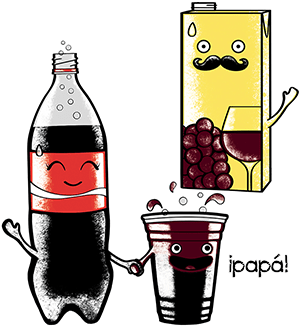
Kalimotxo [kal-ee-moht-cho] is a drink consisting of approximately 50% red wine and 50% cola-based soft drink.
read more »
Everything is Interesting
Kalimotxo [kal-ee-moht-cho] is a drink consisting of approximately 50% red wine and 50% cola-based soft drink.
read more »

Spruce beer is a beverage flavored with the buds, needles, or essence of spruce trees. Spruce beer can refer to either alcoholic or non-alcoholic beverages. A number of flavors are associated with spruce-flavored beverages, ranging from floral, citrusy, and fruity to cola-like flavors to resinous and piney. This diversity in flavor likely comes from the choice of spruce species, the season in which the needles are harvested, and the manner of preparation.
The fresh shoots of many spruces and pines are a natural source of vitamin C. Captain Cook made alcoholic sugar-based spruce beer during his sea voyages in order to prevent scurvy in his crew. Though spruce has sometimes been used as a flavoring ingredient in beer, such as Alba Scots Pine Ale,[and the Alaskan Brewing Company’s Winter Ale, the only beer termed ‘spruce beer’ is Wigram Brewing Company’ Spruce Beer, which is based on Captain Cooks first beer brewed in New Zealand in 1773.

Root beer is a carbonated, sweetened beverage, originally made using the root of a sassafras plant (or the bark of a sassafras tree) as the primary flavor. Root beer, popularized in North America, comes in two forms: alcoholic and soft drink. The historical root beer provided a drink with a very low alcohol content, like a small or ‘near beer’. Although roots are used as the source of many soft drinks in many countries throughout the world (and even alcoholic beverages/beers), the name root beer is rarely used outside North America, Britain, Ireland and the Philippines. Most other countries have their own indigenous versions of root-based beverages and small beers but with different names.
There are hundreds of root beer brands in the United States, and there is no standardized recipe. The primary ingredient, artificial sassafras flavoring, is complemented with other flavors, common ones being vanilla, wintergreen, cherry tree bark, licorice root, sarsaparilla root, nutmeg, acacia, anise, molasses, cinnamon, clove and honey. Homemade root beer is usually made from concentrate, though it can also be made from actual herbs and roots. Both alcoholic and non-alcoholic root beers have a thick and foamy head when poured, often enhanced by the addition of yucca extract.

The Marula is a medium-sized dioecious tree, indigenous to Africa. The fruits are used in the liqueur Amarula. The distribution of this species throughout Africa has followed the Bantu people in their migrations, as it has been an important item in their diet since time immemorial. When ripe, the fruits have a light yellow skin, with white flesh, rich in vitamin C, are succulent, tart with a strong and distinctive flavor.
The marula fruit is also eaten by various animals in Southern Africa. In the movie ‘Animals Are Beautiful People’ by Jamie Uys, released in 1974, some scenes portray elephants, warthogs and monkeys becoming intoxicated from eating fermented marula fruit. Later research showed that these scenes were improbable and, in all probability, staged. Elephants would need a huge amount of fermented marulas to have any effect on them, and the amount of water drunk by elephants each day would also dilute the effect.
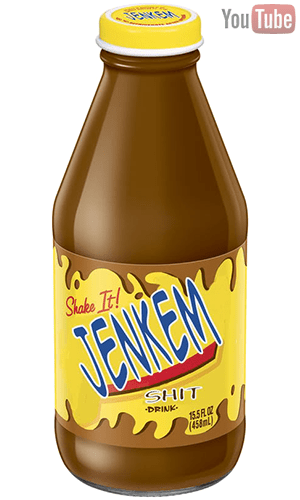
Jenkem is an alleged hallucinogenic recreational drug composed of noxious gas formed from fermented sewage. In the mid to late 1990s, several reports stated that Jenkem was being used by Zambian street children. The surfacing of the drug, or rumors of its existence, has caused at least one US municipality to amend its city ordinance regarding substances that cannot be legally inhaled to include organic substances.

A Mickey Finn (or simply Mickey) is a slang term for a drink laced with a drug (especially chloral hydrate) given to someone without their knowledge in order to incapacitate them. Serving someone a Mickey Finn is most commonly referred to as ‘slipping a mickey.’ The practice is most likely named for the bartender of a Chicago establishment, the Lone Star Saloon and Palm Garden Restaurant.
In December 1903, several newspapers document that a Michael ‘Mickey’ Finn managed the Lone Star Saloon and was accused of using knockout drops to incapacitate and rob some of his customers. Moreover, the first known written example (according to the Oxford English Dictionary) of the use of the term Mickey Finn is in 1915, twelve years after his trial, lending credence to this theory of the origination of the phrase.

Whisky production in Japan began around 1870, but the first commercial production was in 1924 upon the opening of the country’s first distillery, Yamazaki. Broadly speaking the style of Japanese whisky is more similar to that of Scotch whisky than Irish whiskey, and thus the spelling typically follows the Scottish convention (omitting the letter ‘e’).
There are several companies producing whisky in Japan. Perhaps the two most well known are Suntory and Nikka. Both produce blended as well as single malt whiskies.

Free Beer, formerly known as ‘Our Beer,’ is the first brand of Danish beer with a ‘free’ recipe – free as in ‘freedom,’ taken after the term ‘free software.’ The name ‘Free Bee’ is a play on Richard Stallman’s common explanation that free software is ‘free as in speech, not free as in beer.’ The recipe is published under a Creative Commons license, specifically the Attribution-ShareAlike license. The beer was created by students at the IT-University in Copenhagen together with Superflex, a Copenhagen-based artist collective, to illustrate how concepts of the free software movement might be applied outside the digital world.
Initially, much of the homebrewing community spoke out against the quality and comprehensiveness of the recipe. Making reference to the technical problems of when software instructions (‘source code’) cannot be made into a functioning program, several people commented that if the recipe were source code, it would not compile (a compiler is a program that takes ‘source code’ from a high-level language and changes it to a target language, mostly machine code, the lowest level language). Since then the recipe went through several iterations and has now reached version 4.0, which corrects most of the early mistakes. The quality of the beer also improved, and the amount of sugar in it decreased by 90%.

Pruno, or prison wine, is an alcoholic liquid variously made from apples, oranges, fruit cocktail, ketchup, sugar, and possibly other ingredients, including bread. Pruno originated in (and remains largely confined to) prisons, where it can be produced cheaply, easily, and discreetly. The concoction can be made using only a plastic bag, hot running water, and a towel or sock to conceal the pulp during fermentation. The end result has been colorfully described as a ‘vomit-flavored wine-cooler.’ Depending on the time spent fermenting, the sugar content, and the quality of the ingredients and preparation, pruno’s alcohol content by volume can range from 2 – 14%.
Typically, the fermenting mass of fruit — called the motor in prison parlance (from ‘promoter’) – is retained from batch to batch to make the fermentation start faster. Increasing sugar results in more alcohol until the waste products of fermentation kill the motor. This also causes the taste of the end product to suffer. Ascorbic acid or Vitamin C powder is sometimes used to stop the fermentation, which, combined with the tartness of the added acid, counteracts the cloyingly sweet flavor. In an effort to eradicate pruno, some wardens have gone as far as banning all fresh fruit from prison cafeterias. In such cases, inmates often resort to using sauerkraut and orange juice.

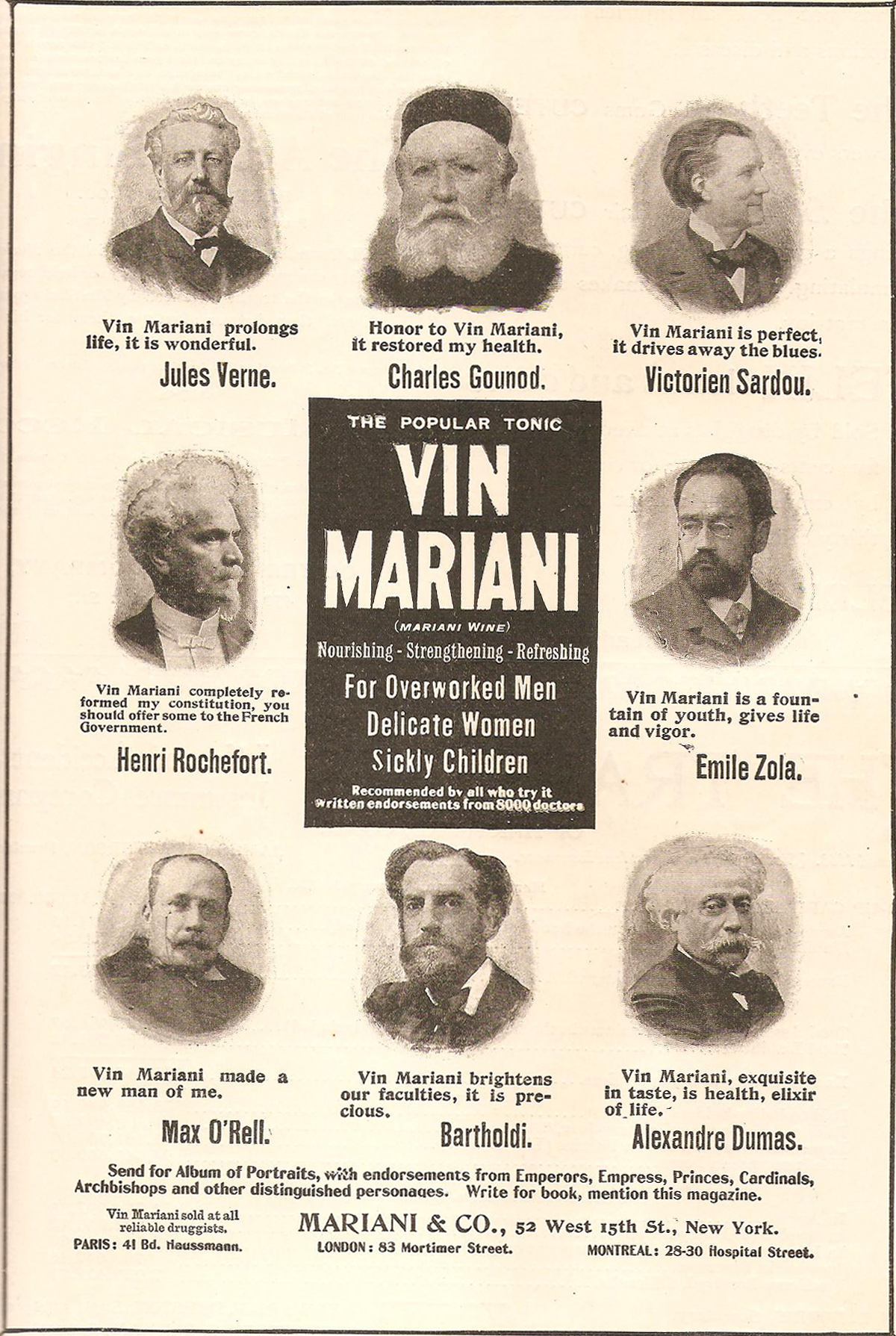
Vin Mariani (French: Mariani’s wine) was a tonic and patent medicine created circa 1863 by Angelo Mariani, a chemist who became intrigued with coca and its economic potential after reading Paolo Mantegazza’s paper on coca’s effects. Mariani started marketing a wine called Vin Tonique Mariani (à la Coca du Pérou) which was made from Bordeaux wine treated with coca leaves.
The ethanol in the wine acted as a solvent and extracted the cocaine from the coca leaves, altering the drink’s effect. It originally contained 6 mg of cocaine per fluid ounce of wine, but Vin Mariani which was to be exported contained 7.2 mg per ounce in order to compete with the higher cocaine content of similar drinks in the United States. Ads for Vin Mariani claimed that it would restore health, strength, energy, and vitality.
read more »


Kush [koosh] refers to a subset of strains of indica cannabis. The origins of Kush cannabis are from landrace plants mainly in Afghanistan, but are also from Iran, Pakistan, and Northern India. The name derives from the Hindu Kush mountain range. Kush strains of cannabis were brought to the United States in the mid-to-late 1970s and continue to be available. Kush strains were among those cultivated by the British firm GW Pharmaceuticals for its legally licensed commercial trial of medicinal cannabis.
Congressman Mark Kirk, a Republican member of the House of Representatives from Illinois, introduced legislation to increase the penalties for selling kush: The High-Potency Marijuana Sentencing Enhancement Act of 2009 (H.R. 2848). Kirk said that as kush may sell for up to $600 per ounce increases penalties are justified, saying that ‘if you can make as much money selling pot as cocaine, you should face the same penalties.’
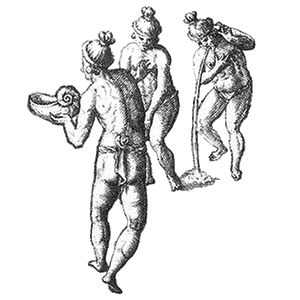
Black drink was the name given by colonists to a ritual beverage called Asi, brewed by Native Americans in the Southeastern United States. It was prepared from the roasted leaves and stems of the Yaupon Holly, native to the Atlantic and Gulf Coasts. The active ingredient in the drink was caffeine. The beverage was often used as a substitute for coffee and tea by colonists under the name cassine or cassina.
Prior to the 19th century, the black drink was consumed during the daily deliberations of the village councils and at all other important council meetings. Caddo, Creeks, Cherokees, Choctaws, and others believed it purified the drinker and purged him of anger and falsehoods. Black drink was prepared by special village officials and served in large communal cups, frequently made of whelk shell. The men in council were served in order of precedence, starting with important visitors. They consumed large quantities at a sitting. Afterward, they purged themselves by vomiting.


 The Daily Omnivore