September 15, 2012

Limerence [lim-rens] is a term coined in 1977 by American psychologist Dorothy Tennov to describe an involuntary state of mind which seems to result from a romantic attraction to another person combined with an overwhelming, obsessive need to have one’s feelings reciprocated. The concept grew out of Tennov’s mid-1960s work, when she interviewed over 500 people on the topic of love, and was first published in her 1979 book ‘Love and Limerence: The Experience of Being in Love.’
Though there are no established preconditions for limerence, there is a high rate of coincidence between limerence, depersonalization/derealization disorders, and dysfunctional attachment environments in childhood. This might suggest that sustained exposure to a psychologically unstable environment in childhood, or unhealthy/incomplete attachment between a child and their caretakers in early life, may make an individual more susceptible to limerence. There is also a statistically significant correlation between limerence and post traumatic stress disorder.
read more »
Posted in Health, Love, Sex |
1 Comment »
September 15, 2012

Involuntary celibacy (colloquially ‘incel’) is chronic near-total or total absence in a person’s sexuality of intimate relationships or sexual intercourse that is occurring for reasons other than voluntary celibacy, asexuality, antisexualism, or sexual abstinence. It is the psycho-social opposite of having a sex life.
Incel people, despite being open to sexual intimacy and potential romance with another person and also making active, repeated efforts towards such an end, cannot cause any such end(s) to occur with any significant degree of regularity—or even at all.
read more »
Posted in Health, Love, Sex |
1 Comment »
September 14, 2012

In linguistics, an eggcorn is an idiosyncratic substitution of a word or phrase for a word or words that sound similar or identical in the speaker’s dialect. The new phrase introduces a meaning that is different from the original, but plausible in the same context, such as ‘old-timers’ disease’ for ‘Alzheimer’s disease.’ This is as opposed to a malapropism, where the substitution creates a nonsensical phrase. Classical malapropisms generally derive their comic effect from the fault of the user, while eggcorns are errors that exhibit creativity or logic. Eggcorns often involve replacing an unfamiliar, archaic, or obscure word with a more common or modern word (‘baited breath’ for ‘bated breath’).
The term eggcorn was coined by professor of linguistics Geoffrey Pullum in 2003, in response to an article by Mark Liberman on ‘Language Log,’ a blog for linguists. Liberman discussed the case of a woman who substitutes the phrase ‘egg corn’ for the word ‘acorn,’ arguing that the precise phenomenon lacked a name; Pullum suggested using ‘eggcorn’ itself. The phenomenon is very similar to the form of wordplay known as the pun, except that, by definition, the speaker (or writer) intends the pun to have some effect on the recipient, whereas one who speaks or writes an eggcorn is unaware of the mistake.
Posted in Humor, Language |
Leave a Comment »
August 25, 2012

Fursuits are animal costumes made from various materials. They range from simple tails and ears to full costumes cooled by battery-powered fans. Fursuits can be worn for personal enjoyment, work, or charity. The term ‘fursuit’ is believed to have been coined in 1993 by Robert King and can also refer to animal mascot costumes in general, as opposed to human or inanimate object mascots. Fursuits have also been featured in visual mediums as backdrops or as part of a central theme.
Fursuits are associated with furry fandom, a subculture devoted to anthropomorphic animal characters. More advanced fursuit features include jaws which move when the user speaks, and moving tails. Often, the suits depict a personal character and are used in a form of role play, or for expressing their owners’ ‘true’ personality. Some fursuiters do not talk while in costume to ‘preserve the magic.’ A few members of the furry fandom consider the fursuit a sexual item. Fursuits can be sold with or modified to contain provisions for sexual activity, such as openings, removable panels, and anatomically correct artificial genitalia. Sexual arousal that depends on portraying one’s fursuit identity has been called ‘fursuitism’ and sexuality in furry fandom is refered to as ‘yiff’ or ‘yiffing.’
Posted in Games, Sex |
2 Comments »
August 25, 2012

Plushophilia is a sexual fetish involving stuffed animals. Plushophiles are sometimes called ‘plushies,’ although this term can also refer to non-sexual stuffed animal enthusiasts, and to stuffed animals in general. Plushophilia is sometimes assumed to be a practice common within furry fandom (a subculture revolving around animal anthropomorphism), due in part to a 2001 ‘Vanity Fair’ article that linked various members of the furry community with plushophilia.
Pornography and sexual activity involving animal anthropomorphism is known in the furry fandom community as ‘yiff’ (and sexual acts as ‘yiffing’). Sexual arousal that depends upon imagining one’s self as plush or anthropomorphized animal is ‘autoplushophilia.’ Paraphilic interests that involve being in another form have been referred to as Erotic target location errors, a term coined in 1993 by sexologist Ray Blanchard, referring to having a sexual preference in features that are somewhere other than on one’s sexual partner.
Posted in Health, Sex |
Leave a Comment »
August 25, 2012
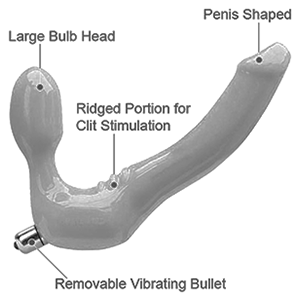
Pegging is a sexual practice in which a woman penetrates a man’s anus with a strap-on dildo. The neologism ‘pegging’ was popularized when it became the winning entry in a contest in advice columnist Dan Savage’s ‘Savage Love’ sex advice column, held after an observation was made that there was no common name for the act. In terms of physical pleasure, a woman’s genitals may get direct stimulation from the base of the dildo, or in the case of a double-ended dildo, from vaginal (or internal) penetration. A woman can use a secondary vibrator, between the dildo and her genitals, to get pleasure from pegging.
Men may find stimulation of the anus, rectum, and adjacent organs enjoyable. During anal sex, pleasure can be particularly derived from the prostate, which can lead to an orgasm. Some men enjoy masturbating (or being manually stimulated) during pegging. Savage wrote that he believes all men should try pegging at least once, as it may introduce them to a new enjoyable sexual activity and illuminate them to the receiver’s perspective in sex.
read more »
Posted in Sex |
Leave a Comment »
August 25, 2012

In 2003, the columnist and gay rights activist Dan Savage held a contest among his readers to create a definition for the word ‘santorum‘ as a response to comments by then-U.S. Senator Rick Santorum that had been criticized as anti-gay. Savage announced the winning entry, which defined ‘santorum’ as ‘the frothy mixture of lube and fecal matter that is sometimes the byproduct of anal sex.’
He created a web site, spreadingsantorum.com (and santorum.com), to promote the definition, which became a prominent search result for Santorum’s name on several web search engines. In 2010 Savage offered to take the site down if Santorum donated US$5 million to Freedom to Marry, a group advocating legal recognition of same-sex marriages. In 2011 Santorum asked Google to remove the definition from its search engine index. Google refused, responding that the company does not remove content from search results except in very limited circumstances.
read more »
Posted in Language, Politics, Sex |
1 Comment »
July 25, 2012

Truthiness is a quality characterizing a ‘truth’ that a person claims to know intuitively ‘from the gut’ or because it ‘feels right’ without regard to evidence, logic, intellectual examination, or facts. American television comedian Stephen Colbert coined the word in this meaning as the subject of a segment called ‘The Wørd’ during the 2005 pilot episode of his political satire program ‘The Colbert Report.’
By using this as part of his routine, Colbert satirized the misuse of appeal to emotion and ‘gut feeling’ as a rhetorical device in contemporaneous socio-political discourse. He particularly applied it to President George W. Bush’s nomination of Harriet Miers to the Supreme Court and the decision to invade Iraq in 2003. Colbert later ascribed truthiness to other institutions and organizations, including Wikipedia. Colbert has sometimes used a mock Latin version of the term, ‘Veritasiness.’
read more »
Posted in Humor, Language, Politics |
Leave a Comment »
July 25, 2012
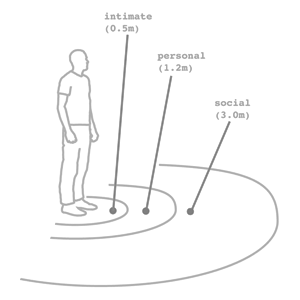
Proxemics [prok-see-miks] is a subcategory of the study of nonverbal communication along with haptics (touch), kinesics (body movement), vocalics (paralanguage), and chronemics (structure of time). Proxemics can be defined as ‘the interrelated observations and theories of man’s use of space as a specialized elaboration of culture.’
Edward T. Hall, the cultural anthropologist who coined the term in 1963, emphasized the impact of proxemic behavior (the use of space) on interpersonal communication. Hall believed that the value in studying proxemics comes from its applicability in evaluating not only the way man interacts with others in his daily life, but also ‘the organization of space in his houses and buildings, and ultimately the layout of his towns.’
read more »
Posted in Language, Science, World |
Leave a Comment »
July 24, 2012


Pronoia [proh-noi-uh] is a neologism that is defined as the opposite state of mind as paranoia: having the sense that there is a conspiracy that exists to help the person. It is also used to describe a philosophy that the world is set up to secretly benefit people. The writer and Electronic Frontier Foundation co-founder John Perry Barlow defined pronoia as ‘the suspicion the Universe is a conspiracy on your behalf.’ The academic journal ‘Social Problems’ published an article entitled ‘Pronoia’ by Fred H. Goldner in 1982.
According to Goldner: ‘Pronoia is the positive counterpart of paranoia. It is the delusion that others think well of one. Actions and the products of one’s efforts are thought to be well received and praised by others. Mere acquaintances are thought to be close friends; politeness and the exchange of pleasantries are taken as expressions of deep attachment and the promise of future support. Pronoia appears rooted in the social complexity and cultural ambiguity of our lives: we have become increasingly dependent on the opinions of others based on uncertain criteria.’
read more »
Posted in Health, Humor, Language |
1 Comment »
July 18, 2012
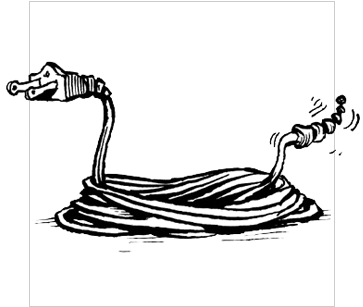
Resistentialism [ri-zis-ten-shul-iz-um] is a jocular theory to describe ‘seemingly spiteful behavior manifested by inanimate objects.’ For example, objects that cause problems (like lost keys or a fleeing bouncy ball) exhibit a high degree of malice toward humans and lend support to resistentialist beliefs. In other words, a war is being fought between humans and inanimate objects, and all the little annoyances objects give people throughout the day are battles between the two.
The term was coined by humorist Paul Jennings in a piece titled ‘Report on Resistentialism,’ published in ‘The Spectator’ in 1948 and reprinted in ‘The New York Times.’ The movement is a spoof of existentialism in general, and Jean-Paul Sartre in particular (Jennings gives the inventor of Resistentialism as Pierre-Marie Ventre). The slogan of Resistentialism is ‘Les choses sont contre nous’ — ‘Things are against us.’
read more »
Posted in Humor, Language, Philosophy |
Leave a Comment »
July 18, 2012


Cradle-to-cradle design (C2C) is a biomimetic approach to the design of systems. It models human industry on nature’s processes in which materials are viewed as nutrients circulating in healthy, safe metabolisms. It suggests that industry must protect and enrich ecosystems and nature’s biological metabolism while also maintaining safe, productive technical metabolism for the high-quality use and circulation of organic and synthetic materials.
Put simply, it is a holistic economic, industrial and social framework that seeks to create systems that are not just efficient but essentially waste free. The model in its broadest sense is not limited to industrial design and manufacturing; it can be applied to many different aspects of human civilization such as urban environments, buildings, economics, and social systems.
read more »
Posted in Money, Technology |
Leave a Comment »


 The Daily Omnivore