March 21, 2013

Tourist trap is an establishment, or group of establishments, that has been created or re-purposed with the aim of attracting tourists and their money. Tourist traps will typically provide services, entertainment, souvenirs and other products for tourists to purchase.
While the term may have negative connotations for some, such establishments may be viewed by tourists as fun and interesting diversions. In some areas like Ishpeming, Michigan, Flush toilets may be a sufficient draw to entice tourists to stop as they are not readily available at many tourist facilities in Michigan’s Upper Peninsula. Wall Drug, in South Dakota, began its tourist trade simply by offering ice water.
Posted in Humor, Money |
Leave a Comment »
March 5, 2013

Mat is a term for strong obscene profanity in Russian and some other Slavic language communities. Mat is censored in the media and the use of mat in public constitutes a form of disorderly conduct, or mild hooliganism (although, such laws are only enforced episodically, in particular due to the vagueness of the legal definition).
However, despite the public ban, mat is used by Russians of all ages and nearly all social groups, with particular fervor in male-dominated military and the structurally similar social strata.
read more »
Posted in Language, World |
Leave a Comment »
January 17, 2013

Quantum mysticism [mis-tuh-siz-uhm] is a term that has been used to refer to a set of metaphysical beliefs and associated practices that seek to relate consciousness, intelligence, or mystical world-views to the ideas of quantum mechanics and its interpretations. The term originally emerged from the founders of quantum theory in the early twentieth century as they debated the interpretations and implications of their nascent theories, which would later evolve into quantum mechanics, and later after WWII, with publications such as Schrödinger’s and Eugene Wigner’s 1961 paper.
The essential qualities of early quantum theory, and the ontological (related to the nature of being) questions that emerged from it, made a distinction between philosophical and scientific discussion difficult as quantum theory developed into a strong scientific theory. Quantum Mysticism is usually considered pseudoscience. Many of the leading Quantum physicists did however give mystical interpretations to their findings.
read more »
Posted in Philosophy, Science |
Leave a Comment »
September 15, 2012

Nice guy is a term in the general public discourse and in popular culture describing an adult or teenage male with friendly yet unassertive personality traits in the context of a relationship with a woman. A typical nice guy believes in putting the needs of others before his own, avoids confrontations, does favors, gives emotional support, tries to get out of trouble, and generally acts nicely towards women.
There is an active debate about whether the nice guy personality profile may actually make a man less desirable to women romantically or sexually. Part of this debate includes speculation about hypocrisy among women in the dating world: that women may say they want a nice guy but won’t date him or have sex with him, and rather subconsciously prefer men who are more confident and assertive but less considerate.
read more »
Posted in Humor, Love, Sex |
Leave a Comment »
September 15, 2012

Involuntary celibacy (colloquially ‘incel’) is chronic near-total or total absence in a person’s sexuality of intimate relationships or sexual intercourse that is occurring for reasons other than voluntary celibacy, asexuality, antisexualism, or sexual abstinence. It is the psycho-social opposite of having a sex life.
Incel people, despite being open to sexual intimacy and potential romance with another person and also making active, repeated efforts towards such an end, cannot cause any such end(s) to occur with any significant degree of regularity—or even at all.
read more »
Posted in Health, Love, Sex |
1 Comment »
August 25, 2012

In 2003, the columnist and gay rights activist Dan Savage held a contest among his readers to create a definition for the word ‘santorum‘ as a response to comments by then-U.S. Senator Rick Santorum that had been criticized as anti-gay. Savage announced the winning entry, which defined ‘santorum’ as ‘the frothy mixture of lube and fecal matter that is sometimes the byproduct of anal sex.’
He created a web site, spreadingsantorum.com (and santorum.com), to promote the definition, which became a prominent search result for Santorum’s name on several web search engines. In 2010 Savage offered to take the site down if Santorum donated US$5 million to Freedom to Marry, a group advocating legal recognition of same-sex marriages. In 2011 Santorum asked Google to remove the definition from its search engine index. Google refused, responding that the company does not remove content from search results except in very limited circumstances.
read more »
Posted in Language, Politics, Sex |
1 Comment »
August 24, 2012
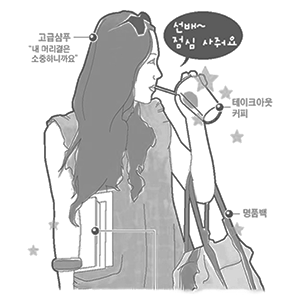
Doenjang girl is a satirical Korean expression for girls and young women who are addicted to luxury and vanity. Doenjang is a fermented soybean paste used to make sour of bean soup.
Instead of visiting an expensive foreign restaurant they will eat a three dollar bowl of soup and then go to Starbucks to purchase a six dollar latte, because carrying a Starbucks cup is considered posh. Likewise, doejang girls carry around shopping bags from Chanel and other high end stores to look as if they were shopping there.
Posted in Money, World |
Leave a Comment »
August 9, 2012

Feminazi is a term popularized by radio talk-show host Rush Limbaugh to describe ‘an extreme or militant feminist.’ In 2004, Limbaugh named feminist activists Gloria Steinem, Susan Sarandon, Christine Lahti, and Camryn Manheim as ‘famous feminazis.’
Feminazi is a portmanteau of the nouns feminist and Nazi. The term is used pejoratively by some U.S. conservatives to criticize feminists that they perceive as extreme.
read more »
Posted in Language, Politics, Sex |
Leave a Comment »
July 9, 2012

Ugly American is a pejorative term used to refer to perceptions of loud, arrogant, demeaning, thoughtless and ethnocentric behavior of American. Although the term is usually associated with or applied to travelers and tourists, it also applies to US corporate businesses in the international arena.
The term has been defined as: ‘Americans traveling or living abroad who remain ignorant of local culture and judge everything by American standards.’
read more »
Posted in Language, Politics, World |
Leave a Comment »
May 13, 2012

Gauche [gohsh] caviar [kav-ee-ahr] (‘Caviar left’) is a pejorative French term to describe someone who claims to be a socialist while living in a way that contradicts socialist values. The expression is a political neologism dating from the 1980s and implies a degree of hypocrisy. It is broadly similar to the English ‘champagne socialist,’ the American ‘Limousine liberal,’ the German ‘Salonkommunist,’ the Italian ‘Radical Chic,’ and the Danish ‘Kystbanesocialist’ (referring to well-off coastal neighborhoods north of Copenhagen). French encyclopedia ‘Petit Larousse’ defines ‘left caviar’ as a pejorative expression for a, ‘Progressivism combined with a taste for society life and its accoutrements.’
The term was once prevalent in Parisian circles, applied deprecatingly to those who professed allegiance to the Socialist Party, but who maintained a far from proletariat lifestyle that distinguished them from the working-class base of the French Socialist Party. It was often employed by detractors of former French President François Mitterrand. In early 2007, French politician Ségolène Royal was identified with the ‘gauche caviar’ when it was revealed that she had been avoiding paying taxes. The description damaged her campaign for the French presidency. The weekly French news magazine, ‘Le Nouvel Observateur,’ has been described as the ‘quasi-official organ of France’s ‘gauche caviar.”
Posted in Food, Money, Politics |
Leave a Comment »
May 10, 2012

Jumping the shark is an idiom created by American radio personality Jon Hein to describe the moment in the evolution of a television show when it begins a decline in quality that is beyond recovery. The phrase is also used to refer to a particular scene, episode or aspect of a show in which the writers use some type of ‘gimmick’ in a desperate attempt to keep viewers’ interest.
The phrase refers to a scene in the fifth season premiere of ‘Happy Days in 1977: the gang visits Los Angeles, where a waterskiing Fonzie, wearing swim trunks and his trademark leather jacket, jumps over a confined shark, in response to a challenge. For a show that in its early seasons depicted universally relatable experiences against a backdrop of 1950s nostalgia, this marked an audacious, cartoonish turn towards attention-seeking gimmickry and continued the faddish lionization of an increasingly superhuman Fonzie.
Posted in Humor, Language |
Leave a Comment »
April 9, 2012

Yo-yo dieting, also known as ‘weight cycling,’ is a term coined by Kelly D. Brownell, Ph.D., at Yale University. In this process, the dieter is initially successful in the pursuit of weight loss but is unsuccessful in maintaining the loss long-term and begins to gain the weight back. The dieter then seeks to lose the regained weight, and the cycle begins again.
The reasons for yo-yo dieting are varied but often include embarking upon a hypocaloric diet that was initially too extreme. At first the dieter may experience elation at the thought of their rejection of food. Over time, however, the limits imposed by such extreme diets cause effects such as depression or fatigue that make the diet impossible to sustain. Ultimately, the dieter reverts to their old eating habits, now with the added emotional effects of failing to lose weight by restrictive diet. Such an emotional state leads many people to eating more than they would have before dieting, causing them to rapidly regain weight.
Posted in Food, Health |
Leave a Comment »


 The Daily Omnivore