November 26, 2011
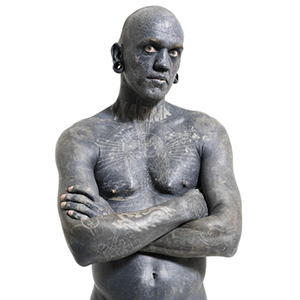
Lucky Diamond Rich (b. 1971) is ‘the world’s most tattooed person’ (a title formerly held by Tom Leppard), and has tattoos covering his entire body, including the inside of his foreskin, mouth and ears. He holds the Guinness world record as of 2006, being 100 percent tattooed.
He is also a performance artist and street performer whose act includes sword-swallowing, unicycling and juggling. As a young boy, he read about and began to have recurring thoughts of the most tattooed men and women. It did not go much further than just a thought until he got his first tattoo, which was of a small juggling club on his hip.
Posted in Art |
Leave a Comment »
November 25, 2011

Ryoji Ikeda (b. 1966) is a Japanese sound artist who lives and works in Paris. Ikeda’s music is concerned primarily with sound in a variety of ‘raw’ states, such as sine tones and noise, often using frequencies at the edges of the range of human hearing. The conclusion of his album ‘+/-‘ features just such a tone; of it, Ikeda says ‘a high frequency sound is used that the listener becomes aware of only upon its disappearance.’
Rhythmically, Ikeda’s music is highly imaginative, exploiting beat patterns and, at times, using a variety of discrete tones and noise to create the semblance of a drum machine. His work also encroaches on the world of ambient music; many tracks on his albums are concerned with slowly evolving soundscapes, with little or no sense of pulse.
Posted in Art, Technology |
Leave a Comment »
November 25, 2011


Dieter Rams (b. 1932) is a German industrial designer closely associated with the consumer products company Braun and the Functionalist school of industrial design. Rams studied architecture at the Werkkunstschule Wiesbaden as well as learning carpentry from 1943 to 1957. After working for the architect Otto Apel between 1953 and 1955 he joined the electronic devices manufacturer Braun where he became chief of design in 1961, a position he kept until 1995.
Rams once explained his design approach in the phrase ‘Weniger, aber besser’ which freely translates as ‘Less, but better.’ Rams and his staff designed many memorable products for Braun including the famous SK-4 record player and the high-quality ‘D’-series (D45, D46) of 35 mm film slide projectors. He is also known for designing the 606 Universal Shelving System by Vitsœ in 1960. Many of his designs — coffee makers, calculators, radios, audio/visual equipment, consumer appliances and office products — have found a permanent home at many museums over the world, including MoMA in New York. He continues to be highly regarded in design circles and currently has a major retrospective of his work on tour around the world.
read more »
Posted in Art, Money, Technology |
1 Comment »
November 23, 2011
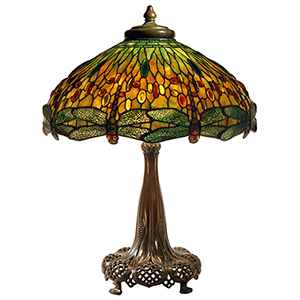
Louis Comfort Tiffany (1848 – 1933) was an American artist and designer who worked in the decorative arts and is best known for his work in stained glass in the Art Nouveau and Aesthetic movements.
Tiffany was affiliated with a prestigious collaborative of designers known as the Associated Artists, which included Lockwood de Forest, Candace Wheeler, and Samuel Colman. Tiffany designed stained glass windows and lamps, glass mosaics, blown glass, ceramics, jewelry, enamels and metalwork.
read more »
Posted in Art |
Leave a Comment »
November 22, 2011
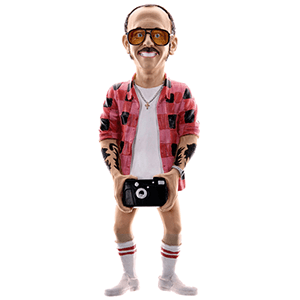
Terry Richardson (b. 1965) is an American fashion photographer. Richardson was born in New York City, the son of Bob Richardson, a fashion photographer who struggled with schizophrenia and drug abuse. Richardson was raised in Hollywood. He was shy as a teenager and at some times deemed ‘completely lacking in social skills.’ He played bass guitar in the punk rock band The Invisible Government for 5 years. Richardson began photography when the band broke up and his mother introduced him to Tony Kent, a photographer who hired him as an assistant.
Richardson’s photographs often contain graphic sexual subject matter. Richardson has shot advertisements for fashion designers and editorial photographs. His alleged attitude towards models has been criticized by Danish model and filmmaker Rie Rasmussen and others, who have accused Richardson of exploiting and sexually abusing the models he photographs.
Posted in Art, Money, Sex |
Leave a Comment »
November 22, 2011

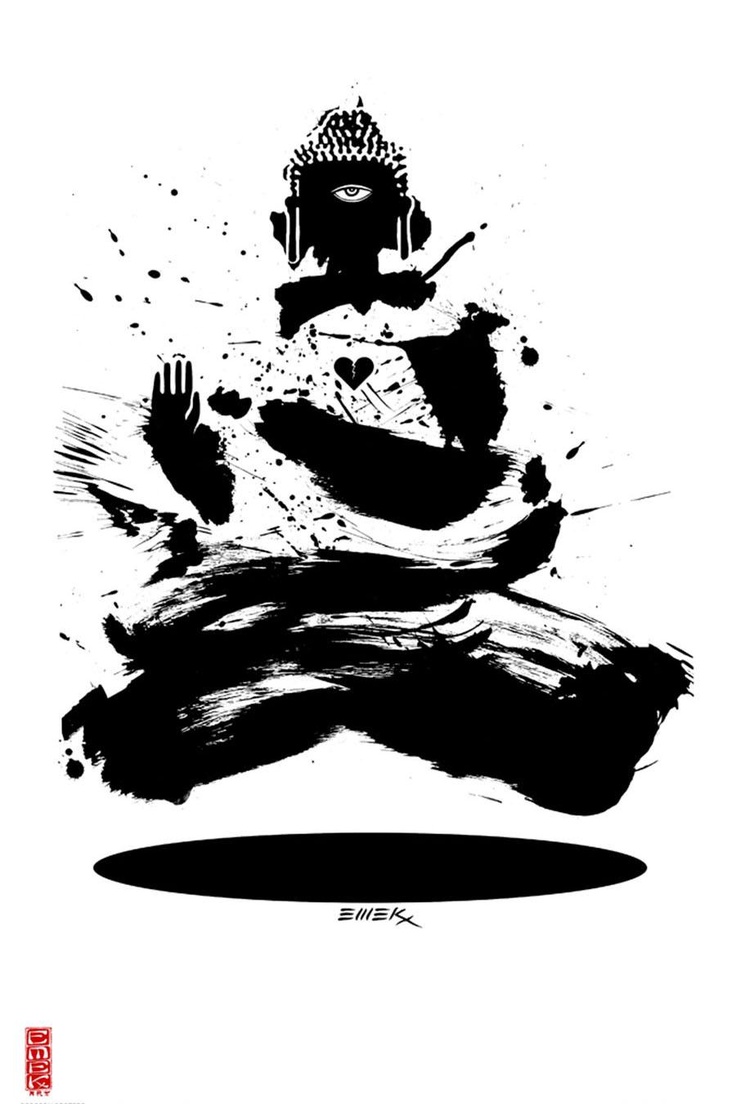
Emek (b. 1970) is a popular graphic designer and concert poster designer since the early 1990s. He is widely credited with helping to revive the rock poster scene. He is the brother of artist and author Gan Golan. His style, known for its attention to detail and layers of meaning, infuses socio-political commentary into pop culture imagery.
In the tradition of psychedelic posters from the 1960s, Emek still draws his posters by hand. He was shaped by both rock art posters from the 1960s, and punk flyers from the 1980s. Emek’s poster-making career accelerated in the 1990s with alternative rock acts from Europe and North America, including Pearl Jam, Radiohead, Queens of the Stone Age, Tool, and Marilyn Manson.
read more »
Posted in Art |
Leave a Comment »
November 21, 2011

Steve Haworth is a body modification artist based in Phoenix, Arizona. He is responsible for the invention and popularization of subdermal and transdermal implants, such as the ‘Metal Mohawk.’ He designed specialized medical instruments called dermal elevators for this process. He has also done pioneering work with surface bars, ear shaping, tongue splitting, magnetic implants, and artistic branding (using electrocautery units). He has worked on individuals noted for their extensive modifications such as The Enigma, Katzen, Stalking Cat and The Lizardman. Many other respected artists in the body modification community cite Haworth as an inspiration. Fellow body modification artist Samppa von Cyborg says that ‘He’s the most important, most respected body modder out there.’ Shawn Porter of body modification blog ‘Scar Wars’ explains, ‘I directly credit Steve’s branding as a main influence on the newer generation of scarification artists; his high detail branding (which caused a stir when it was featured in ‘In the Flesh,’ ‘Body Art,’ and ‘Bizarre’) showed people that you could do more than just dots, chevrons and geometric shapes.’
Haworth’s father was a manufacturer of surgical equipment, and he continued in the family business, eventually branching into piercing jewelry and body modification instruments. Currently he is retired from regular piercing, preferring to concentrate on 3D implants and other types of body modification. He continues to manufacture body jewelry and tools for body modification. He and his business partner Jesse Jarrell create unique silicone jewelry for large-gauge piercing with their company Kaos Softwear. Haworth travels around the country and the world frequently, and conducts seminars on his body modification techniques. He founded the body suspension group ‘Life Suspended’ and performs suspensions with them on regular basis. He is also the co-founder of the production company ‘Horns & Halos,’ which puts on several fetish-themed events every year.
Posted in Art, Health, Technology |
Leave a Comment »
November 21, 2011
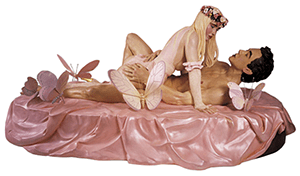

Ilona Staller (b. 1951), also known by her stage name la Cicciolina, is a Hungarian-born Italian porn star, politician, and singer. She continued to make hardcore pornographic films while in office. She is famous for delivering political speeches with one breast exposed. In 1964 she began working for a Hungarian modeling agency; in her memoirs she claimed that she had provided Hungarian authorities with information on American diplomats staying at a Budapest luxury hotel where she worked as a maid in the late 1960s.
Staller married American sculptor Jeff Koons in 1991. Koons produced a series of sculptures and photographs of them having sex in many positions, settings and costumes, which were exhibited under the title ‘Made In Heaven.’ The marriage broke up in 1992, and their son Ludwig Maximillian was born shortly afterwards. Staller left the US with the child, and a lengthy custody battle ensued. Koons won custody in 1998 but Ludwig remains with Staller in Italy.
read more »
Posted in Politics, Sex, World |
Leave a Comment »
November 21, 2011
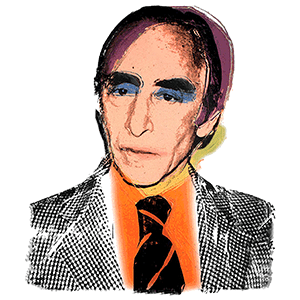
Leo Castelli (1907 – 1999), born Leo Krausz, was an American art dealer whose gallery showcased cutting edge Contemporary art for five decades. Castelli showed Surrealism, Abstract Expressionism, Neo-Dada, Pop Art, Op Art, Color field painting, Hard-edge painting, Lyrical Abstraction, Minimal Art, Conceptual Art, and Neo-expressionism, among other movements. Leo Castelli was born at Trieste, of Italian and Austro-Hungarian Jewish origin. Castelli’s first American curatorial effort was the famous Ninth Street Show of 1951, a seminal event of Abstract Expressionism.
In 1957, he opened the Leo Castelli Gallery in a townhouse on 77th Street between Madison and Fifth Avenues. Initially the gallery showcased European Surrealism, Wassily Kandinsky, and other European artists. However the gallery also exhibited American Abstract Expressionism. Jackson Pollock and Willem de Kooning were some artists who were included in group shows. In 1958, Robert Rauschenberg and Jasper Johns joined the gallery, signaling a turning away from Abstract Expressionism, towards Pop Art, Minimalism and Conceptual Art. From the early 1960s through the late 70s, Frank Stella, Roy Lichtenstein, Andy Warhol, and Ed Ruscha joined the stable of Castelli artists.
Posted in Art, Money |
Leave a Comment »
November 20, 2011

Rick Strassman (b. 1952) is psychiatrist and psychopharmacology researcher, and the first person in the US after twenty years of intermission to embark in human research with psychedelic, hallucinogenic, or entheogenic substances. During the intermission period, research was restricted by law to animals studies only.
Dr Strassman’s studies aimed to investigate the effects of DMT (dimethyltryptamine), a powerful psychedelic, that he hypothesizes is produced by the human brain in the pineal gland. DMT is found naturally in various natural sources, and is related to human neurotransmitters such as serotonin and melatonin.
read more »
Posted in Drugs, Health, Science |
Leave a Comment »
October 31, 2011
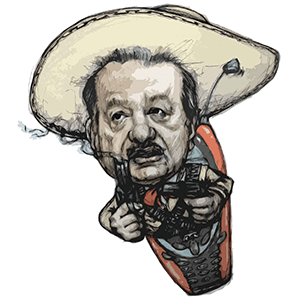
Carlos Slim (b. 1940) is a Mexican businessman, and the richest person in the world, worth more than US$60 billion. He owns the Mexican phone company Telmex, which provides a telephone service to most Mexicans. After graduating, Slim expanded on his father’s ownings of real estate in Mexico City. By age 26, he was worth $40 million. During the 1980s and 1990s, Slim bought several companies that were bankrupt or being privatized. Slim owns about 7% of the New York Times.
The Mexican magnate’s growing fortune has caused a controversy because it has been amassed in a developing country where per capita income does not surpass $14,500 a year, and nearly 17% of the population lives in poverty. Critics claim that Slim is a monopolist, pointing to Telmex’s control of 90% of the Mexican landline telephone market. Slim’s wealth is the equivalent of roughly 5% of Mexico’s annual economic output. Telmex, of which 49.1% is owned by Slim and his family, charges among the highest usage fees in the world, according to the Organisation for Economic Co-operation and Development.
read more »
Posted in Money, Technology, World |
Leave a Comment »
October 29, 2011
Mickey Hart (b. 1943), real name Michael Steven Hartman, is an American percussionist and musicologist. He is best known as one of the two drummers of the rock band the Grateful Dead. He and fellow Dead drummer Bill Kreutzmann earned the nickname ‘the rhythm devils.’ Before joining the Grateful Dead, Hart and his father, Leonard Hart, a champion rudimental drummer, owned and operated Hart Music, selling drums and musical instruments in San Carlos, California. Hart joined the Grateful Dead in 1967, and left in 1971 when he extricated himself from the band, due to conflict between band management and Mickey’s father. During his sabbatical, in 1972, he recorded the album ‘Rolling Thunder.’ He returned to the Dead in 1974, and remained with the group until their official dissolution in 1995. Collaboration with the remaining members of the Grateful Dead continues, under the band name The Dead.
Alongside his work with the Grateful Dead, Mickey Hart has flourished as a solo artist, percussionist, and the author of several books. In these endeavors he has pursued a lifelong interest in ethnomusicology and in world music. His travels and his interest in all things percussion-related led him to collect percussion instruments, and to collaborate with percussion masters the world over.
read more »
Posted in Art, Health, World |
1 Comment »




 The Daily Omnivore