July 31, 2012
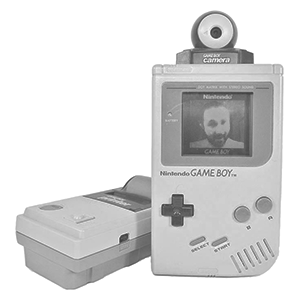
The Game Boy Camera is an official Nintendo accessory for the handheld Game Boy and Super Game Boy gaming consoles and was released in 1998. It is also compatible with all of the Game Boy platforms (with the exception of Game Boy Micro). The camera can take 256×224 (down scaled to half resolution on the unit with anti-aliasing), black & white digital images using the 4-color palette of the Game Boy system.
It interfaced with the Game Boy Printer, which utilized thermal paper to print any saved images, making a hard copy. Both the camera and the printer were marketed by Nintendo as light-hearted entertainment devices aimed mainly at children. The Game Boy Camera was used to take the photographs for the album cover of Neil Young’s album ‘Silver & Gold.’
Posted in Games, Technology |
Leave a Comment »
July 5, 2012
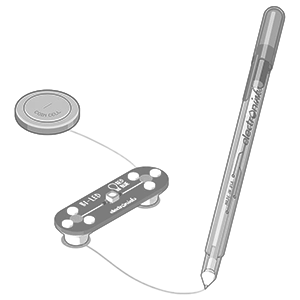
‘Conductive ink‘ is an ink that conducts electricity. These materials may be classed as fired high solids systems or PTF (polymer thick film) systems that allow circuits to be drawn or printed on a variety of substrate materials such as polyester or paper.
These types of materials usually contain conductive materials such as powdered or flaked silver and carbon like materials. Conductive inks can be a more economical way to lay down a modern conductive traces when compared to traditional industrial standards such as etching copper from copper plated substrates to form the same conductive traces on relevant substrates, as printing is a purely additive process producing little to no waste streams which then have to be recovered or treated.
read more »
Posted in Money, Technology |
Leave a Comment »
June 26, 2012

Boombox is a colloquial expression for a portable music player with two or more loudspeakers. It is a device capable of receiving radio stations and playing recorded music (usually cassettes or CDs), usually at relatively high volume. Many models are also capable of recording (onto cassette) from radio and (sometimes) other sources. Designed for portability, most boomboxes can be powered by batteries, as well as by line current.
The first Boombox was developed by the inventor of the C-Cassette, Philips of the Netherlands. Their first ‘Radiorecorder’ was released in 1969. The Philips innovation was the first time that radio broadcasts could be recorded onto C-Cassette tapes without cables or microphones. Early sound quality of tape recordings was poor but as the C-Cassette technology evolved, with stereo recording, Chromium tapes and noise reduction, soon HiFi quality devices become possible. Several European electronics brands such as Grundig also introduced similar devices.
read more »
Posted in Art, Money, Technology |
Leave a Comment »
June 6, 2012

The Neo Geo is an arcade system board and home video game console released in 1990 by Japanese game company SNK. The MVS (Multi Video System), as the Neo Geo was known to the coin-operated arcade game industry, offered arcade operators the ability to put up to six different arcade titles into a single cabinet, a key economic consideration for operators with limited floorspace.
With its games stored on self-contained cartridges, a game-cabinet could be exchanged for a different game-title by swapping the game’s ROM-cartridge and cabinet artwork. Several popular franchise-series, including ‘Fatal Fury,’ ‘The King of Fighters,’ ‘Metal Slug,’ and ‘Samurai Shodown,’ were released for the platform. The Neo Geo system was also marketed as a very costly home console, commonly referred to today as the AES (Advanced Entertainment System).
read more »
Posted in Games, Money, Technology |
Leave a Comment »
May 30, 2012

Doritos is a brand of seasoned tortilla chips founded by Arch West and produced since 1964 by Frito-Lay (a division of PepsiCo). The original product was made at the Casa de Fritos location at Disneyland in Anaheim. Using unused tortillas, the company-owned restaurant cut them up and fried them and added basic seasoning. Arch West was the Vice President of Marketing of Frito-Lay at the time, and noticed the popularity.
He made a deal with Alex Foods in 1964, the provider of many items for Casa de Fritos at Disneyland, and produced the chips for a short time regionally, before it was overwhelmed by the volume, and Frito-Lay moved the production in-house to its Tulsa plant. ‘Doritos’ were first available in 1966, the first tortilla chip to be launched nationally in the United States.
read more »
Posted in Food, Money |
2 Comments »
April 22, 2012
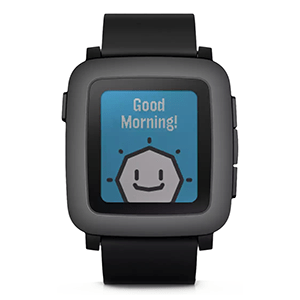
The Pebble E-Paper Watch, known now as the Pebble Classic, is an American smartwatch developed by Pebble Technology Corporation, and is the first generation of the Pebble watch lineup. The smartwatch was pledged from a Kickstarter campaign, proving massively successful, collecting around $10 million for development of the smartwatch.
Pebble connects to both Android and iOS phones, so they can display notifications from the phone, control music, view calendar events, and create reminders. An online app store makes the Pebble compatible with apps tailored for them from many third party sellers, for many purposes especially sports. In 2015, Pebble Technology released its second-generation Time, with a color e-paper display, microphone, and updated design.
Posted in Money, Technology |
Leave a Comment »
April 2, 2012
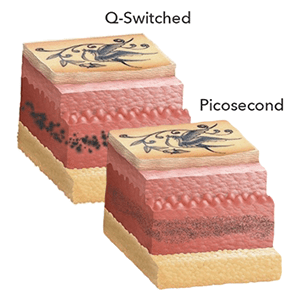
InfinitInk is a tattoo ink, which allows for easier tattoo removal, with removal up to three times faster than conventional inks. It is produced by Freedom2, Inc., and is available as of 2009 in limited release in the United States. It is currently only available in black and red, with other colors planned. The initial ink formulation consisted of inert plastic beads, containing bioremovable dyes. Laser application ruptures the beads, allowing the ink to leak out and be removed by the body.
The concept for this ink arose initially from potential medical uses, such as in reconstructive surgery and in radiation oncology. However, it was clear that a permanent and safe, yet more removable ink would also find use by some artists for decorative tattooing.
Posted in Money, Technology |
Leave a Comment »
March 13, 2012

A wired glove (sometimes called a dataglove or cyberglove) is an input device for human–computer interaction worn like a glove. Various sensor technologies are used to capture physical data such as bending of fingers. Often a motion tracker, such as a magnetic tracking device or inertial tracking device, is attached to capture the global position/rotation data of the glove. These movements are then interpreted by the software that accompanies the glove, so any one movement can mean any number of things.
Gestures can then be categorized into useful information, such as to recognize Sign Language or other symbolic functions. Expensive high-end wired gloves can also provide haptic feedback, which is a simulation of the sense of touch. This allows a wired glove to also be used as an output device. Traditionally, wired gloves have only been available at a huge cost, with the finger bend sensors and the tracking device having to be bought separately. Wired gloves are often used in virtual reality environments.
read more »
Posted in Games, Money, Technology |
Leave a Comment »
March 13, 2012
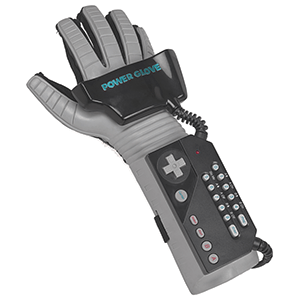
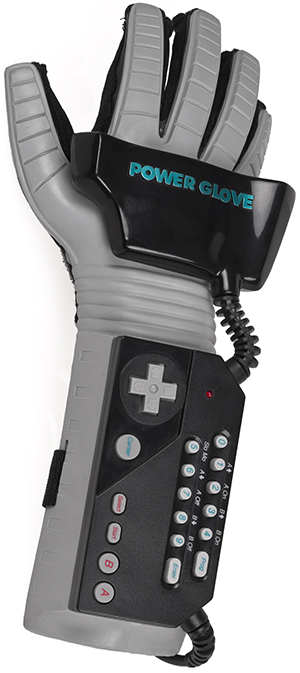
The Power Glove is a controller accessory for the Nintendo Entertainment System, and the first peripheral interface controller to recreate human hand movements on a television or computer screen in real time. The Power Glove was not popular and was criticized for its imprecise and difficult-to-use controls. The Power Glove was originally released in 1989. Though it was an officially licensed product, Nintendo was not involved in the design or release of this accessory. Rather, it was designed by Grant Goddard and Samuel Cooper Davis for Abrams Gentile Entertainment (AGE), made by Mattel in the United States and PAX in Japan.
Additional development was accomplished through the efforts of Thomas G. Zimmerman and Jaron Lanier, a virtual reality pioneer responsible for co-developing and commercializing the DataGlove who had made a failed attempt at a similar design for Nintendo earlier. The Power Glove and DataGlove were based on Zimmerman’s instrumented glove. Zimmerman built the first prototype that demonstrated finger flex measurement and hand position tracking using a pair of ultrasonic transmitters. His original prototype used optical flex sensors to measure finger bending which were replaced with less expensive carbon-based flex sensors by the AGE team.
read more »
Posted in Games, Money, Technology |
Leave a Comment »
March 13, 2012
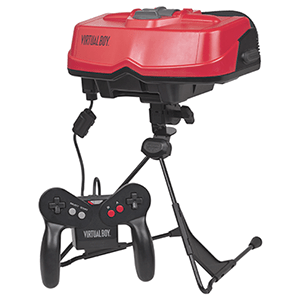
The Virtual Boy was a video game console developed and manufactured by Nintendo. It was the first video game console that was supposed to be capable of displaying ‘true 3D graphics’ out of the box. Whereas most video games use monocular cues to achieve the illusion of three dimensions on a two-dimensional screen, The Virtual Boy creates an illusion of depth through the effect known as parallax.
In a manner similar to using a head-mounted display, the user looks into an eyepiece made of neoprene on the front of the machine, and then an eyeglass-style projector allows viewing of the monochromatic (in this case, red) image. It was released in 1995 in Japan and North America at a price of around US$180. It met with a lukewarm reception that was unaffected by continued price drops. Nintendo discontinued it the following year.
read more »
Posted in Games, Money, Technology |
Leave a Comment »
March 12, 2012

Slingshot is a water purification device created by Dean Kamen. Powered by a stirling engine running on a combustible fuel source, it claims to be able to produce clean water from almost any source. The device takes contaminated water and runs it through a vapor compression distiller that produces clean water, producing 250 gallons daily, enough for 100 people. The test devices have been used with ‘anything that looks wet,’ including polluted river water, saline ocean water, and raw sewage. In a demonstration at a technology conference in 2004, Kamen ran his own urine through the machine and drank the clean water that came out.
A pair of Slingshot devices ran successfully for a month in a village in Honduras during the summer of 2006. While the initial devices cost hundreds of thousands of dollars, Kamen hopes that increased economies of scale will allow production machines to be made available for $2,000 each. The Slingshot process operates by means of vapor compression distillation, requires no filters, and can operate using cow dung as fuel. In addition to producing drinkable water, the Slingshot also generates enough electricity to light 70 energy-efficient light bulbs.Kamen hopes to seed thousands of the units with local village entrepreneurs, in much the same way independent cell phone businesses have thrived and gradually changed the face of many impoverished areas around the globe.
Posted in Food, Technology, World |
Leave a Comment »
February 29, 2012

The Raspberry Pi (or RasPi) is a $35 single-board computer developed in the UK by the Raspberry Pi Foundation which aims to ‘promote the study of computer science and related topics, especially at school level, and to put the fun back into learning computing.’ The design is based around a Broadcom BCM2835 system on a chip (SoC), which includes a 700 MHz ARM CPU, VideoCore IV GPU, and 256 Megabytes of RAM. The design does not include a built-in hard disk or solid-state drive, instead relying on an SD card for booting and long-term storage.
The foundation has released one model (Model B) initially, and a second model (Model A) will be released sometime later. Model A will have one USB port and no Ethernet controller, and will cost $25, while Model B contains two USB ports and a 10/100 Ethernet controller and costs $35. Though the Model A doesn’t have an RJ45 Ethernet port, it can connect to a network by using a user-supplied USB Ethernet or Wi-Fi adapter. As is typical of modern computers, generic USB keyboards and mice are compatible with the Raspberry Pi. The system will use a Linux kernel-based operating systems.
Posted in Money, Technology, World |
Leave a Comment »


 The Daily Omnivore