October 9, 2012

‘Conversion therapy‘ (also known as ‘Reparative therapy’) is a pseudo-scientific therapy that aims to change sexual orientation. Mainstream American medical and scientific organizations have expressed concern over conversion therapy and consider it potentially harmful. The advancement of conversion therapy may cause social harm by disseminating inaccurate views about sexual orientation. As a result, conversion therapy on minors is illegal in California.
The American Psychiatric Association has condemned psychiatric ‘treatment’ which is ‘based upon the assumption that homosexuality per se is a mental disorder or based upon the a priori assumption that a patient should change his/her sexual homosexual orientation.’ It states that, ‘Ethical practitioners refrain from attempts to change individuals’ sexual orientation.’ And that political and moral debates over the integration of gays and lesbians into the mainstream of American society have obscured scientific data about changing sexual orientation ‘by calling into question the motives and even the character of individuals on both sides of the issue.’
read more »
Posted in Health, Philosophy, Sex |
1 Comment »
November 9, 2011

A polygraph (popularly referred to as a lie detector) measures and records several physiological indices such as blood pressure, pulse, respiration, and skin conductivity while the subject is asked and answers a series of questions. The belief is that deceptive answers will produce physiological responses that can be differentiated from those associated with non-deceptive answers. The polygraph was invented in 1921 by John Augustus Larson, a medical student at the University of California at Berkeley and a police officer of the Berkeley Police Department.
Many members of the scientific community consider polygraphy to be pseudoscience. Nonetheless, in some countries polygraphs are used as an interrogation tool with criminal suspects or candidates for sensitive public or private sector employment. US federal government agencies such as the FBI and the CIA and many police departments use polygraph examinations to interrogate suspects and screen new employees. Within the US federal government, a polygraph examination is also referred to as a psychophysiological detection of deception (PDD) examination.
read more »
Posted in Politics, Technology |
1 Comment »
July 15, 2011

Lysenkoism [li-seng-koh-iz-uhm] is used colloquially to describe the manipulation or distortion of the scientific process as a way to reach a predetermined conclusion as dictated by an ideological bias, often related to social or political objectives. The word is derived from a set of political and social campaigns in science and agriculture by the director of the Soviet Lenin All-Union Academy of Agricultural Sciences, Trofim Lysenko and his followers, which began in the late 1920s and formally ended in 1964.
In 1928, Trofim Lysenko, a previously unknown plant scientist, claimed to have developed an agricultural technique, termed vernalization, which tripled or quadrupled crop yield by exposing wheat seed to high humidity and low temperature. While cold and moisture exposure are a normal part of the life cycle of fall-seeded winter cereals, the vernalization technique claimed to enhance yields by increasing the intensity of exposure, in some cases planting soaked seeds directly into the snow cover of frozen fields. In reality, the technique was neither new (it had been known since 1854, and was extensively studied during the previous twenty years), nor did it produce the yields he promised.
read more »
Posted in Politics, Science, World |
1 Comment »
July 14, 2011
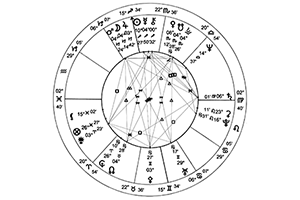
Pseudoscience refers to concepts that are presented as scientific, but which do not adhere to a valid scientific method, or cannot be reliably tested. Pseudoscience is often characterized by the use of vague, exaggerated or unprovable claims, an over-reliance on confirmation rather than rigorous attempts at refutation, a lack of openness to evaluation by other experts, and a general absence of systematic processes to rationally develop theories. So-called ‘Pop science’ blurs the divide between science and pseudoscience among the general public, and may also involve science fiction (it is disseminated to, and can also easily emanate from, persons not accountable to scientific methodology and expert peer review).
Pseudoscientific beliefs are widespread, even among public school science teachers and newspaper reporters. The demarcation problem between science and pseudoscience has ethical political implications (as well as philosophical and scientific). Differentiating science from pseudoscience has practical implications in the case of health care, expert testimony, environmental policies, and science education. Distinguishing scientific facts and theories from pseudoscientific beliefs such as those found in astrology, medical quackery, and occult beliefs combined with scientific concepts, is part of science education and scientific literacy.
read more »
Posted in Language, Science |
Leave a Comment »
July 14, 2011

Hologram therapy is the pseudoscientific practice of adorning oneself with hologram jewelry for enhancement of athletic performance. Merchants claim it to be a method in alternative holistic medicine that can improve general physical fitness and athletic prowess. It centers around wearing plastic holograms purported to resonate with frequencies that react positively with the putative energy field of the human body.
Promoters borrow from concepts in crystal healing, vibrational medicine, energy medicine, and physics, but provide a sparse and disjointed scientific explanation. The holograms are printed on stickers, plastic wristbands, and pendants. Promoters rely heavily on the ritualistic superstition that often characterizes athletes.
Posted in Health, Money |
Leave a Comment »
May 6, 2011

Chromotherapy, sometimes called color therapy, is an pseudoscientific alternative medicine practice. It is claimed that a therapist trained in chromotherapy can use color and light to balance ‘energy’ wherever a person’s body be lacking, be it physical, emotional, spiritual, or mental.
Color therapy is unrelated to light therapy, a valid and proven form of medical treatment for seasonal affective disorder and a small number of other conditions.
read more »
Posted in Health, Humor |
Leave a Comment »
March 2, 2011
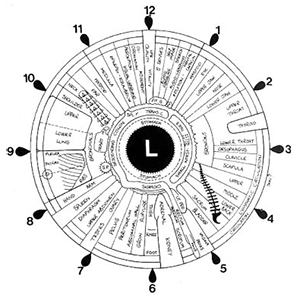
Iridology is a pseudoscience whose proponents believe that patterns, colors, and other characteristics of the iris can be examined to determine information about a patient’s systemic health. Practitioners match their observations to iris charts, which divide the iris into zones that correspond to specific parts of the human body.
Posted in Philosophy, Science |
Leave a Comment »
October 28, 2010

Phiten is a Japanese company that makes necklaces worn for the purpose of soothing one’s body. The medical and performance-enhancing claims relating to Phiten’s products are considered pseudoscience, and the technology behind the company’s products is not approved by the U.S. Food and Drug Administration. The company claims its products relieve fatigue by balancing the body’s signals that run from brain to the body and thus regulating the body’s ‘bio-electric currents’ through what the company calls the ‘Phild process,’ where titanium is turned into ‘aqua-titanium,’ a water-soluble form of titanium. The company claims to be able to integrate small amounts of the metal directly into the fabric.
Some of the professional athletes in Japan that wear Phiten necklaces include pro golfers, Olympic runners, and pro baseball players. In the USA, the company sponsors MLB players Josh Beckett, Tim Lincecum, Joba Chamberlain, Randy Johnson, Clay Buchholz, Justin Verlander, Justin Morneau, Brandon Webb, C.J. Wilson, and Dustin Pedroia.
Posted in Money, Technology, World |
Leave a Comment »
September 26, 2010

The Ahnenerbe was a Nazi German think tank that promoted itself as a ‘study society for Intellectual Ancient History.’ Founded on July 1, 1935, by Heinrich Himmler, Herman Wirth, and Richard Walther Darré, the Ahnenerbe’s goal was to research the anthropological and cultural history of the Aryan race, and later to experiment and launch voyages with the intent of proving that prehistoric and mythological Nordic populations had once ruled the world.
The Ahnenerbe had several different research institutions. Most of these were archeological and anthropological but others included a meteorology department, devoted to ‘Welteislehre’ (World Ice Theory), a pseudoscientific cosmological theory proposed by Hans Hörbiger, an Austrian engineer and inventor. According to his theory, ice was the basic substance of all cosmic processes, and ice moons, ice planets, and the ‘global ether’ (also made of ice) had determined the entire development of the universe. There was also a section devoted to musicology, whose aim was to determine ‘the essence’ of German music. The section made sound recordings, transcribed manuscripts and songbooks, and photographed and filmed instrument use and folk dances. The lur, a Bronze Age musical instrument, became central to this research, which concluded that Germanic consonance was in direct conflict to Jewish atonalism.
Posted in Science, War |
Leave a Comment »
August 12, 2010
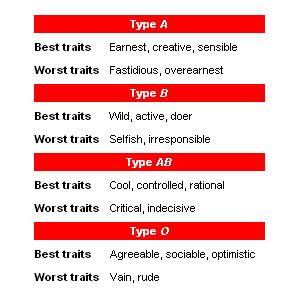

Ketsuekigata is a Japanese pseudoscience based on human blood types. There is a popular belief in Japan that a person’s ABO blood type is predictive of their personality, temperament, and compatibility with others. Ultimately deriving from ideas of historical scientific racism, the popular belief originates with publications by Masahiko Nomi in the 1970s. The scientific community dismisses such beliefs as superstition. Discussion of blood types is widely popular in women’s magazines as a way of gauging relationship compatibility with a potential or current partner. Morning television shows feature blood type horoscopes, and similar horoscopes are published daily in newspapers. In addition, a series of four books that describe people’s character by blood type ranked third, fourth, fifth and ninth on a list of best selling books in Japan in 2008.
Although there is no proven correlation between blood type and personality, it remains popular with the many matchmaking services that cater to blood type. In this way, it is similar to the use of astrological signs in the West, which is also popular in Japan. Asking one’s blood type is common in Japan, and people are often surprised when a non-Japanese does not know his or her own blood type.
Posted in Humor, Philosophy, World |
Leave a Comment »




 The Daily Omnivore